


Neuralink User Plays GTA VI Without a Controller
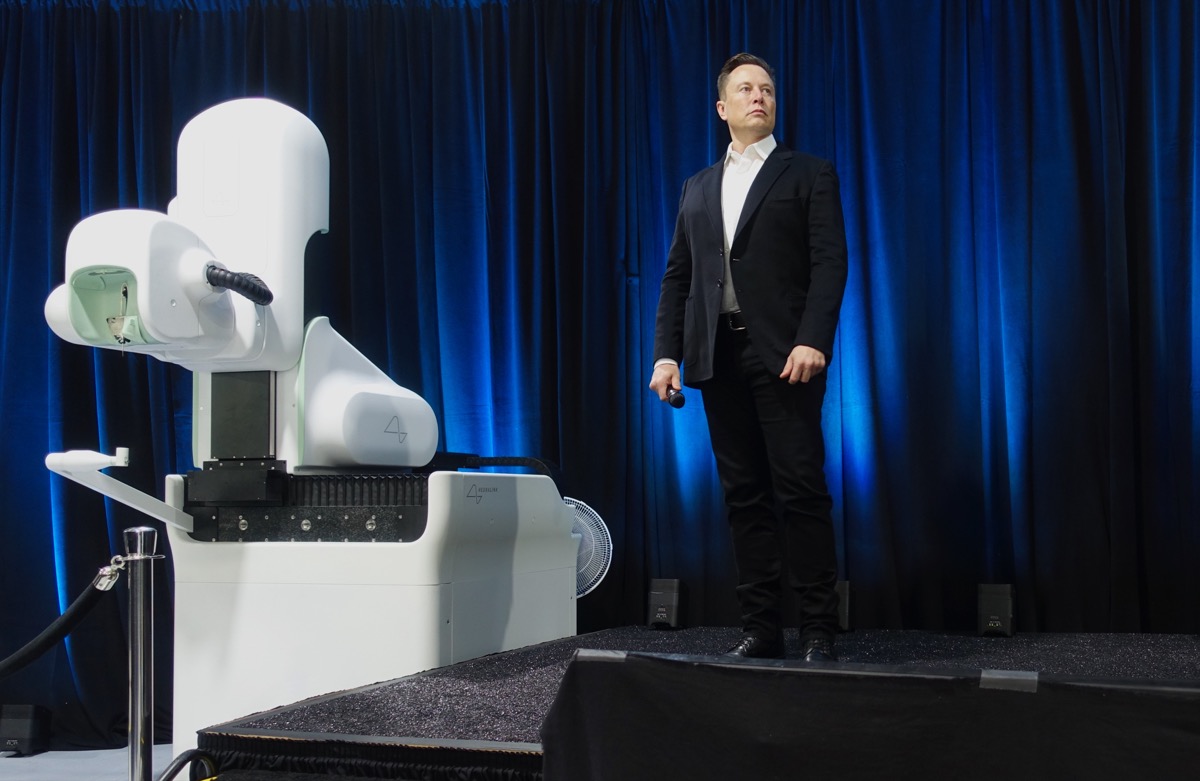
Elon Musk beside a Neuralink surgical robot at a presentation in August 2020. Photo by Steve Jurvetson / Wikimedia Commons. CC BY 2.0.
A Neuralink clinical trial participant steers a boat, drives a car and flies a plane in GTA VI. The video, published by the company on November 20, shows how a brain implant can replace familiar gamepad inputs. For the player, it offers a way to act independently in a complex virtual world again. For brain-interface developers, it is another example of controlling a device without hand movements.
The technology has applications beyond gaming. Neuralink is already testing control of a robotic arm, while other researchers are exploring how people with severe motor impairments can use robots and work remotely. These developments provide a basis for discussing new kinds of remote work for people with limited mobility.
A Brain Implant Replaces the Gamepad
The almost two-minute clip shows the participant and a neural decoding panel alongside the gameplay. As he performs actions, the corresponding controller buttons light up on screen. To raise the plane’s nose, the player imagines sliding his right hand forward. Other intended movements are mapped to individual game commands.
This is how a brain–computer interface, or BCI, works. Thin electrodes record neural activity in brain regions associated with movement. The implant’s electronics transmit the data wirelessly to an app, where software decodes the action the person intends to perform. On a computer, that becomes a cursor movement, a button press or another command.
After a spinal cord injury, the intention to move can remain even when the hands can no longer carry out the command. A brain interface uses that signal to control an external device. The participant learns to use the new input method, while developers adapt the decoding to the person’s signals and the actions they need.
Control in a Complex Game
In GTA VI, players need to change direction, accelerate, monitor their surroundings and switch between actions. This setting can reveal how comfortable it is to use several commands in sequence or at the same time. Selecting an object on a screen and flying a plane place different demands on the controls.
Games have been part of Neuralink’s trials for years. Its first participant, Noland Arbaugh, received an implant in January 2024 and later demonstrated computer control and Civilization VI gameplay. The second participant, Alex, played Counter-Strike by combining the implant with an adaptive mouth-operated controller. This setup allowed him to move and aim simultaneously.
The new video also illustrates more accessible recreation. For someone with limited mobility, a complex game offers a way to choose routes, develop skills and interact independently with a virtual environment. Similar interfaces could eventually be used in training simulators and virtual workspaces. The GTA VI clip remains a gaming demonstration, and professional operator training would need to be studied separately.
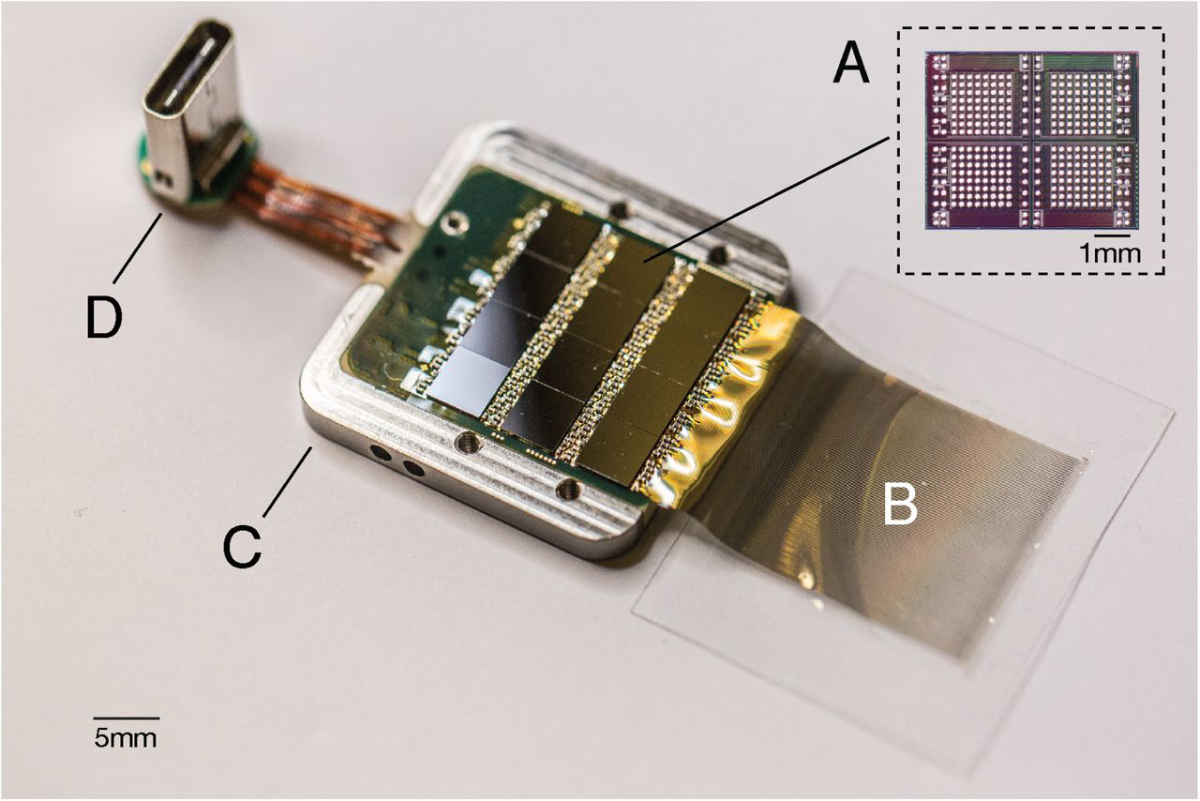
A prototype Neuralink recording device published in 2019. Elon Musk, Neuralink / Journal of Medical Internet Research. CC BY-ND 4.0.
Robotic Arm Trials Are Underway
In November 2024, Neuralink announced the CONVOY study. It aims to test whether a person with an N1 implant can control an assistive robotic arm. This extends the interface’s applications to interaction with physical objects.
In November 2025, Barrow Neurological Institute featured Alex Conley, a CONVOY participant and the second person to receive a Neuralink implant. According to the institute, he was the first to use the device to control such an arm. This involves coordinating a manipulator’s movements in physical space, where object positions and grasp accuracy matter.
Similar research predates Neuralink. In 2015, for example, a team at the California Institute of Technology and its partners presented the results of Erik Sorto’s work with a brain interface. He could control a robotic arm and bring a drink to his mouth independently. These projects are gradually building the experience needed for everyday use of brain interfaces.
Working on a Computer
Some work tasks can already be performed through ordinary software. Before his spinal cord injury, Alex Conley repaired vehicles and other machinery. After receiving the implant, he began learning Fusion 360, a program for designing three-dimensional objects. On his second day using the interface, he designed a mount for his Neuralink charger. The part was then 3D-printed and installed beside his computer.
This example illustrates the practical value of precise cursor control. A person can design objects, edit documents and use the software they need for education or a profession. Speed, convenient switching between tools and the ability to work without constant assistance all matter for these tasks.
On Neuralink’s clinical trials page, Noland Arbaugh also says the technology helped him find work. The company does not disclose his employment arrangements there, but his experience adds a working-life example to the gaming demonstrations. Computer access helps people return to activities that previously required hand movements.
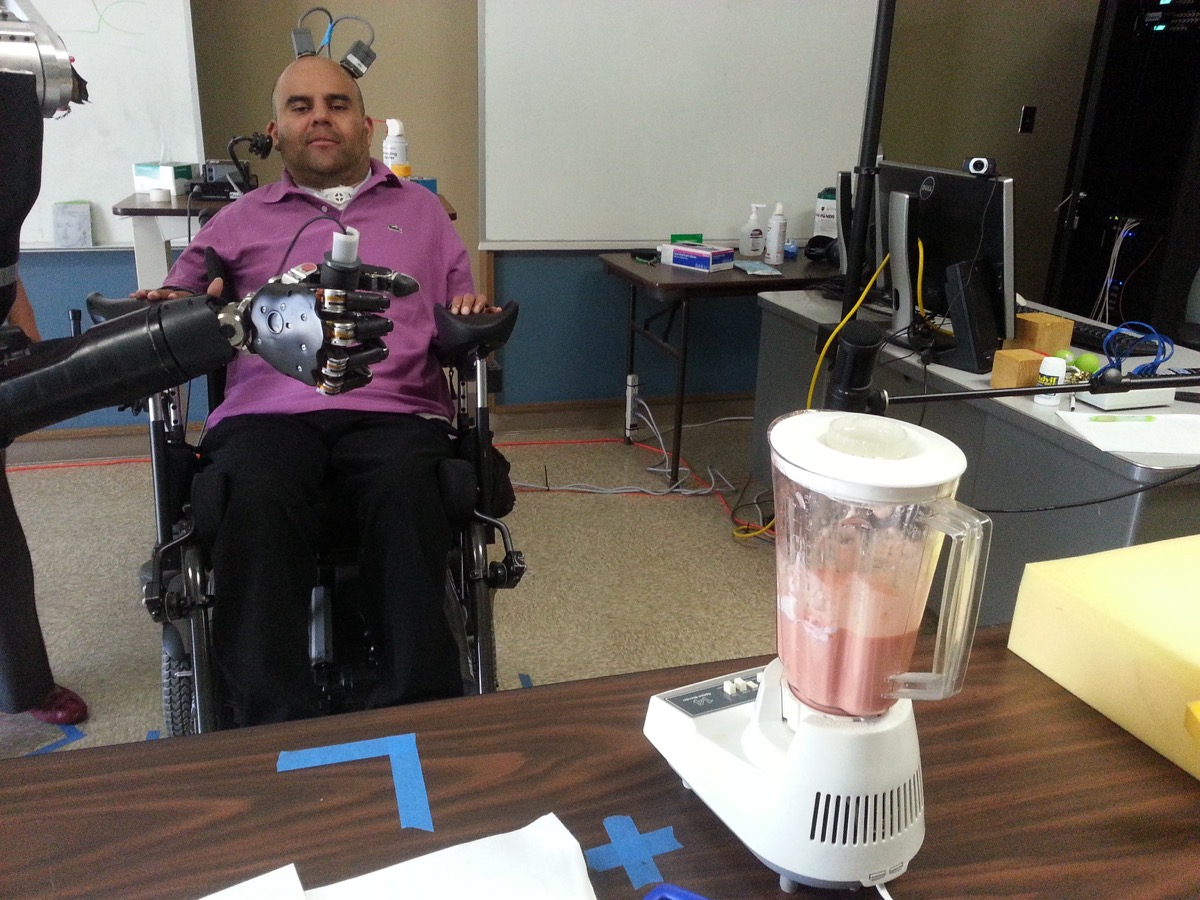
Erik Sorto controls a robotic arm in research by Caltech and its partners, presented in 2015. Photo by Spencer Kellis / Caltech.
Working Through Robot Avatars
Japan offers an existing example of employment for people who have difficulty leaving home. At Tokyo’s DAWN café, staff communicate with customers and serve them through OriHime and OriHime-D robot avatars. The permanent experimental café opened in June 2021.
An operator watches through a camera, talks to guests and controls the robot remotely. In an experiment described by the Japan Science and Technology Agency, these staff greeted visitors, attended tables and helped serve food. One operator was a former barista who could use their experience again while remaining in another city.
OriHime does not require a brain implant. In a study presented by its developers in 2020, ten participants with disabilities used a mouse or gaze input, depending on their abilities. The authors examined how to organize this work and adapt the workload to each person.
Working through a robot therefore already has real examples. A brain interface could extend access to this model to people who struggle to use a mouse, keyboard or other input devices. The robot, workstation and shift arrangements would still need to be developed for the job.
Simulators for Future Operators
The connection between virtual control and physical equipment is also being studied outside Neuralink. In January 2025, Nature Medicine published research by a team from Stanford, the University of Michigan and other institutions. A participant with paralysis controlled a virtual quadcopter by attempting finger movements. The system decoded several groups of movements and translated them into flight commands.
The participant had to fly the drone through rings on a virtual course. This task can be used to assess control in three-dimensional space, vary the difficulty and repeat exercises without risking collisions with real objects. Controlling a drone had been one of the participant’s personal goals even before joining the study.
A similar sequence could be envisaged for future operator training. First, a person learns the commands in a simulator and practices a specific task. Developers then test whether that skill transfers to a robot or another machine connected to a remote workstation. Examples might include inspecting equipment through a mobile robot or moving objects with a manipulator.
Operating a crane or other heavy machinery would require separate testing of reliability, protection against unintended commands and emergency stopping. Neuralink’s published demonstrations do not establish readiness for that work. Trials of assistive robotic arms and existing telepresence services provide more immediate foundations for developing this field.
The Person Directs, the Robot Assists
Practical applications do not necessarily require a person to specify every movement of a machine manually. In a University of Pittsburgh study published in 2016, brain control was combined with computer vision. Two participants with paralysis in all four limbs moved objects with a robotic arm, while software helped position the gripper more precisely.
With this assistance, participants completed the tasks more successfully. The person retained control of the overall movement and object selection, while automation helped with the precise grasp. This is a promising way to divide tasks in a possible remote operator role. The user makes the decision, and software helps execute the technically difficult part of the movement.
What the Investment Funds
Developing a brain interface requires simultaneous improvements to the implant, software, surgical equipment and clinical trial operations. In June 2025, Neuralink announced a $650 million Series E round. Founders Fund, Sequoia Capital and ARK Invest were among the investors. The company said the funding would expand access to trials and support the development of future devices.
Commercial prospects depend on whether the technology can work reliably in everyday life. Neuralink remains at the clinical research stage, and its devices have not been approved for general use. Regular use for education, design, communication and robotic arm control will provide a stronger basis for assessing future demand than the popularity of a single video.
The GTA VI demonstration shows how complex control through a brain interface can already be. The next practical gains for the industry would enable people to perform more everyday activities and work tasks independently. As reliability and access improve, digital work could be joined by new forms of employment through human-controlled machines.
Explore the Neuralink opportunity on Regolith to learn about the terms of investing in the company at the pre-IPO stage.
