

 Русский
 Marketplace Regolith
Your investment opportunities


Bob’s Discount Furniture
Bob’s Discount Furniture
Value furniture retailer from the USA
Updated on 9 Feb 2026

Bill Barton
President & CEO
Updated on 9 Feb 2026
Why Bob's Discount Furniture Is a Must-Have in Your Portfolio
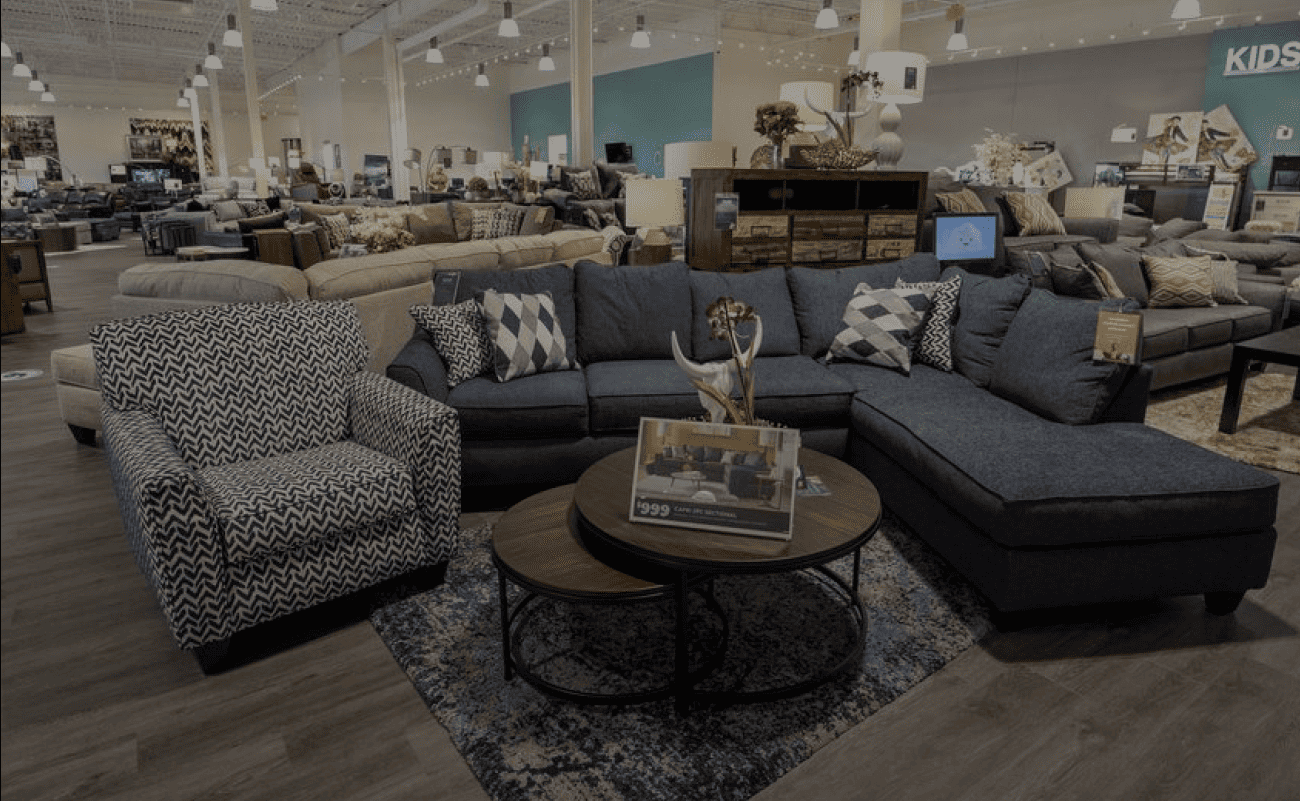
Bob's Discount Furniture is one of the largest value-segment furniture retailers in the United States. The company was founded by Bob Kaufman and has been owned by Bain Capital since 2014. Today, Bob's operates over 200 stores across 26 states and plans to expand to 500+ locations by 2035.
Financial results confirm the strength of the business: trailing twelve-month revenue (through September 2025) reached $2 billion, with net income of $119 million. Revenue grew 20% and net income surged 64% in the first nine months of 2025. Average order value is approximately $1,400.
Bob's model combines brick-and-mortar retail (86% of revenue) with a growing e-commerce channel (14%). Prices average 10% below value-segment competitors, attracting a broad customer base. Notably, 46% of customers have household incomes above $100K, and 27% earn over $150K — signaling strong appeal among middle-class consumers.
The company has optimized its supply chain: production has been fully moved out of China, with primary sourcing now from Vietnam (63%) and the USA (27%), reducing tariff exposure.
The U.S. furniture market is poised for recovery amid pent-up demand: housing turnover is at historic lows, creating significant upside potential as the real estate market rebounds. Bob's holds a strong position in the value segment and is ready to scale with the market.
Participation Terms
The Bob's Discount Furniture IPO is one of the notable offerings in the U.S. retail sector. The company plans to list on the NYSE under the ticker BOBS, with a price range of $17–19 per share and an offering size of 19.45 million shares, targeting up to $370 million in proceeds.
Bob's is going public at a valuation of up to $2.48 billion, backed by leading investment banks: J.P. Morgan, Morgan Stanley, Goldman Sachs, and RBC Capital Markets. The company is showing revenue and profit growt, and its plan to expand to 500+ stores by 2035 offers significant upside potential.
Application and funding deadline: Tuesday, February 4, 6:00 PM (UAE).
Facts and Strengths
• Proven business model: Bob's has operated for over 30 years, navigating multiple economic cycles while maintaining profitability and growing market share.
• Growing affluent customer base: New customers earning over $150K grew 25% year over year — the brand attracts not just budget shoppers, but higher-income consumers as well.
• Geographic expansion potential: The company operates in 26 states, with many major U.S. markets still untapped. The plan is to more than double the store count by 2035.
• Tariff risk mitigation: Production was fully moved out of China by the end of 2024. Primary suppliers are now in Vietnam (63%) and the USA (27%).
• Strong cash flow: Net income growth of 64% in the first nine months of 2025 demonstrates operational efficiency and the ability to generate cash flow for expansion.
The Founding and Growth of Bob's Discount Furniture
Bob's Discount Furniture was founded in 1991 by Bob Kaufman in Connecticut. The idea was simple: offer American families quality furniture at fair prices – no gimmicks, no hidden markups. At the time, the U.S. furniture market was polarized: expensive brands for affluent buyers and cheap, low-quality furniture for everyone else. Bob's carved out a niche in the middle.
The company bet on a unique customer experience. Every store features a café with free coffee and ice cream, and the atmosphere feels more like a showroom than a warehouse. This set Bob's apart from competitors and built a loyal customer base.
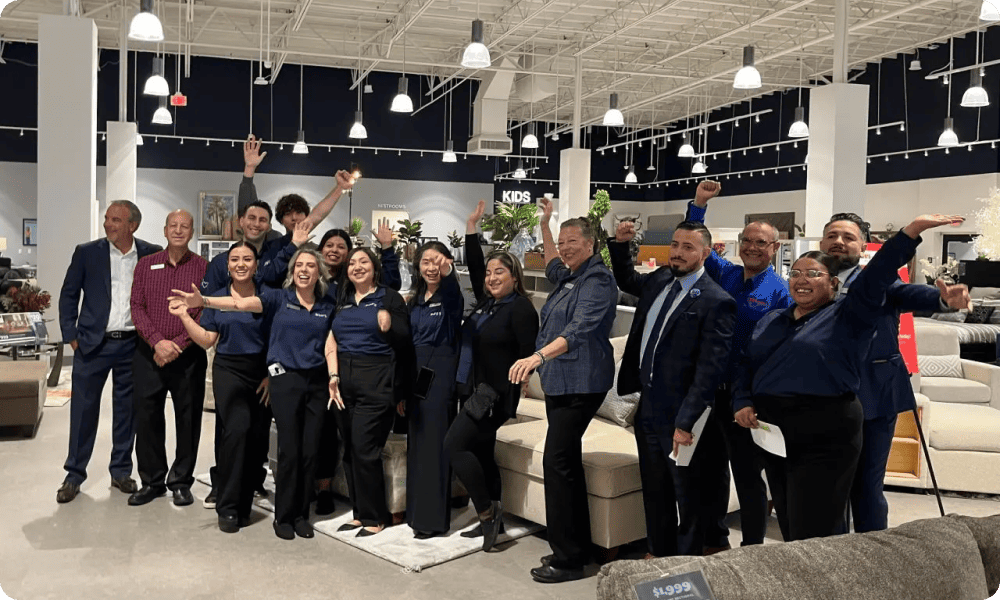
The company's growth attracted investor attention. In 2014, Bain Capital acquired Bob's Discount Furniture and began scaling the business. Over the following years, the chain grew from a few dozen locations to over 200 stores across 26 states.
Today, Bob's is one of the largest value-segment furniture retailers in the U.S. The company combines offline presence (86% of revenue) with a growing e-commerce channel (14%). Average order value is approximately $1,400, and the customer base includes both budget-conscious shoppers and families earning over $150K.
The revenue model is built on high inventory turnover and operational efficiency. The company has optimized its supply chain by shifting production from China to Vietnam and the USA, reducing tariff risk and speeding up delivery.
The U.S. furniture market is undergoing a transformation. Housing turnover is at historic lows, creating pent-up demand. When the real estate market recovers, a wave of new homeowners will need furniture – and Bob's is ready to meet them with a plan to expand to 500+ stores by 2035.
The Bob's Discount Furniture IPO is an opportunity to invest in a time-tested business with a clear growth model and the potential to double its store network over the next decade.
Frequently Asked Questions (FAQ)
— What is an IPO?
An IPO (Initial Public Offering) is when a private company lists its shares on a stock exchange for the first time to raise capital from investors. From that point onward, the company’s shares can be freely bought and sold on the open market.
— Where are IPOs conducted?
IPOs take place on the world’s largest stock exchanges. In the U.S., the primary venues are the NYSE (New York Stock Exchange) and NASDAQ. Once a company goes public, its shares are freely traded on these exchanges, and the market price is established after the offering.
— What is allocation?
Allocation (from “allocation” — distribution) refers to the process of distributing resources, assets, or capital for maximum efficiency. In investing, allocation usually means distributing the available amount of shares among investors in an IPO or private placement.
— How much allocation does an investor receive?
The allocation size depends on the specific deal and typically ranges from 2% to 30% of the submitted order. In rare cases, allocation may reach up to 100%. Information about the actual IPO volume and share price we entered at becomes available roughly one day before the offering, approximately six hours prior to the trade.
Example — Bullish IPO (Aug 13, 2025):
An investor placed an order for $10,000. The allocation was 29.6%, meaning $2,960 was invested in the IPO. The remaining $7,040, including the purchase commission, was refunded to the balance and became available for withdrawal.Klarna IPO (Sept 10, 2025):
An investor placed an order for $10,000. The allocation was 14%, meaning $1,400 was invested in the IPO. The remaining $8,600, including the purchase commission, was refunded to the balance and became available for withdrawal.Figure IPO (Sept 11, 2025):
An investor placed an order for $10,000. The allocation was 16%, meaning $1,600 was invested in the IPO. The remaining $8,400, including the purchase commission, was refunded to the balance and became available for withdrawal.Gemini IPO (Sept 12, 2025):
An investor placed an order for $10,000. The allocation was 29%, meaning $2,900 was invested in the IPO. The remaining $7,100, including the purchase commission, was refunded to the balance and became available for withdrawal.Legence IPO (Sept 12, 2025):
An investor placed an order for $10,000. The allocation was 78%, meaning $7,800 was invested in the IPO. The remaining $2,200, including the purchase commission, was refunded to the balance and became available for withdrawal.Black Rock Coffee Bar IPO (Sept 12, 2025):
An investor placed an order for $10,000. The allocation was 68%, meaning $6,800 was invested in the IPO. The remaining $3,200, including the purchase commission, was refunded to the balance and became available for withdrawal.
— Why do companies go public?
To raise growth capital, increase brand visibility, and provide early investors and employees with an opportunity to sell part of their shares.
— How is participating in an IPO different from buying shares on the exchange?
When you participate in an IPO, you buy shares before they start trading publicly. This provides an opportunity to purchase at the fixed offering price but also carries the risk that the price may drop once trading begins.
— What do I get by participating in an IPO through Regolith?
You become an investor in the company at the IPO stage via our U.S. partner infrastructure. After the transaction is completed and the lock-up period expires, profits from the share sale are distributed among investors proportionally to their stake in the deal.
— What is a lock-up period and how long does it last?
A lock-up period is a timeframe set by the issuer and underwriters during which shares cannot be sold. For IPOs offered through our platform, this period is 93 days. Once it ends, the shares are sold on the exchange and proceeds are distributed among investors.
— How is participating through the platform different from buying shares independently?
To buy independently, you would need access to a U.S. broker, a significant investment amount, and approval from underwriters. The platform pools capital from investors, providing access to IPOs that are otherwise unavailable to most individuals.
— Through whom is IPO participation carried out?
We operate through a U.S.-based structure that works with a licensed broker in the U.S. Our partner selects promising IPOs and participates in the offering under its own name.
— How is the deal structured legally?
An investor signs an agreement/offer to participate in the investment product. Regolith then transfers funds to its partner entity — Wealthy Labs Limited (the provider), which enters into a forward contract with the broker and executes all operational activities. The provider delivers the financial outcome to Regolith, which then distributes proceeds among investors.
— Is there a minimum investment amount?
Yes. Each IPO has a defined minimum entry threshold, shown on the offering page. On average, Regolith provides access starting from $500.
— Do I receive shares into my personal brokerage account?
No. Shares are purchased and held in the partner’s brokerage account. After the lock-up period, the broker sells the shares and transfers proceeds for distribution among investors.
— Can shares be transferred directly to my brokerage account?
No. Participation is structured via a forward contract with the partner’s brokerage infrastructure. The deal is executed on behalf of the partner, and settlements with investors are carried out through the platform.
— How can I sell my shares after the IPO?
Sales are processed automatically: once the lock-up expires, the partner broker sells the shares on the exchange, and proceeds are distributed proportionally among investors.
— What are the risks of investing in IPOs?
IPOs are high-risk investments. While they may offer high returns, they also carry significant volatility. Share prices on the first trading day — and after the lock-up — can fluctuate sharply. There is a risk that the market price will fall below the offering price. In addition, macroeconomic and sector-specific factors can affect outcomes.
— Can I know in advance how much I will earn?
IPO returns are not guaranteed. The final result depends on the share price at the time of sale after the lock-up, overall market conditions, and the company’s performance.
— How can I verify that Regolith participates in IPOs?
We publish all available deal information in the client dashboard. Additionally, we provide an agreement disclosing the infrastructure used for transactions. Broker and partner documents are not shared, as they contain confidential data protected by contractual obligations.
Bill Barton
President & CEO
Details
Ticker
BOBSExchange
NYSEIPO Range
$17–19Offering Size
~$370MCompany Valuation
~$2.48BShares Offered
19.45MUnderwriters
J.P. Morgan, Morgan Stanley, RBC Capital Markets, UBS, BofA Securities, Evercore ISI, Goldman SachsIPO Date
5 Feb 2026Submit by
4 Feb 2026, 6:00 PM (UAE)Terms
Deal Fee
5%Carried Interest
30%Risk potentinal
Very HighLock-up period
93 daysBob’s Discount Furniture
Value furniture retailer from the USA
Updated on 9 Feb 2026
Bill Barton
President & CEO
