

Marketplace Regolith
Your investment opportunities


Kraken
Kraken
Cryptocurrency exchange, bank and wallet
Updated on 23 Oct 2026

David Ripley
CEO
“Crypto is about freedom. Kraken fights for that freedom every day.”

Updated on 23 Oct 2026
About
Kraken is a cryptocurrency exchange and wallet offering trading in digital assets and their derivatives.
It is a market leader among advanced cryptocurrency trading platforms and is distinguished by its strong commitment to transparency. Kraken was the first crypto company to obtain a banking license. Coinbase became the first cryptocurrency company to go public via an IPO, setting a new industry precedent. Kraken is now the next logical candidate to enter the public markets.
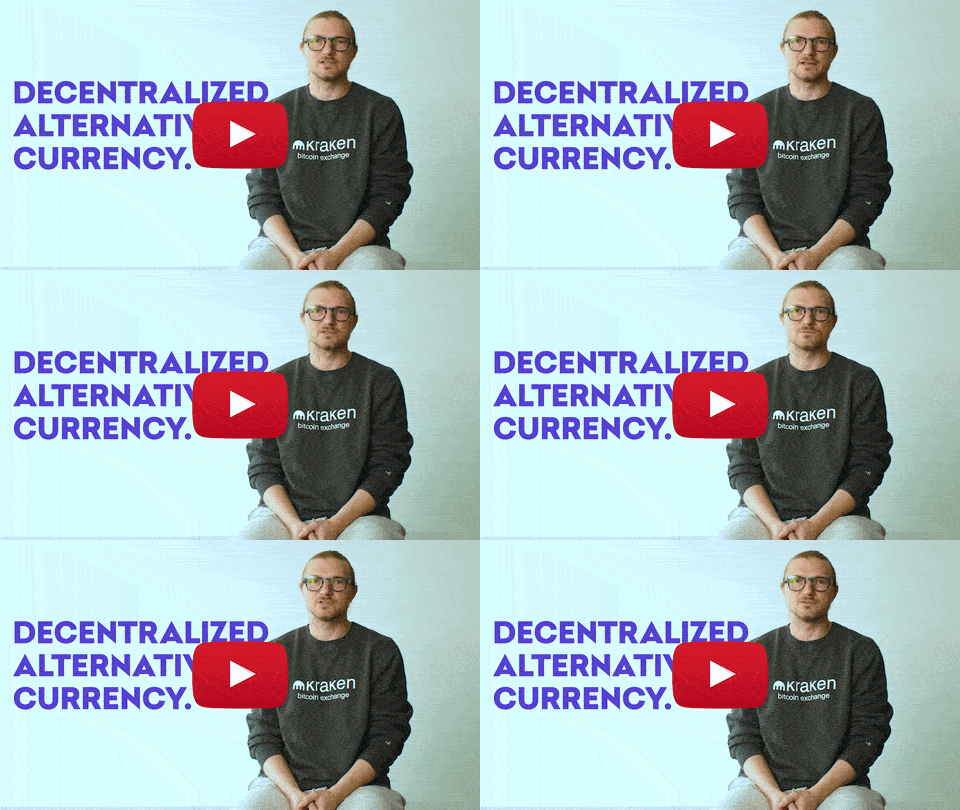
Message from co-founder Jesse Powell
Powell and his company Kraken adhere to the philosophy that cryptocurrencies and blockchain can change the financial system and provide greater freedom and accessibility to financial services.

Why invest in Kraken?
- Reputation and reliability: Kraken is one of the oldest and most established cryptocurrency exchanges. Its long-standing presence in the market and strong focus on security have positioned it as a leading platform in the industry.
- Wide range of digital assets: Kraken provides access to a broad selection of cryptocurrency trading pairs. For investors seeking exposure to multiple digital assets, this represents an attractive opportunity.
- Security: Cryptocurrency exchanges are inherently exposed to risks such as hacking and data breaches. Kraken places a high priority on security and implements robust measures to safeguard client funds.
- Liquidity: Exchange liquidity is a critical factor, particularly for active trading strategies. Kraken offers solid liquidity across many of its trading pairs.
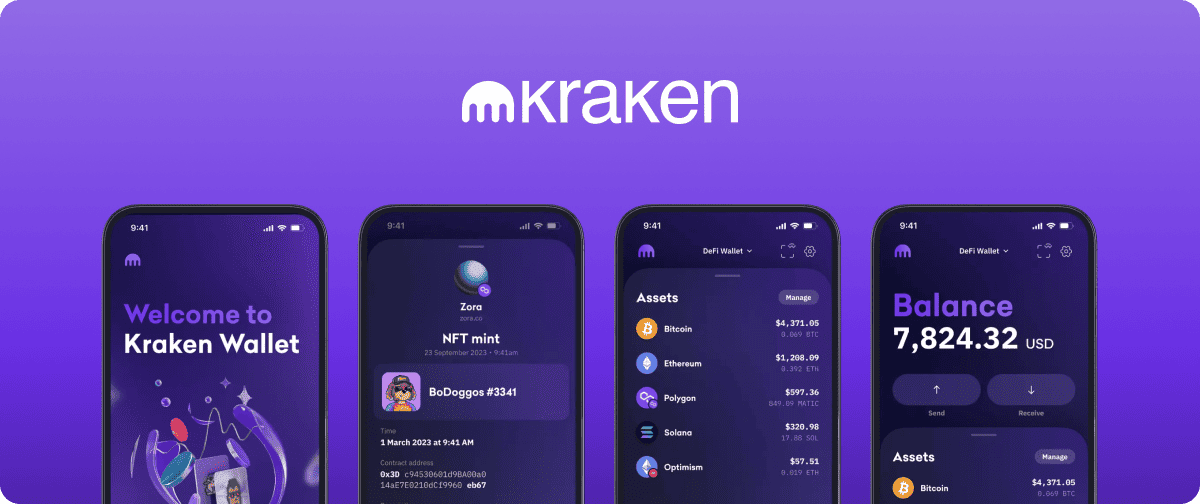
Kraken Becomes the First U.S. Crypto Exchange to Obtain a Banking License
Cryptocurrency exchange Kraken became the first in the United States to receive a Special Purpose Depository Institution (SPDI) charter, granting it functions similar to those of a traditional financial institution. The application by the California-based company was approved by the Wyoming State Banking Board.
- Trust: A banking license signifies that Kraken meets stringent regulatory requirements and standards, ensuring a high level of reliability and transparency. This provides additional protection and confidence for investors seeking to operate on a regulated platform.
- Security: The banking license enables Kraken to enhance the security of client fund custody. Invested assets are held in accordance with banking-grade security standards, helping to mitigate potential risks.
- Enhanced deposit and withdrawal capabilities: The banking license expands Kraken’s ability to process deposits and withdrawals. Investors can utilize a wider range of funding methods, including bank transfers and payment cards, making transactions more convenient and efficient.
- Growth and expanded services: Obtaining a banking license positions Kraken to broaden its range of services and products. The exchange may explore offering additional financial services, such as lending or savings accounts, which could drive further growth and create new opportunities for clients.
Competitive Positioning: Kraken vs. Coinbase
Cryptocurrency exchange Coinbase is one of Kraken’s primary competitors; however, Kraken offers several notable advantages:
- Kraken provides a broader range of advanced trading features and tools, including sophisticated order types and margin trading. This enables users to benefit from greater flexibility and more diverse trading strategies.
- Kraken has built a strong reputation for security and implements robust measures to safeguard user funds and data. While Coinbase also maintains high security standards, Kraken is widely regarded as one of the most reliable platforms in the market.
- Kraken offers extensive margin trading capabilities, allowing users to amplify their positions through leverage. This can be particularly beneficial for experienced traders seeking to enhance potential returns. Coinbase does not provide comparable functionality.
- Kraken supports a wider selection of trading pairs, offering users greater opportunities for portfolio diversification. In contrast, Coinbase maintains a more limited set of available pairs.
The growth of the cryptocurrency market and the desire of both companies' leadership to attract additional capital and expand the business have led to plans for an IPO.
- Coinbase became a publicly traded company on April 14, 2021, marking a major milestone as the first large cryptocurrency exchange to go public in the United States. Kraken has also been considering an IPO since 2021. Former CEO Jesse Powell indicated that the company has explored the possibility of a direct listing, similar to Coinbase’s approach.
- In 2021, Kraken reported trading volume of $574 billion, while Coinbase recorded $1.58 trillion, with a price-to-sales (P/S) ratio of approximately 9x and a market capitalization of $52 billion, which increased to $62 billion by 2024. Coinbase has 242,275,175 shares outstanding, compared to approximately 261,000,000 shares for Kraken.
The price of Kraken's shares on the Regolith platform is $19. This share price was formed at the time when the company's valuation was $5 billion. In the latest funding round, Kraken was valued by investors at $11 billion.
Assuming that Kraken's IPO valuation will be assessed with a P/S multiplier similar to Coinbase's, the company's estimated valuation could be $22.6 billion, then the calculated price per share would be $86.5. This is an approximate valuation and may vary depending on the actual market conditions and other factors at the time of the IPO.
Terms of investments
- The typical duration of an investor's engagement in a project spans approximately five years. This timeframe remains uncertain and is not definitively ascertainable.
- Investment opportunities are accessible on the Marketplace and remain available for investment until marked as Sold Out.
- Exiting a transaction is viable solely after the listing of the company's shares on the stock exchange for trading.
- Venture investments typically entail high risks, yet they also promise substantial profitability upon the successful listing of shares on the stock exchange.
Frequently Asked Questions about Kraken (FAQ)
1. What is Pre-IPO?
Pre-IPO (Pre-Initial Public Offering) refers to investing in a company at a late stage of its development before its shares are listed on a public exchange. Investors gain access to the business well ahead of the IPO or an M&A transaction, typically at a valuation lower than the eventual public market price.
2. How is Pre-IPO different from IPO?
At IPO, shares immediately trade on the stock exchange and become liquid. Pre-IPO is a venture-stage investment: shares are not yet publicly traded, and the holding period is usually 1–5 years until the company goes public.
3. Why do companies raise capital at the Pre-IPO stage?
They seek additional funding to accelerate growth prior to a listing, strengthen their balance sheet, expand product lines, or enter new markets.
4. How is share price and valuation determined at Pre-IPO?
Pricing is based on the company’s financing rounds (Series C, Series D, etc.) and valuations set by venture capital firms and institutional investors. On a marketplace, pricing may either follow the latest round or reflect average levels from secondary market transactions.
5. How can I participate in Pre-IPO via Regolith?
You select a company on the platform and submit an application. Your investment is allocated into the corresponding trust series linked to that Pre-IPO, making you a beneficiary of that series.
6. How is the transaction structured legally?
The investor transfers funds and signs a set of agreements (subscription/participation agreement, trust series joinder, etc.). Shares are held by the trust, while the investor is recognized as its beneficiary.
7. Where are the shares recorded if I invest through the platform?
Shares are held within the trust structure. The trust is the legal owner, and you are the beneficiary of the respective series.
8. How is my participation and ownership confirmed?
Your personal account provides access to key documents: the series participation agreement, trust declaration, and asset specification. These confirm your beneficiary status.
9. Can I verify that Regolith actually participates in the deal?
Yes. Your account contains supporting documents for each trust series, detailing the deal structure and ownership arrangements.
10. What is the minimum investment amount?
The minimum is shown on each deal page. On average, it ranges from $150 to $850 depending on the company.
11. What is the typical investment horizon?
Generally 12–36 months, until IPO or M&A. The exact timing cannot be predetermined.
12. When and how can I exit the investment?
Exit is only possible at a liquidity event — IPO or strategic sale (M&A). At that point, shares are sold and proceeds distributed to investors.
13. What fees apply?
• Entry fee: 5% at the time of purchase
• Exit fee: 20% of profit (success fee)
• No management or exit-only fees apply
14. Do I receive dividends before IPO?
No. Most Pre-IPO companies reinvest profits into growth. Investor returns are realized solely through capital appreciation at IPO or sale.
15. What risks are involved in Pre-IPO investments?
Pre-IPO is a venture-stage asset class. Key risks include:
• IPO delay or cancellation
• Downward revision of valuation
• Low liquidity on the secondary market
• Market-wide or macroeconomic downturns
16. Can I know in advance how much I will earn?
No. Returns depend on valuation at IPO/M&A and market conditions. Potential upside can be 2–5x, but there is also risk of capital loss.
17. What if the IPO is postponed or cancelled?
You remain a shareholder. In case of cancellation, exit may still occur via strategic sale (M&A) or by holding shares until a future listing.
18. What if the valuation declines?
Returns may be significantly below expectations, or the investment may result in a loss.
19. What if the company goes bankrupt?
Pre-IPO is a high-risk venture investment. In the event of bankruptcy, capital may be lost entirely as shares become worthless.
20. How likely is a successful IPO?
Venture statistics show that on average, only 1 in 10 companies reaches IPO or strategic sale. Many remain private or cease operations. This dynamic explains both the potential for outsized returns and the elevated risk profile.
21. Examples of Pre-IPO value growth
SpaceX
In 2022–2023, SpaceX shares on the private market were available around $60 each. By 2025, secondary market prices reached $237 — a ~4x increase (+295%). Importantly, SpaceX has not yet conducted an IPO, leaving further potential upside.Circle (USDC issuer)
In Dec 2024, Circle shares traded at $24. By June 2025, its IPO priced at $31, and shares surged to $123 on day one, later peaking at $290. As of Sep 2025, they trade near $131. From $24 to $131, that’s +446% (over 5x).Example with Regolith fees
An investor placing $100,000 at $24 per share would have received ~4,166 shares. Selling at $123 yields ~$512,000 (+412% gross). After 5% entry fee ($5,000) and 20% success fee ($82,484), net proceeds would be ~$425,000 (+325%).
These examples illustrate how Pre-IPO works: while growth can be exponential, actual results depend on company fundamentals, entry timing, and market conditions.
Significant investors

.svg)

.svg)
.svg)
.svg)
.svg)

.svg)
.svg)

Team






David Ripley
CEO
“Crypto is about freedom. Kraken fights for that freedom every day.”
Details
Foundation date
2011Employees
2300+Attracted investments
~$1.4BCompany valuation
$20BExpected IPO date
2027Terms
Deal fee
5%Carried interest
20%Dividends
NoneRisk potentinal
HighOther
Active users
over 13 mWebsite
Kraken.com