


Anthropic files for IPO as revenue grows fourteenfold

Anthropic, the developer of AI assistant Claude, publicly filed for an IPO on October 26. The company plans to list on Nasdaq under the ticker ANT. After several years of private funding rounds, investors now have access to detailed financial statements from one of the world's largest AI developers.
Anthropic generated $16.286 billion in revenue in the first half of 2026, roughly 14 times the figure a year earlier. Its prospectus also details computing costs, governance arrangements and the reasons for its large reported net loss. These disclosures allow investors to assess the company's business performance alongside the terms of its planned offering.
Nasdaq listing plans
Anthropic filed a Form S-1 registration statement with the U.S. Securities and Exchange Commission. It has chosen the Nasdaq Global Select Market for its Class A shares. Goldman Sachs and Morgan Stanley are among the lead underwriters.
Preparations began earlier: on June 1, Anthropic announced that it had confidentially submitted a draft registration statement. The filing is now public. The price range, number of shares on offer and final trading date have yet to be determined.
The prospectus provides for the sale of newly issued shares and shares held by existing stockholders. Proceeds from the first portion will go to Anthropic; proceeds from the second will go to the selling stockholders. The split will become clear when the offering terms are disclosed.
A team of OpenAI alumni
Anthropic was founded in San Francisco in 2021 by a group of former OpenAI researchers. Its seven co-founders include Dario and Daniela Amodei, Jared Kaplan and Jack Clark. Dario serves as CEO, while Daniela is president.
The team focused on developing powerful AI models and researching their safety. For enterprise customers, this has practical implications: a model needs to work with internal documents, respect access restrictions and produce results that can be checked.
The company introduced the first version of Claude in March 2023. Claude Code entered research preview in February 2025 and became generally available in May. Software development has become one of the main commercial applications of Anthropic's models.

Dario Amodei, co-founder and CEO of Anthropic, at TechCrunch Disrupt in San Francisco. Photo: Kimberly White / Getty Images for TechCrunch, CC BY 2.0.
How Claude generates revenue
Anthropic sells access to its models through its applications, an application programming interface (API) and partner cloud platforms. Individuals and teams pay for subscriptions, while enterprise customers can pay based on usage or sign annual and multiyear contracts with minimum spending commitments.
API pricing depends on the model and the number of tokens processed: small units of text and other data. The more tasks a customer assigns to AI, the more computing resources it consumes. Expanding Claude's use within an organization can therefore increase revenue without adding a new customer.
Claude Code helps users explore projects, modify code, run tests and fix bugs. Claude Cowork is designed for other workplace tasks. For businesses, the value of these products depends on the work completed, such as documents prepared, data processed or development tasks resolved.
Revenue rises fourteenfold
The S-1 shows how quickly sales grew following Claude's launch:
- 2023: $41 million in revenue.
- 2024: $386 million.
- 2025: $4.585 billion, nearly 12 times the previous year's figure.
In the first half of 2026, Anthropic generated $16.286 billion in revenue, up from $1.163 billion in the same period of 2025. Sales increased roughly fourteenfold, and revenue for those six months already exceeded the total for the entire previous year.
Growth also accelerated within the first half: revenue reached $4.731 billion in the first quarter and $11.555 billion in the second. These figures reflect revenue recognized during each period. In earlier funding announcements, the company often cited its revenue run rate, which annualizes the current pace of sales. Investors can now compare actual reported results.
Enterprise customers expand usage
According to the prospectus, as of September 30, 2026, more than 11,900 customers had each generated at least $100,000 in revenue for Anthropic over the preceding 12 months. More than 1,900 had each generated at least $1 million, and about 250 had generated at least $10 million.
Large customers provide recurring spending on Anthropic's models. The company aims to integrate Claude into employees' daily workflows, including development, analysis, document processing and customer service.
The models are available through AWS, Google Cloud and Microsoft Azure. Customers can access AI through the cloud infrastructure they already use. Anthropic gains additional sales channels while remaining dependent on its relationships with major platforms.

U.K. Secretary of State for Science, Innovation and Technology Peter Kyle visiting Anthropic in San Francisco. Archive photo: Alecsandra Dragoi / DSIT, CC BY 2.0.
Profit and liability revaluation
Anthropic's operating expenses totaled $16.979 billion in the first half, resulting in an operating loss of $693 million. Quarterly performance varied considerably: the company posted a $1.667 billion operating loss in the first quarter, followed by $974 million in operating income in the second.
Its first-half net loss was much larger, at $80.748 billion. Most of that amount, $72.388 billion, reflected changes in the fair value of convertible liabilities and other financial instruments. As Anthropic's valuation rose, so did the value of obligations that could convert into its shares.
This revaluation is a noncash accounting item. To assess the company's financial position, it needs to be considered alongside operating results and cash flows. Anthropic generated positive operating cash flow of $3.929 billion in the first half.
Billions for computing capacity
Computing and infrastructure are the largest component of operating expenses. Spending in this category reached $8.945 billion in the first half, more than half of total revenue. Training new models requires powerful computing clusters, while serving customer requests creates ongoing costs as Claude usage grows.
In May, the company announced agreements with Amazon for up to 5 GW of new capacity, and with Google and Broadcom for 5 GW of TPU-based capacity. A separate agreement with SpaceX provides access to the Colossus 1 and Colossus 2 GPU clusters. AWS remains its primary cloud provider and training partner.
Access to infrastructure helps Anthropic meet growing demand. Long-term contracts also create obligations to suppliers that must be met when sales grow more slowly than expected. Anthropic explicitly warns that computing expenses will continue to rise in absolute terms.
Anthropic's rising valuation
Revenue growth has been accompanied by large funding rounds. In March 2025, Anthropic raised $3.5 billion at a post-money valuation of $61.5 billion. In September that year, it secured $13 billion at a $183 billion valuation.
A $30 billion round followed in February 2026 at a $380 billion valuation. In May, Anthropic announced a further $65 billion at a $965 billion valuation. Altimeter Capital, Dragoneer, Greenoaks and Sequoia Capital led the round.
Private funding valuations provide a record of the company's financing history. Its IPO valuation will depend on the final share price and capital structure. Reuters reported on October 26 that some current and prospective investors were discussing a valuation of about $1.5 trillion, down from expectations of up to $2 trillion a week earlier. The filing does not yet include an official price range.
Competing for enterprise AI spending
Anthropic competes with OpenAI, Google and other model developers for corporate budgets and developer adoption. Products are becoming more autonomous: AI can plan actions, use tools and complete sequences of tasks within a software environment. This expands their applications beyond answering questions in a chat.
Enterprise customers compare output quality, cost per task, speed and integration with internal data. Maintaining a technical advantage therefore requires continued investment in research and new model releases. Competitors' price cuts could affect revenue and profitability even as request volumes rise.
Anthropic co-founder Jared Kaplan has contributed to research on how AI capabilities change as models, datasets and computing resources scale. In this business, research feeds directly into the product: a more efficient model can complete a task using fewer resources.
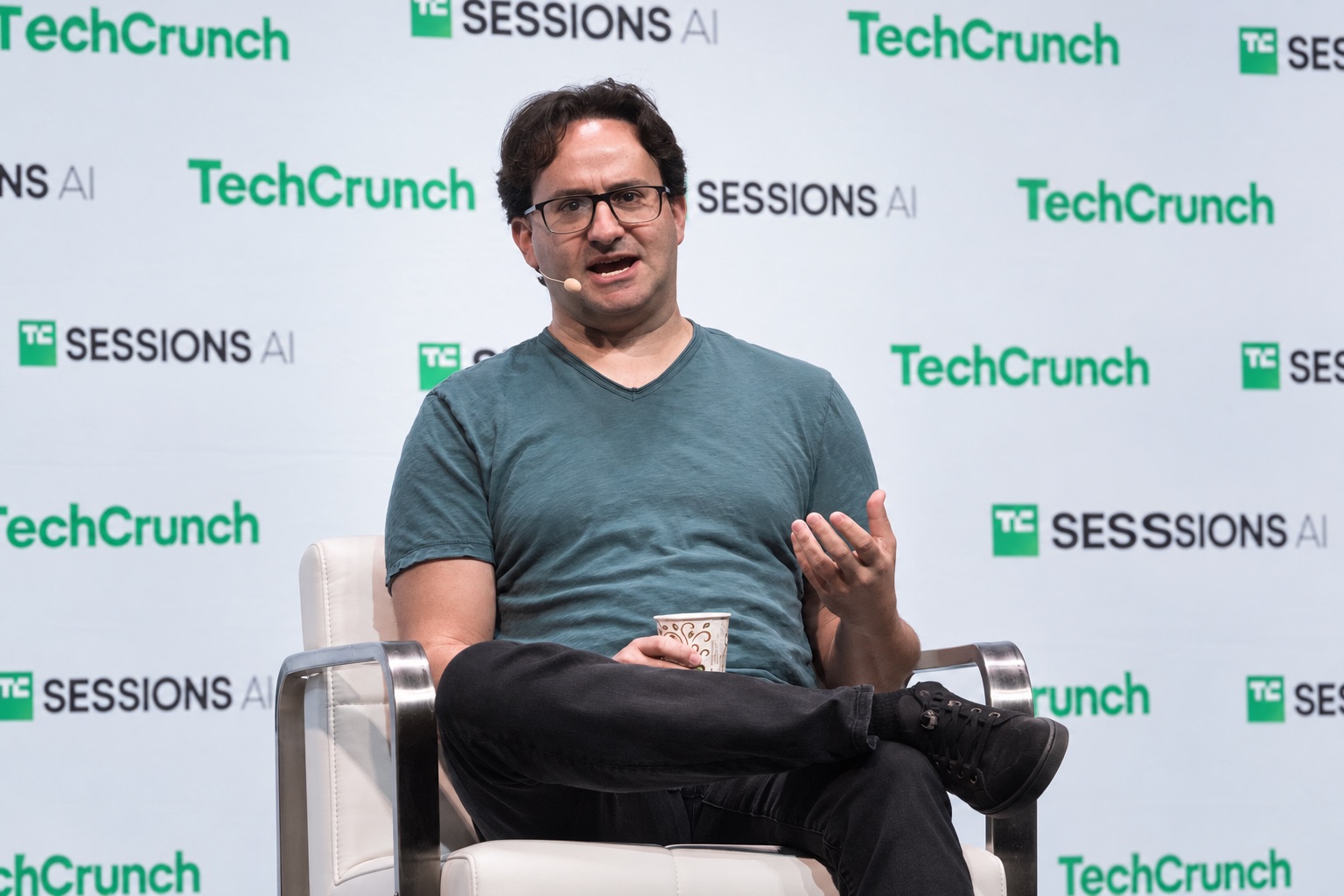
Jared Kaplan, co-founder of Anthropic, at TechCrunch Sessions AI in Berkeley. Photo: Nicole Henderson / TechCrunch, CC BY 2.0.
Founders retain control
Anthropic is organized as a Public Benefit Corporation, which considers both stockholders' interests and a stated public benefit purpose. For Anthropic, that purpose is the responsible development of AI for humanity's long-term benefit.
Under the structure described in the S-1, Founder LLC, an entity representing the seven co-founders, will hold one Class F share carrying 50.1% of the voting power on matters submitted to a general stockholder vote. That share has no economic rights. Separately, the Long-Term Benefit Trust will be able to appoint and remove a majority of board members through Class T shares.
Buyers of Class A shares will therefore have limited influence over governance. Major decisions will remain under the control of the founders and the trust. This structure is intended to protect the company's long-term mission, including when it differs from some investors' preferences.
What to assess before the IPO
The public financial statements allow investors to compare sales, operating expenses and the proposed valuation in detail. Several factors merit attention before participating in the offering:
- Revenue growth and quality. Dependence on the largest customers, changes in Claude usage and customers' spending commitments.
- Computing costs. Whether costs per task are falling faster than customer pricing, and how flexible capacity agreements are.
- Sustainable operating profitability. How the second-quarter result compares with subsequent periods and future model development spending.
- Offering terms. The price range, the split between newly issued shares and sales by existing stockholders, available allocations and resale restrictions.
The next significant update will be the offering terms. They will show the valuation Anthropic proposes to new stockholders and how much capital it will raise to further develop Claude and its computing infrastructure.
Applications for Anthropic's IPO through Regolith are open from $100 until November 6 at 6:00 p.m. Moscow time.
