

IPO Allocations: Why Investors Receive Fewer Shares

The Dynatrace team celebrates its IPO outside the New York Stock Exchange. Photo: Dynatrace / Wikimedia Commons, CC BY 4.0.
What Is an IPO?
An IPO, or initial public offering, is a company's first public sale of shares. It offers shares to a broad range of investors, usually alongside a stock exchange listing. Once trading begins, the shares can be bought and sold on the market.
For a business, an IPO is a way to raise capital for expansion, construction, new products, debt repayment or acquisitions. It can also allow early shareholders to sell part of their stakes. Proceeds from newly issued shares go to the company; proceeds from shares sold by existing owners go to those shareholders. The offering documents disclose the mix of shares being sold and the intended use of the money raised.
Investors acquire an ownership stake in the business. Their returns depend on subsequent changes in the share price and any dividends. After going public, the company regularly discloses financial results and material developments, allowing investors to track its performance through public filings.
How IPO Pricing Works
Before a traditional IPO, the company and its investment banks, known as underwriters, usually announce an indicative price range. The banks collect orders and build a book of demand, recording how many shares investors are willing to buy and at what price. The company and its underwriters then set the final offering price and size.
The initial range can change before the offering. Before submitting an order, investors should check the price at which it may be filled and whether a change in terms will require them to reconfirm. If an offer page lists an estimated price, the final amount invested will depend on the actual IPO price and the allocation received.
What Is an IPO Allocation?
An IPO allocation is the distribution of shares among investors in an initial public offering. For an individual investor, it is often expressed as a percentage of the amount requested.
An investor submits a $10,000 IPO order but receives only $2,000 worth of shares. The remaining funds are returned to their account balance. This is a partial allocation: it determines how much of the requested amount is actually invested at the offering price.
Allocation percentage = amount invested in shares / amount requested × 100%.
An order filled in full represents a 100% allocation. With a zero allocation, the investor receives no shares.
Who Allocates the Shares?
The company and its underwriters determine how the offered shares are distributed among participants. Recipients may include investment funds and brokers through which individual investors submit their orders.
Allocation takes place at several levels. Participants in the offering first receive their respective allotments, after which brokers distribute the available shares among their clients. As a result, two investors submitting identical orders through different intermediaries may receive different numbers of shares.
In the U.S. market, institutional investors, including funds, insurers and other large participants, often receive a substantial share of an offering. The exact split and allocation rules vary from deal to deal.

Redfin's IPO day on Nasdaq, July 28, 2017. Photo: Steve Jurvetson / Wikimedia Commons, CC BY 2.0.
Why Orders Are Partially Filled
The number of shares offered in an IPO is limited. When investors want to buy more shares than are available, the offering is oversubscribed: total demand exceeds supply. The underwriters must decide who receives shares and how many.
Suppose a company offers 10 million shares and receives orders for 50 million. The order book is five times oversubscribed. A simple proportional split would give each participant 20% of the shares requested, but the actual allocation process may apply different rules to different categories of investors.
The outcome depends on the number of shares available to a particular broker, demand from its clients and the offering's allocation rules. Some deals give smaller orders preferential treatment; others focus on large, long-term investors. There is no standard allocation percentage across all IPOs.
Examples from Regolith
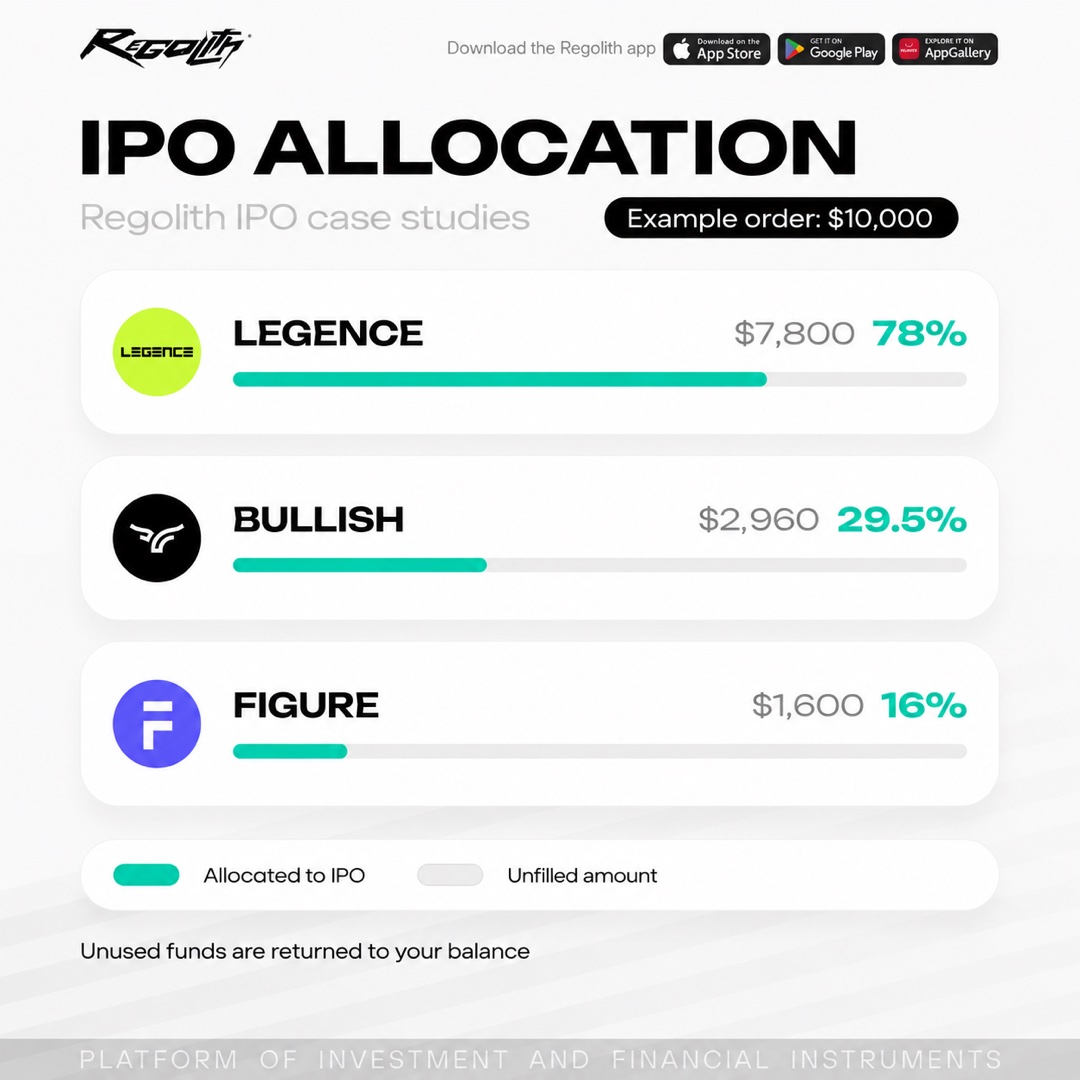
Allocation levels have also varied across IPOs in which Regolith has participated. The illustration below shows examples involving Legence, Bullish and Figure, based on a $10,000 order.
For Legence, 78% of the order, or $7,800, went toward the purchase. For Figure, the allocation was 16%, or $1,600. The difference shows how much the amount actually invested can vary, even with the same initial budget.
How Allocations Affect Returns
Suppose an investor submits a $10,000 order and receives a 10% allocation. At an IPO price of $20 per share, they buy 50 shares for $1,000. The remaining $9,000 is returned to their account balance.
The investor later sells all 50 shares for $26 each. Sale proceeds total $1,300, producing a $300 profit before fees and taxes. The return on the amount invested in shares is 30%. Measured against the full $10,000 initially requested, the profit represents 3%.
To calculate their own result, investors need to subtract the purchase cost and transaction expenses from the sale proceeds. The return on the position is calculated using the amount actually invested in shares. To assess how the original budget was put to work, they can separately compare the profit with the full order amount.
Should You Request More Shares?
After receiving a small allocation, an investor may be tempted to submit a larger order next time. For example, they might request $20,000 worth of shares, expecting only 10% to be filled and the actual investment to total $2,000.
This approach requires caution because the final allocation percentage is unknown in advance. If the order is filled at 80%, the purchase would total $16,000. Investors should size their orders according to how much they would be comfortable investing in one company if the order were filled in full.
The broker's rules also matter. Fidelity, for example, explicitly states that requesting more shares does not in itself improve the chances of receiving an allocation. Investors should understand their intermediary's process before submitting an order.
IPO Price vs. Market Price
An allocation allows investors to buy the shares allotted to them at the offering price. Once exchange trading begins, the market price may immediately move above or below that level.
If investors receive only part of the amount requested, they can try to buy additional shares on the market. This is a separate transaction at the available market price. If the stock has risen, buying more will increase the position's average cost and change its return calculation.
The timing of a sale also depends on the terms of participation. If a lock-up period restricts sales, a gain on the first trading day remains unrealized. The actual result depends on the price at which the investor is able to sell.

Athena Technology Acquisition Corp. II celebrates its listing on the New York Stock Exchange. Photo: Boosquet / Wikimedia Commons, CC BY-SA 4.0.
What to Check Before Investing
Before submitting an order, review the company's filings and the terms of the specific offering. For U.S. IPOs, detailed information is typically available in the S-1 registration statement and the prospectus. Five areas deserve particular attention:
- Who receives the proceeds. The Use of Proceeds section explains how the company plans to spend the money raised. The offering details also show how much stock is being sold by existing shareholders.
- How the business makes money. Review revenue trends, profit or loss, cash flow and debt. Customer concentration also matters: losing a major customer can materially affect results.
- The proposed valuation. The price of one share says little about the value of the business. Compare the post-IPO market capitalization with revenue, earnings and the valuations of peers in the same sector. For an unprofitable company, cash reserves and the rate of spending also matter.
- How the order is processed. Check the confirmation deadline, how funds are reserved and returned, and whether fees are based on the amount requested or the amount actually invested. This can affect costs when the allocation is small.
- When shares can be sold. Check for a lock-up period, its duration and the terms for exiting the investment. Whether shares can be sold on the first trading day depends on the terms of your participation.
On Regolith, the unused portion of an order is returned to the account balance. The terms of participation are listed on each offer page. Choose an order size that would leave you comfortable with your exposure to a single company even if the order were filled in full.
