


Marketplace Regolith
Your investment opportunities


Polymarket
Polymarket
Global event prediction exchange
Updated on 9 Jul 2026

Shayne Coplan
Founder & CEO
“Prediction markets are the most accurate tool humanity has today.”
Updated on 9 Jul 2026
About
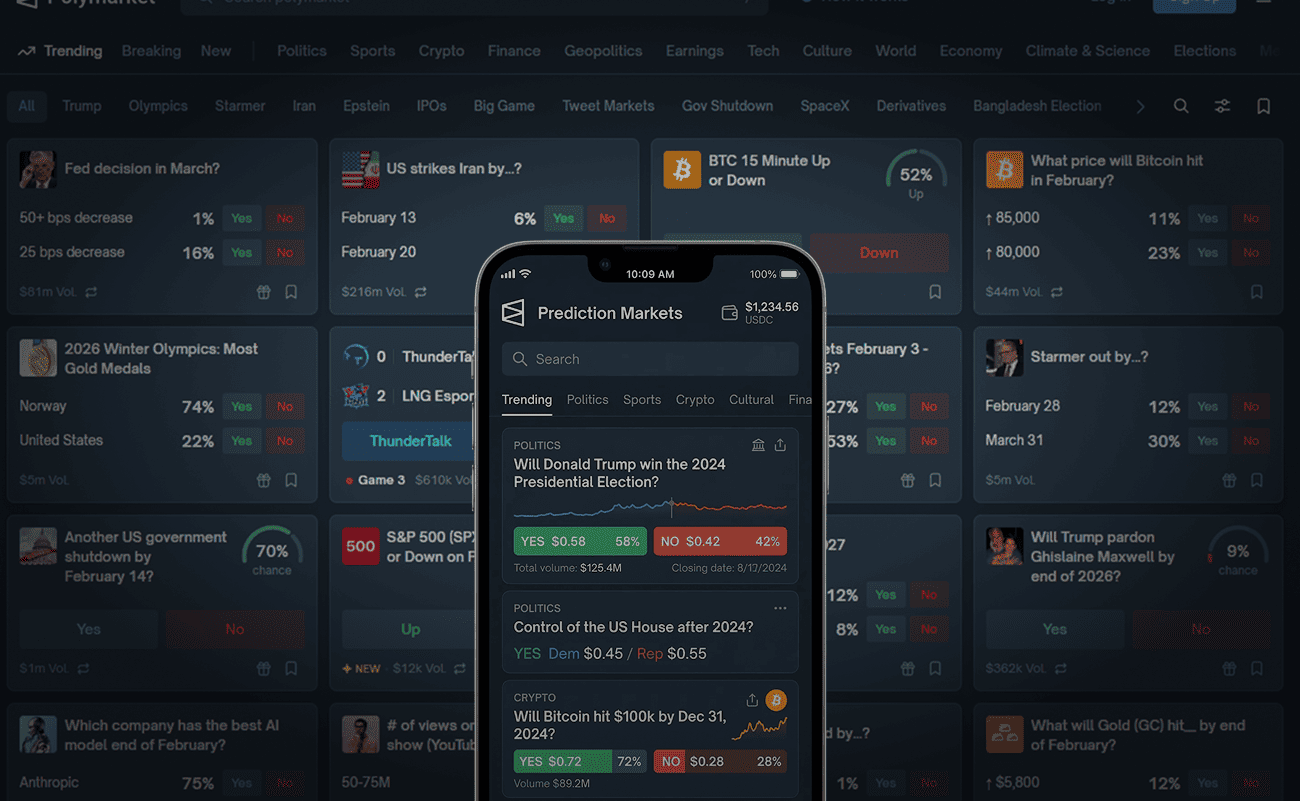
Polymarket is the world's largest prediction market platform, built on the Polygon blockchain.
Users place bets on the outcomes of real-world events: elections, economic decisions, technology launches, sports, and more. In essence, Polymarket turns the collective opinion of millions of people into precise probabilities.
The platform's data is cited by Bloomberg, Reuters, The Wall Street Journal, CNN, and other leading global media outlets.
Polymarket was founded in 2020 by Shayne Coplan in New York. By 2026, the company has raised $2.3 billion in funding. The latest deal valued the company at $15 billion, while a new round is reportedly being negotiated at around $20 billion (per WSJ).

What makes Polymarket attractive to investors
- Market dominance: Polymarket leads the prediction market space by a wide margin. Monthly trading volumes are measured in billions of dollars. The platform has become the industry standard.
- Institutional investors: Shareholders include ICE (owner of the New York Stock Exchange, invested $2 billion), Peter Thiel's Founders Fund, Coinbase Ventures, and 1789 Capital. This investor lineup reflects a high level of confidence in the company.
- Favorable regulatory environment: The administration has eased its approach to prediction market regulation. DraftKings and Robinhood have already launched their own similar products – the industry is gaining legitimacy at the level of major financial platforms.
- Cultural impact: During the 2024 presidential election, Polymarket predicted the outcome more accurately than most traditional polls. The platform has moved beyond the crypto community to become a mainstream tool.
- Founder: Shayne Coplan founded Polymarket at age 22 and by 26 became one of the youngest self-made billionaires in the world.
Polymarket and the prediction market
A prediction market is an exchange where contracts on the outcomes of real-world events are traded. If an event occurs, the contract is worth $1. If not – $0. The contract price at any given moment reflects the market's view of the event's probability.
Polymarket operates on the Polygon blockchain, enabling instant settlement and minimal fees. Users trade in USDC (a stablecoin pegged to the US dollar).

The platform covers thousands of markets: politics, economics, cryptocurrencies, technology, sports, weather, and culture. During major global events – elections, geopolitical crises, product launches – trading volumes surge, making Polymarket one of the most dynamic fintech projects in the world.
Polymarket and the path to IPO
The prediction market is growing rapidly. DraftKings and Robinhood have already launched their own products, and Kalshi has received regulatory approval in the US. Polymarket remains the undisputed leader in trading volume, reach, and brand recognition.
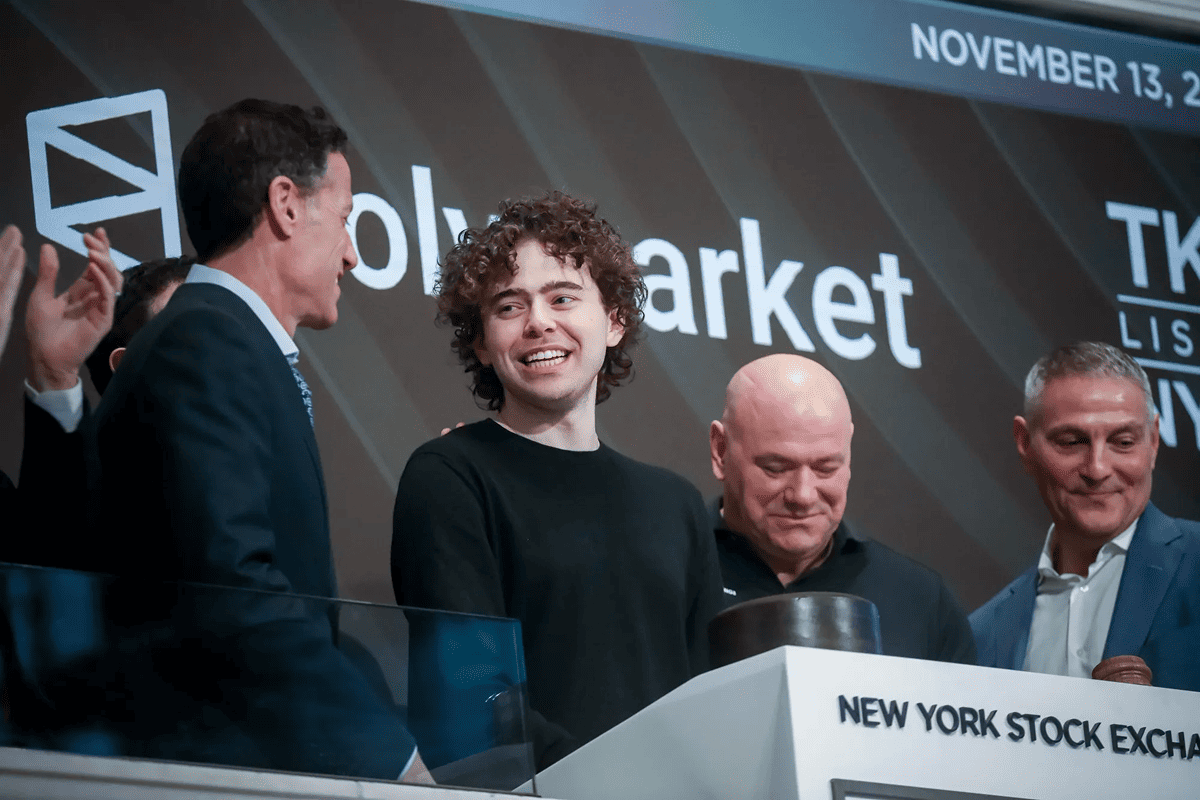
The company has raised about $2.3 billion across seven funding rounds. The largest was ICE's strategic $2 billion commitment, closed in March 2026. By the spring of 2026, Polymarket's valuation had climbed to $15 billion, and a new round is already being discussed at around $20 billion.
Coinbase became the first crypto company to go public in 2021, setting a new standard for the industry. In April 2026, Kraken filed a confidential IPO application. Polymarket is widely seen by analysts as one of the most likely next candidates for an IPO among the new wave of crypto companies.
The current share price on the secondary market is ~$145, based on recent transactions between private investors and reflecting the company's current valuation. The price may change upon IPO depending on market conditions and demand.
The $20 billion round: key details
In March 2026, The Wall Street Journal reported that Polymarket is preparing a new funding round at a valuation of approximately $20 billion – double its late 2025 valuation.
On March 27, 2026, the first phase of the round closed: Intercontinental Exchange (ICE) – the parent of the NYSE – made a $600 million direct investment in Polymarket, completing its $2 billion strategic commitment. According to Bloomberg, the deal was priced at a $15 billion valuation, while the target valuation for the new, broader round is being discussed at around $20 billion.
Investor interest is backed by record trading volumes. In February 2026, the platform processed more than $7 billion – 7.5 times higher than a year earlier. On February 28, an all-time daily record was set: $425 million in a single day.
An additional growth driver is the partnership with Dow Jones (January 2026). Polymarket data is now integrated into The Wall Street Journal, Barron's, and MarketWatch, bringing the platform to the audience of the world's leading financial media.
Polymarket team
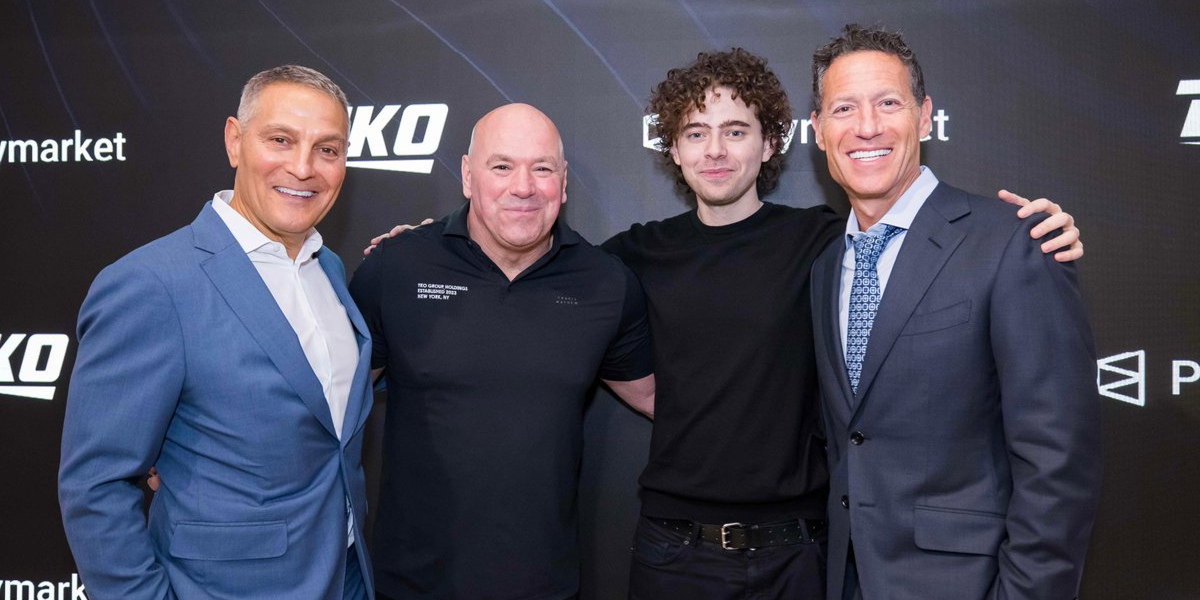
As of early 2026, the company employs over 150 people. The team includes developers, data specialists, market makers, and regulatory experts. Headquarters are located in New York, with employees working across 5 continents.
Despite its compact team size, Polymarket processes billions of dollars in monthly trading volume. Its blockchain infrastructure automates most processes – smart contracts execute trades without manual intervention, making the business model scalable with minimal operational costs.
Competitors
- Kalshi: A CFTC-regulated prediction exchange in the US. It operates in a fully legal framework, giving it an advantage among American users. However, Polymarket significantly outperforms Kalshi in trading volume, number of markets, and global reach.
- DraftKings: The largest sports betting platform in the US, which has added prediction markets as an additional product. For DraftKings, this is one of many features, whereas for Polymarket, predictions are the core business.
- Robinhood: A popular broker that has launched prediction markets for its users. It has an enormous client base, but its prediction product is at an early stage of development.
- Metaculus and PredictIt: Earlier prediction platforms with lower volumes and limited functionality. PredictIt operates primarily as a research project with betting limits.

Polymarket leads its competitors through a combination of global reach, high liquidity, blockchain-powered settlement speed, and breadth of markets. No other platform brings all of these factors together in a single product.
The Shayne Coplan phenomenon
"Prediction markets are the most accurate tool humanity has today." – Shayne Coplan, founder of Polymarket
Coplan founded Polymarket at age 22, working from his apartment on Manhattan's Lower East Side. By 26, he became one of the youngest self-made billionaires in the world. Coplan believes that real people placing real money on outcomes produce more accurate forecasts than traditional polls and experts. The 2024 election confirmed this – Polymarket predicted the result more accurately than most pollsters.
Pre-IPO investment features
- The average investment holding period ranges from one year to several years. This timeline is unpredictable and cannot be set by anyone.
- Exit from the deal is only possible after the company's shares are listed on a stock exchange for trading.
- Pre-IPO investments are high-risk but potentially high-return in the event of a successful listing.
- Minimum request amount – $5,000.
- For investors from $200,000, structuring through a separate SPV (Special Purpose Vehicle) is available – an individual legal entity created for a specific deal.
Participation Terms
Participation is available through the Booking format. You submit a request to purchase Polymarket shares on the secondary market, after which an investor pool is formed and shares are acquired from current shareholders.
The final price is fixed at the time the secondary deal closes. Closing timeline is 2 weeks to 2 months depending on share availability and legal processing.
A ROFR period (~30 days) also applies – a standard procedure in which the company or existing shareholders have the right to purchase the shares at the agreed price. Once this period expires, the deal is finalized and shares are distributed among investors. If the deal does not go through, funds are returned to your account.
This format allows you to reserve participation in the deal ahead of an official IPO announcement and lock in a price at the current secondary market level.
Frequently Asked Questions about Polymarket (FAQ)
1. What is Pre-IPO?
Pre-IPO (Pre-Initial Public Offering) refers to investing in a company at a late stage of development before its shares are listed on a stock exchange. It gives investors the opportunity to enter a business well ahead of an IPO or M&A deal at a price that is typically below the public market level.
2. How does Pre-IPO differ from IPO?
In an IPO, shares are immediately listed on an exchange and become liquid. Pre-IPO is a venture stage: shares are not yet publicly traded, and the investment horizon is typically 1–5 years before the company goes public.
3. Why do companies raise capital at the Pre-IPO stage?
Companies need additional capital for growth ahead of a public listing, as well as to strengthen their balance sheet, expand their product lineup, or enter new markets.
4. How is the share price determined at the Pre-IPO stage?
The price is based on the company's funding rounds and transactions on the secondary market between private investors. The indicative price on the platform reflects the current secondary market level. The final price is fixed at the time the deal closes and may differ from the listed price.
5. How can I participate in Pre-IPO through Regolith?
The platform offers two formats for Pre-IPO participation:
- Direct purchase – shares have already been acquired by Regolith and are available to investors. You select a company, submit a request, and your funds are allocated to the corresponding trust series.
- Booking (request collection) – for certain deals, shares are purchased on the secondary market after an investor pool is formed. You submit a request, after which shares are acquired from current shareholders and distributed through a trust or a separate SPV. Minimum amount – $5,000. Closing timeline – 2 weeks to 2 months.
The format is indicated on the page of each offering.
6. What is the secondary market?
It is a market where current shareholders of private companies sell their stakes before the company goes public. The buyer receives the same rights to the shares as early investors.
7. What is the closing timeline for booking format deals?
2 weeks to 2 months depending on share availability on the secondary market and legal processing. A ROFR period (~30 days) also applies.
8. What is a ROFR period?
ROFR (Right of First Refusal) is the right of first refusal. After a secondary deal is closed, the company or its existing shareholders have ~30 days to purchase the shares at the agreed price. If they decline, the deal is finalized. If they exercise this right, funds are returned to investors' accounts.
9. How is the deal structured legally?
For standard requests, the structure uses a US trust with a separate series for each investment. The investor signs a set of agreements (participation agreement, trust series accession agreement, etc.). For investors from $200,000, a separate SPV (Special Purpose Vehicle) – an individual legal entity created for a specific deal – may be used.
10. Where are the shares held?
Shares are held within the trust structure. The trust is the legal owner of the shares, and the investor is its beneficiary within the selected series.
11. How is my participation confirmed?
Documents are available in your personal account: series participation agreement, trust declaration, and asset specification. These confirm your beneficiary status.
12. Can I verify that Regolith is actually participating in the deal?
Yes. Supporting documents for each trust series are published in your personal account, detailing the terms and ownership structure.
13. What is the minimum amount to participate?
It depends on the format. For direct purchases, the minimum amount is listed on the page of each offering. For the booking format – $5,000.
14. What is the typical investment term?
The average term is 12–36 months, until the company's IPO or M&A. Exact timelines cannot be determined in advance.
15. When and how can I exit a deal?
Exit is only possible upon a liquidity event – an IPO or sale of the company to a strategic investor. At that point, shares are sold and profits are distributed among investors.
16. What fees apply?
An entry fee of 5% applies at the time of purchase. Upon exit, a 20% success fee on profits is charged. There are no management fees or exit fees.
17. Do I receive dividends before the IPO?
No. Most Pre-IPO companies reinvest profits into growth. Investor returns are generated solely through an increase in the company's valuation and a successful public listing.
18. What are the risks of Pre-IPO investing?
Pre-IPO investments fall under the venture category. Key risks include:
- postponement or cancellation of the IPO
- decline in the company's valuation
- ROFR exercise (the company repurchases shares and the deal does not go through)
- low liquidity on the secondary market
- broader market and macroeconomic factors
19. Can I know in advance how much I will earn?
No. Returns depend on the company's valuation at the time of IPO or M&A and overall market conditions. Potential returns may range from x2 to x5 on the initial investment, but there is also a risk of capital loss.
20. What happens if the company's IPO is delayed or does not take place?
The investor retains ownership of their stake in the company. In the event of an IPO cancellation, exit may be possible through a sale to a strategic buyer (M&A) or by holding shares until a future listing attempt.
21. What happens if the company's valuation declines?
In such a case, the deal's return may be significantly lower than expected or result in losses.
22. What happens if the company goes bankrupt?
Pre-IPO investments are classified as venture investments and carry a high level of risk. In the event of bankruptcy or cessation of operations, invested funds may be lost in full as the shares lose their value.
23. What is the probability of a company successfully going public?
According to venture statistics, a significant portion of early-stage companies never reach an IPO. For late-stage companies with major institutional investors, the probability of going public is substantially higher. However, neither the timing nor the fact of an IPO can be guaranteed.
24. What are some examples of share price changes in Pre-IPO investments?
The examples below illustrate how share prices can change from the point of entry at the Pre-IPO stage through to IPO or secondary market trading.
SpaceX
In 2022–2023, SpaceX shares on the private market were available at around $60 per share. By May 2026, the price on the secondary market had risen to ~$610 – roughly a 10x increase from the 2022 level. In April 2026, SpaceX filed a confidential IPO application. According to Bloomberg, the target valuation for the listing is $2 trillion, which would make it potentially the largest public offering in stock-market history.
Circle (USDC issuer)
In December 2024, Circle shares at the Pre-IPO stage were trading at $24. In June 2025, the company went public on the NYSE (ticker: CRCL). Shares reached a peak of approximately $290 before correcting. As of March 9, 2026, shares trade in the $98–112 range. Growth from the Pre-IPO level ($24) to the current ~$105 represents over 300%.
Sample calculation including Regolith fees
Suppose an investor invested $100,000 in Circle at $24 per share at the Pre-IPO stage. They would have received approximately 4,166 shares. The company went public on the NYSE in June 2025, with shares reaching $290.
At a sale price of $105 (current level), the portfolio would be worth approximately $437,000.
Gross return would be +337%.
From this amount, an entry fee of 5% ($5,000) and a success fee of 20% on profits ($67,460) are deducted.
The investor's net result after all deductions would be approximately $365,000, corresponding to a return of +265% on the initial amount.
These examples illustrate how the Pre-IPO model works: share price growth can be exponential, but the actual outcome depends on the specific company, timing of entry, and market conditions.
Shayne Coplan
Founder & CEO
“Prediction markets are the most accurate tool humanity has today.”
Details
Foundation date
2020Employees
150+Attracted Investments
$2.3BCompany Valuation
$20BExpected IPO date
2027Terms
Deal Fee
5%Carried Interest
20%Dividends
NoneParticipation format
BookingRisk potentinal
High