

Investing in Dinosaurs: Why Skeletons Sell for Millions
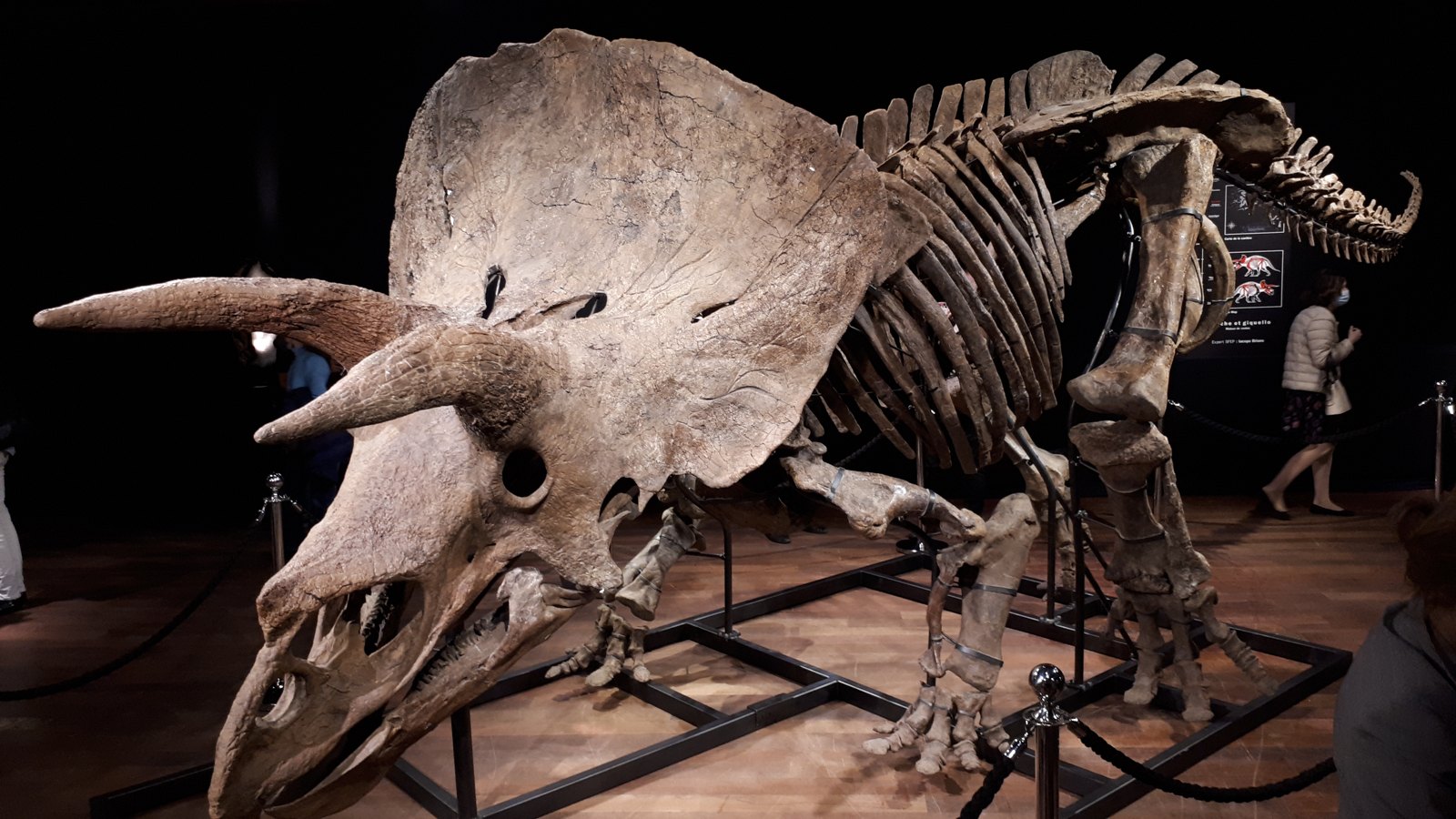
The Big John Triceratops skeleton on display at the Drouot auction house in Paris. Photo: Eviatar Bach / Wikimedia Commons · CC BY-SA 4.0.
In just ten minutes of bidding, seven buyers drove the price of the Tyrannosaurus rex skeleton Gus to $50.13 million. The sale took place at Sotheby’s in New York on July 14, 2026, setting a new world auction record for a dinosaur. The prehistoric animal reached the same price bracket as works of art sought by leading collectors.
Before a fossil reaches an auction, it has to be found, legally acquired, freed from the surrounding rock and restored. Regolith and Artefactum Gallery handle this process through a joint project: the team acquires rare specimens, prepares them for display and sells them to collectors, galleries and museums. Investors can participate from $500.
Two Centuries of Collecting
The fossil trade began long before today’s auction records. In the early 19th century, growing interest in geology already allowed some collectors to earn a living by finding fossils. Among them was Mary Anning, who supported her family by selling finds from England’s Jurassic Coast. Her work helped build collections and advance paleontology.
A professional market developed over time, bringing together museums, private collectors, dealers, laboratories and galleries. Transactions can involve a complete skeleton, an individual skull, a tooth or a slab containing several fossil animals.
A Dinosaur for a King
Wealthy entrepreneurs took an interest in dinosaurs long before modern auctions. In the late 19th century, industrialist Andrew Carnegie decided to make a Diplodocus skeleton the centerpiece of his museum in Pittsburgh. The new species was named Diplodocus carnegii in his honor.
After seeing an illustration of the dinosaur at Carnegie’s Scottish castle, Britain’s King Edward VII wanted a similar exhibit for London’s Natural History Museum. Carnegie commissioned a plaster cast. It arrived in London in 36 crates and was unveiled to the public on May 12, 1905. Known as Dippy, the Diplodocus became one of the world’s most recognizable museum dinosaurs.
More casts later went on display in other countries. Carnegie kept the original fossils in his museum while making the discovery known around the world. Private funding was supporting research and building museum collections a century before today’s record sales.

Dippy at London’s Natural History Museum, September 3, 2016. The exhibit is a plaster cast of the skeleton. Photo: Webstershows / Wikimedia Commons · CC BY-SA 4.0.
Auction Records
One of the best-known transactions was the purchase of the Tyrannosaurus rex SUE in 1997. Chicago’s Field Museum acquired the skeleton for $8.4 million with support from private benefactors and companies. Over the following decades, record prices rose substantially.

SUE the Tyrannosaurus rex at the Field Museum, Chicago, March 22, 2019. Photo: Jonathan Chen / Wikimedia Commons · CC BY-SA 4.0.
In 2020, a Tyrannosaurus rex skeleton named STAN sold for $31,847,500 at Christie’s in an auction that also featured works by Picasso, Rothko and other artists. Buyers could bid for a rare skeleton alongside paintings by celebrated artists.
The table below brings together five major dinosaur skeleton auction sales. Prices depend on each specimen’s rarity and condition. A fossil’s potential value is assessed against sales of similar specimens with comparable preservation and preparation quality.
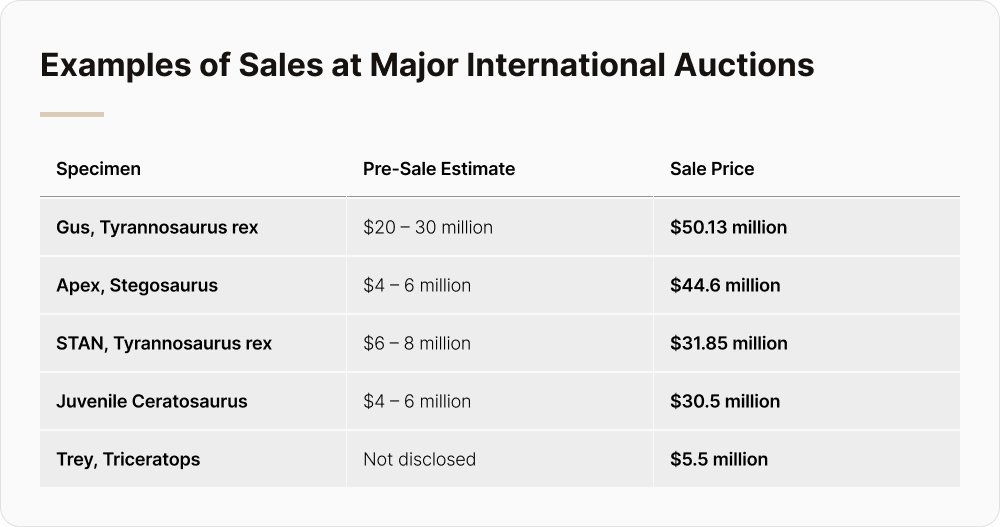
Examples of sales at major international auctions. Materials from Regolith and Artefactum Gallery.
Who Buys Dinosaurs?
Museums acquire fossils for research and public collections. Private buyers may collect particular species, seek a striking exhibit for their own gallery or purchase a specimen with a view to resale. Their interests sometimes overlap: a privately owned specimen can become part of a museum exhibition.
This happened with the Stegosaurus Apex. After purchasing it at Sotheby’s in 2024 for $44.6 million, investor Ken Griffin lent it to the American Museum of Natural History in New York. Visitors could see a specimen acquired by a private collector.
Scientists are concerned about whether they will be able to study fossils after a sale to a private collector. London’s Natural History Museum notes that high prices make it harder for museums to compete for important finds, while access to privately owned specimens can be restricted. Both the bones and the records of where and how they were found matter to science: they help reconstruct the environment in which the animal lived.

Trinity the Tyrannosaurus rex on display ahead of the Koller auction. Tonhalle, Zurich, April 4, 2023. Photo: Spucky123r / Wikimedia Commons · CC BY-SA 4.0.
Three Dinosaurs, One Skeleton
A seemingly complete skeleton can be assembled from the remains of several animals. In 2023, auction house Koller presented the Tyrannosaurus rex TRX-293 Trinity in Zurich. It combined bones from three specimens found in the U.S. states of Montana and Wyoming. The auction catalog openly described the skeleton’s composition and included a diagram showing the origin of the bones.
Original fossil material accounted for just over 50% of the exhibit, which carried a presale estimate of CHF 5–8 million. Buyers need a detailed inventory showing which bones survive, which individual they belong to and how missing parts have been replaced. Two equally impressive skeletons can therefore differ considerably in collectible value.
What Makes Fossils Valuable?
Age alone does not make a fossil expensive. Value depends on the rarity of the species, the specimen’s condition and the amount of original material preserved. A complete skull and a few scattered bones from the same animal have different values to a collector.
A specimen’s history matters, too. Documentation should establish where it came from and trace changes in ownership. Specialists identify the animal, distinguish original elements from reconstructions and assess the quality of the work. An individual specimen may require an independent expert assessment.
Preparing a find for sale can take several months. First, the bones are carefully freed from the surrounding rock, a process known as preparation. They are then stabilized, restored and, where necessary, mounted on a supporting frame. The collector receives a finished exhibit with documentation of its provenance, condition and the work performed.
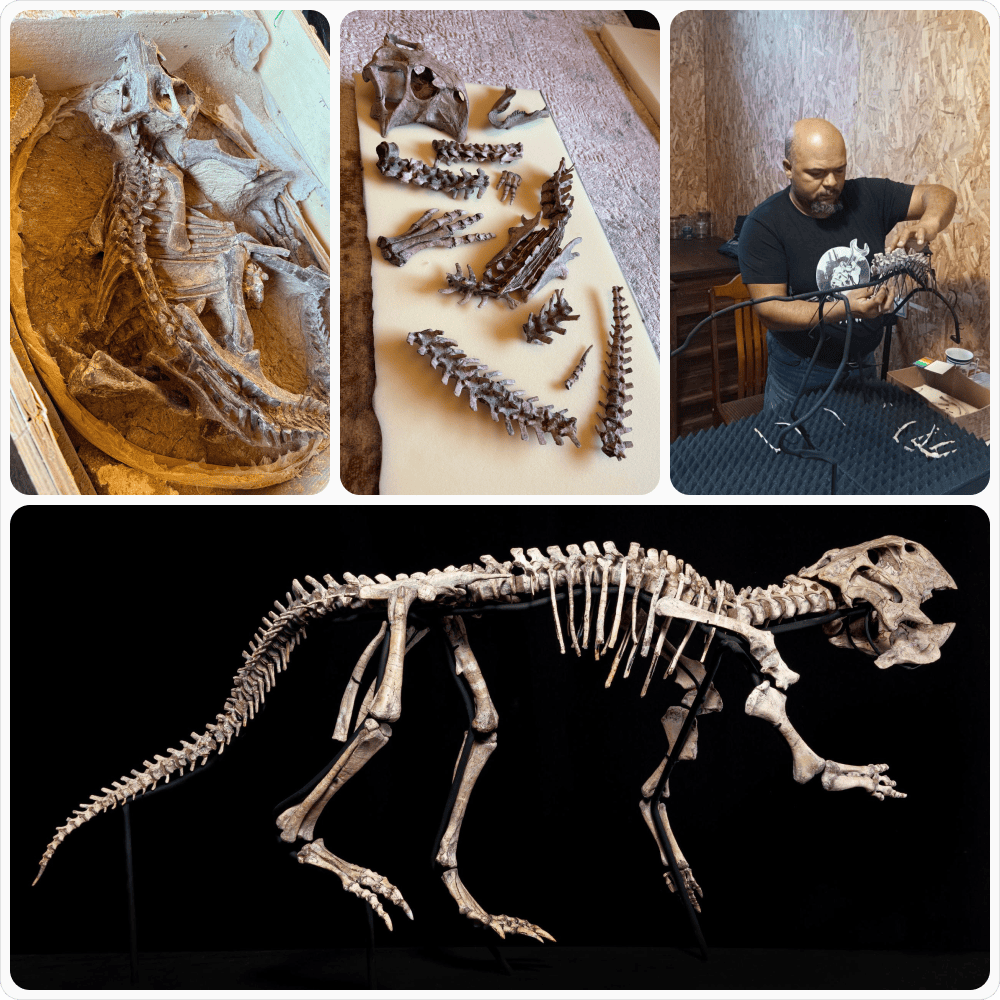
Preparing a Psittacosaurus skeleton for display: removing bones from rock, restoration and mounting.
Provenance Can Make or Break a Sale
Checking provenance protects both the buyer and the transaction. In 2016, U.S. prosecutors announced the seizure of a Tarbosaurus skull that had been illegally exported from Mongolia. It had been sold at an auction in Manhattan in 2007. After its provenance was investigated, the owner agreed to surrender it to the authorities for return to Mongolia.
Before making a purchase, we therefore verify ownership, the specimen’s provenance and whether it can be legally exported. Investing in the preparation of a rare specimen makes economic sense if it can subsequently be sold legally.
Two Years Preparing Apex
The story of the Stegosaurus Apex illustrates the work required before a major sale. Paleontologist Jason Cooper discovered it in 2022 on his property in Colorado, near the town of Dinosaur. Before the July 2024 auction, the specimen underwent excavation, restoration, preparation and mounting.
Sotheby’s specialist Cassandra Hatton worked with Cooper from the time the skeleton was discovered. The auction house documented its preparation, including the preservation of skin impressions and small skeletal elements. The result was a skeleton comprising 254 original bone elements, accompanied by a record of the work carried out.
Seven bidders competed for Apex, which sold for the $44.6 million mentioned earlier. For an investor, however, the costs incurred over the preceding two years also matter: specialist labor, equipment, transport and preparation for sale. The difference between the value of an unprepared find and a finished exhibit needs to cover these costs and reward those who funded the project.
Regolith and Artefactum
Artefactum Gallery was founded in Dubai in 2022. According to the project, its catalog contains more than 120 fossils and paleontological specimens. The gallery also handles meteorites, minerals and other collectibles, sells exhibits and sources rare specimens for clients.
The team selects and acquires paleontological specimens, checks the documentation and arranges the necessary work. Depending on its condition, a find undergoes preparation, conservation, restoration and museum mounting. The team then seeks a buyer among private collectors, galleries and museums. Sales can take place directly, through specialist platforms or at international auctions.
Profit comes from the difference between the acquisition and resale prices, after expenses. The amount paid by a collector needs to cover the purchase, expert assessment, preparation, storage, transport and sale of the specimen. The economics of the entire transaction therefore matter to investors.
Completed Transactions
We have already completed several transactions involving rare fossils.
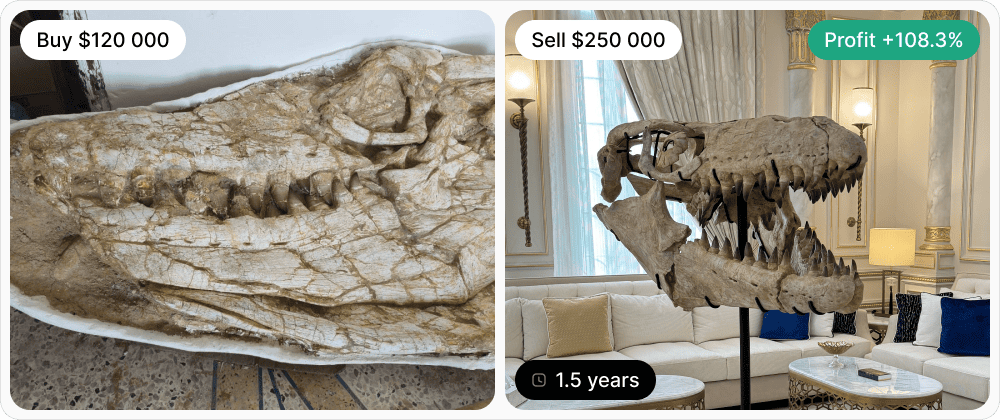
A mosasaur from a completed project transaction: acquired for $120,000 and sold for $250,000 after 18 months.
In one of our completed transactions, a mosasaur skull was acquired for $120,000 and sold 18 months later for $250,000. A Keichousaurus sold for $18,000 against an acquisition cost of $6,000; a buyer was found within three days.
A Triceratops was acquired for approximately $800,000 and subsequently sold for $2 million.
A particularly demanding project involved a 4.2 × 1.8 m slab containing trilobites, ancient marine arthropods. Preparation took around a year. The specimen’s cost was approximately $40,000, and it sold for $350,000. Much of the work before the sale involved exposing and preserving the fossils within the rock.
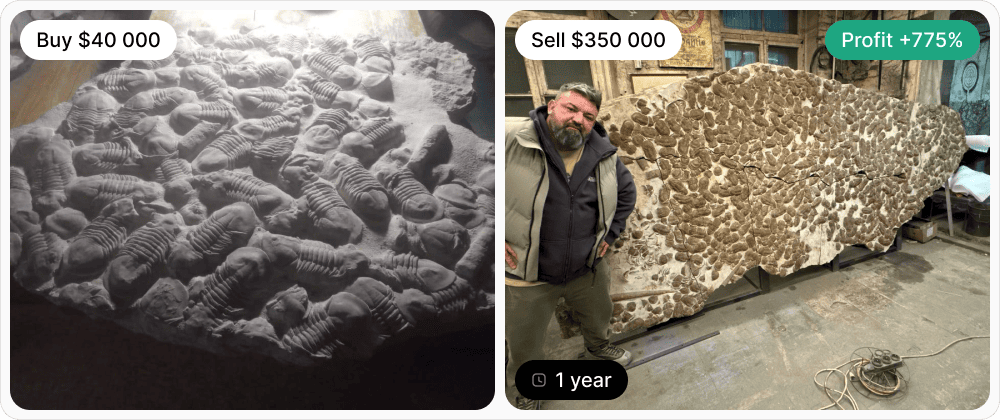
A trilobite slab measuring 4.2 × 1.8 m. Preparation took around a year. Materials from the Regolith and Artefactum Gallery project.
Two Specimens Worth $462,000
Two specimens are currently available, with a combined value of $462,000.
Dunkleosteus Skull – $77,000
Dunkleosteus was an armored predatory fish that lived long before dinosaurs appeared. Rather than conventional teeth, it used the sharp edges of bony plates to cut through prey. Its massive head plates have become a distinctive feature of this prehistoric animal.
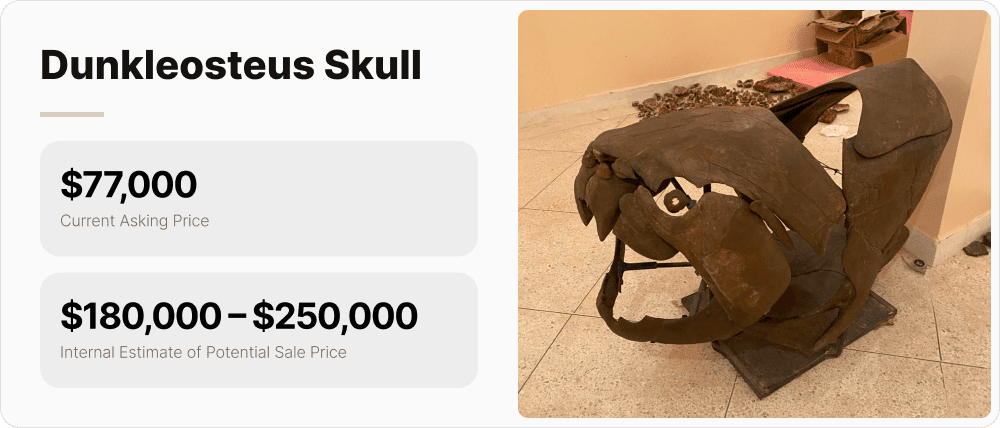
A Dunkleosteus skull in the current offering. $77,000 is the price of the specimen; $180,000–250,000 is the project’s internal estimate of its potential sale price. Materials from the Regolith and Artefactum Gallery project.
The project’s internal estimate of the skull’s potential sale price is $180,000–250,000, roughly 2.3–3.2 times the amount offered for investment in the specimen. This estimate refers to the future sale price before expenses and profit distribution; neither a buyer nor a sale price has been secured in advance.
Triceratops Skull – $385,000
Triceratops is easily recognized by its three horns and broad bony frill. It lived in North America around 66 million years ago. The project offers an opportunity to invest in an individual skull prepared for subsequent sale.
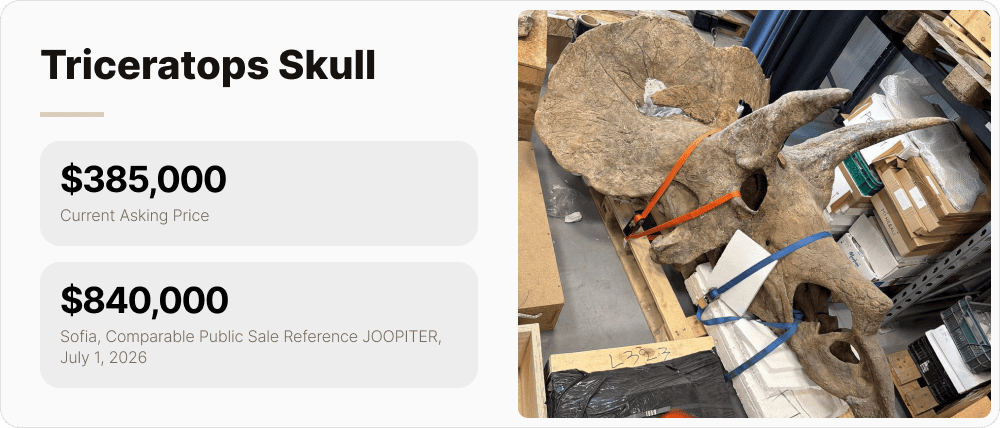
The Triceratops skull in the current $385,000 offering. The $840,000 figure on the card refers to a different skull, Sofia, and is cited by the project as a comparable sale. Materials from the Regolith and Artefactum Gallery project.
JOOPITER provides a public price reference for this category. At an auction that closed on July 1, 2026, the skull of a young Triceratops named Sofia carried a presale estimate of $600,000–800,000. Such comparisons help establish the price range, but differences in preservation, original material and provenance must be considered for each skull.
Gallery Visits and Fieldwork
Participation offers a chance to see the gallery’s work firsthand. Investors contributing $500 or more can visit Artefactum Gallery in Dubai on a tour arranged by appointment.
An investment of $25,000 or more provides access to a seven-day paleontological expedition in Morocco. The itinerary covers the Erfoud, Aoufous and Jbel Issoumour areas. Working with local specialists, participants can search for fossils, take part in field excavations, watch finds being extracted from rock and learn how they are identified. The main focus is trilobites. Investors pay for their own international flights.
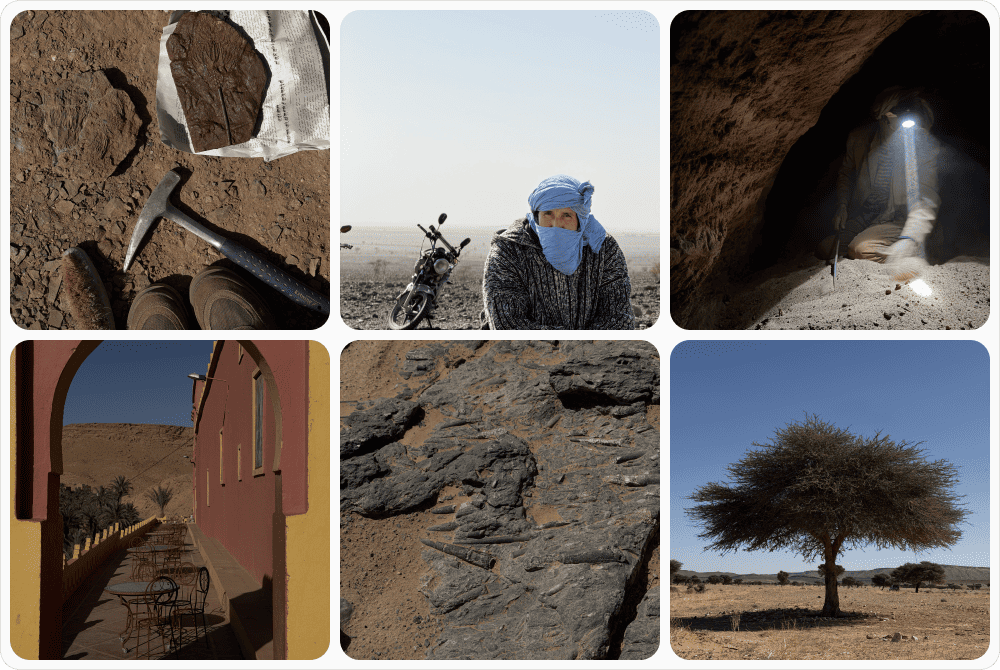
A paleontological expedition in Morocco. Materials from the Regolith and Artefactum Gallery project.
A visit to the gallery or an excavation site makes it easier to appreciate the work needed to turn a find into a finished exhibit. The project’s investment approach follows the same process: select a suitable specimen, prepare it and sell it to a buyer willing to pay for its rarity, preservation and documented history.
Available specimens and full participation terms for the Regolith and Artefactum Gallery project.
