

Kraken Grew Revenue by 17% and Continued Expanding Its Business in the Second Quarter
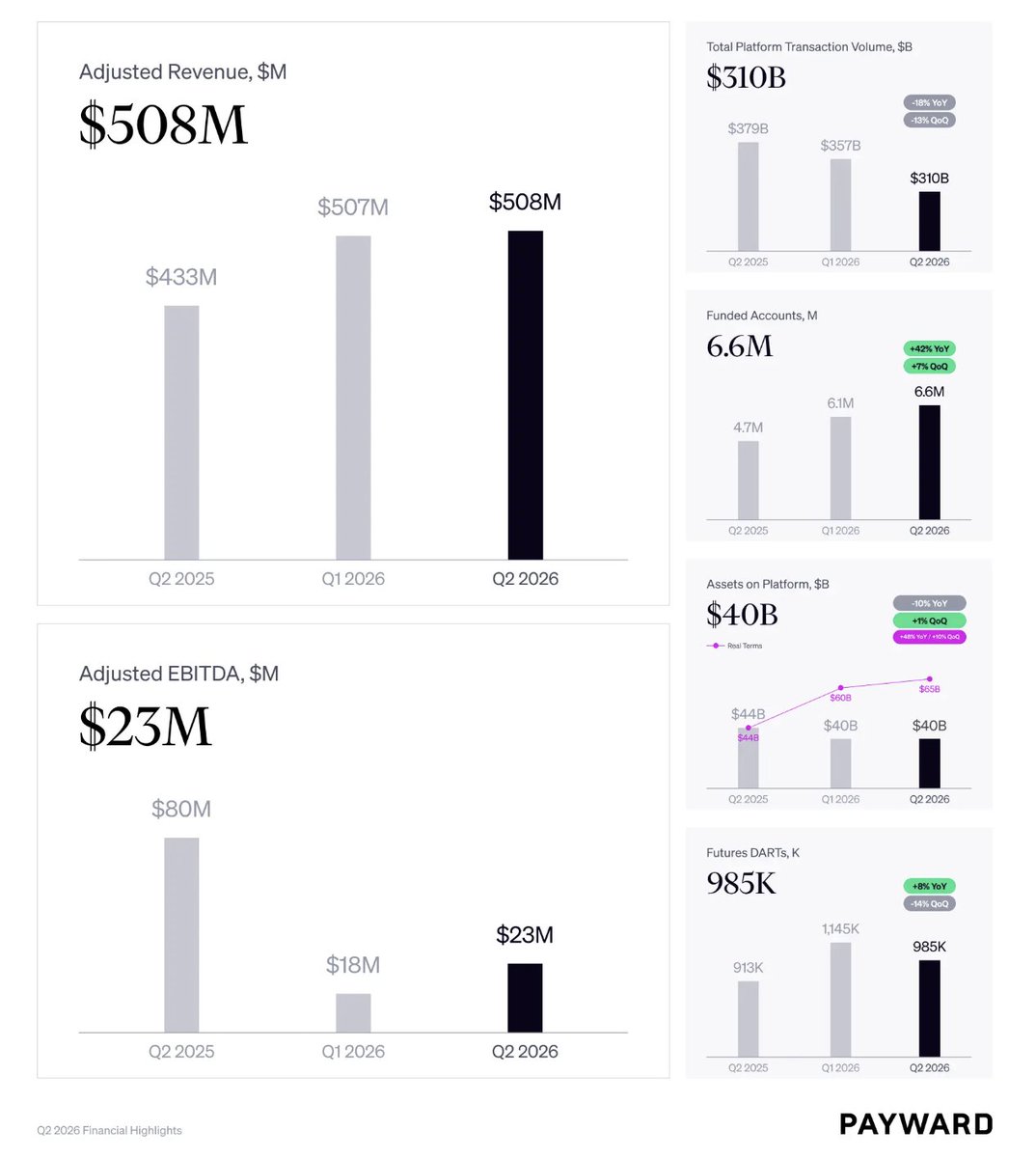
Payward, the parent company of Kraken, closed the second quarter with adjusted revenue up 17% year over year to $508 million. At the same time, total transaction volume fell 13% to $310 billion, while spot crypto trading volumes across the broader market declined by nearly 28% during the quarter.
For Kraken, this is an important result. The company continued to grow while its core market remained under pressure. At the same time, Payward is expanding well beyond the traditional crypto exchange model, developing futures, tokenized equities, payments infrastructure, B2B services, and other businesses.
By the end of 2025, trading accounted for just 47% of Payward’s revenue, while the remaining 53% came from other areas, including custody, payments, and financing.
Key Q2 Results
Payward reported $508 million in adjusted revenue, up 17% from a year earlier. Quarter over quarter, however, revenue was almost unchanged from $507 million in Q1.
The number of funded accounts increased to 6.6 million, up from 6.1 million in the previous quarter, while assets on the platform remained at around $40 billion. Transaction activity moved in the opposite direction. Payward’s total transaction volume fell to $310 billion from $357 billion in Q1. The broader crypto market was already under pressure in the first three months of the year, when spot trading volumes fell 38% and Bitcoin lost 22% during the quarter.
For a crypto exchange, the combination is notable: trading volumes are falling while revenue continues to grow. It is one of the clearest signs that Kraken’s business mix is changing.
Payward financial results for Q2 2026. Source: Payward official report
Kraken Is Diversifying Its Revenue
A few years ago, Kraken was primarily associated with cryptocurrency trading. Today, Payward is building a broader financial infrastructure business.
In 2025, adjusted revenue reached $2.2 billion, up 33%, while total transaction volume grew to $2 trillion. Trading generated just 47% of revenue. The remaining 53% came from custody, payments, financing, and related services.
That diversification becomes particularly important during weaker periods for the crypto market. The less revenue depends on spot trading activity, the less exposed the business is to fluctuations in trading volumes.
In Q1 2026, Payward also reported strong growth in futures. The number of daily futures trades increased 51% year over year, supported by the acquisitions of NinjaTrader and Breakout, as well as the expansion of Kraken’s own derivatives offering.
xStocks Is Becoming a Business of Its Own
One of Kraken’s most notable new products is xStocks, tokenized versions of US stocks and ETFs.
The platform offers more than 100 stocks and funds, including Apple, Nvidia, and other major public companies. For clients outside the US, xStocks provide economic exposure to traditional assets through Kraken’s blockchain infrastructure.
In February 2026, Kraken expanded the product by launching perpetual futures on tokenized equities. Eligible verified clients outside the US can now trade contracts on Nvidia, Apple, Tesla, Alphabet, the S&P 500, Nasdaq 100, and other assets around the clock.
Another step is tokenized IPO access. In June, Payward announced plans to allow retail investors to submit orders for US IPOs at the offering price through xStocks and receive tokenized allocations after the company goes public.
Kraken is therefore moving further into areas that traditionally sat outside the crypto exchange business, including stocks, ETFs, IPOs, and derivatives linked to conventional financial assets.
Launch of Kraken Derivatives US for futures trading in the United States. Source: Kraken
Payward Is Building Infrastructure for Other Companies
Another part of the expansion beyond retail trading is Payward Services.
The company has launched a B2B platform for banks, fintech companies, brokers, and payment providers. Through a single infrastructure layer, partners can access stablecoin payments, tokenized assets, crypto trading, staking, lending, and fiat settlement.
This allows Payward to monetize Kraken’s technology not only through its own users, but also through external financial institutions. The business model is gradually changing as a result. Kraken is becoming an infrastructure provider for other market participants alongside its existing role as a trading platform.
Expanding Banking Infrastructure
In the spring, Kraken took an important step toward direct access to the US banking system.
Kraken Financial became the first digital asset bank in the US to receive limited access to a Federal Reserve master account. This enables it to connect directly to key US payment systems, including Fedwire, without necessarily relying on intermediary banks. The initial rollout is expected to focus on institutional clients.
Direct access to payment infrastructure can help Kraken reduce its reliance on third-party banks and handle fiat transfers more efficiently.
At the same time, the company continues to expand its regulatory footprint. In the first half of 2025, Payward secured MiFID and EMI licenses in the UK, followed by MiCA authorization in Europe during the summer.
Growth Is Still Expensive
Despite the positive revenue trend, profitability has remained one of the weaker areas in recent quarters.
Adjusted EBITDA reached about $23 million in Q2. That was 28% higher than the $18 million reported in Q1, but still well below the levels Payward generated across 2025.
For the full year 2025, adjusted EBITDA reached $531 million, up 26%. At the start of 2026, the company increased spending on M&A, customer acquisition, new product launches, AI tools, and regulatory infrastructure. In Q1, Payward directly attributed the lower EBITDA level to continued investment in growth.
The picture is therefore mixed. Revenue and the customer base are growing, and the business is becoming more diversified, but that expansion is also requiring significant investment.
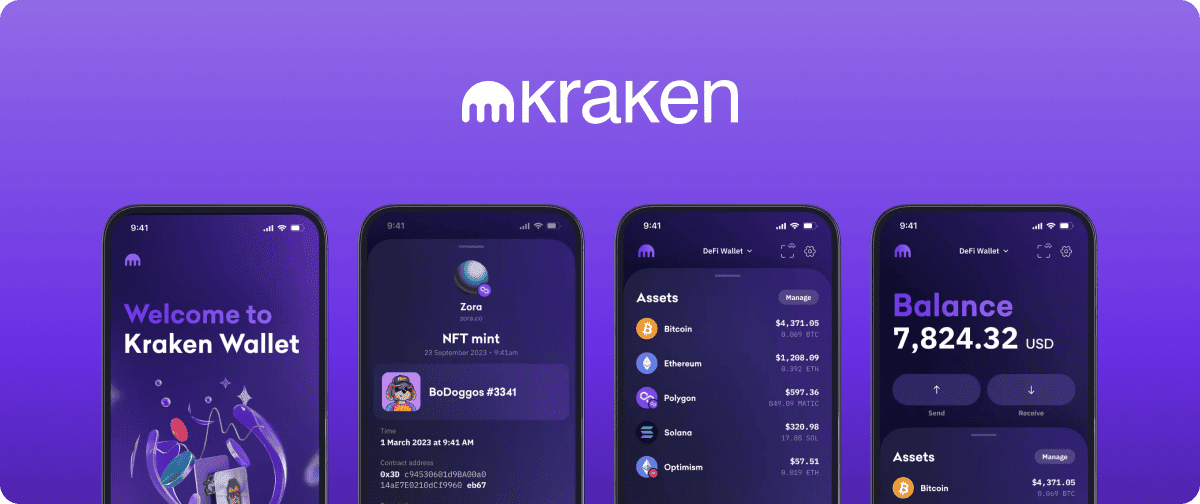
Kraken Wallet mobile interface
M&A as Part of the Growth Strategy
Acquisitions are another important part of Kraken’s expansion. In 2025, Payward acquired NinjaTrader, strengthening its position in futures trading, as well as Breakout, Small Exchange, and Capitalise.ai. In early 2026, the company completed its acquisition of Backed, bringing the issuance, trading, and settlement of xStocks closer together within the same infrastructure.
In Q1, Payward also named Magna, Bitnomial, and Reap among its latest acquisitions, covering areas such as tokenization, derivatives, and global payments.
Kraken is using acquisitions to steadily broaden its business, moving from crypto trading into payments, derivatives, and tokenized assets.
What Is Happening With Kraken’s IPO?
Kraken confidentially filed for a US IPO in November 2025. At the time, the company was valued at around $20 billion following a funding round involving Jane Street and Citadel Securities.
The listing was initially expected in the first quarter of 2026, but reports in March indicated that Kraken had paused the process because of unfavorable market conditions. The company continues to consider an IPO but has not announced a new date.
Kraken has already laid much of the groundwork for a public listing, but the timing will depend on market conditions. Against that backdrop, the second-quarter results matter: revenue and the customer base are growing, while profitability remains relatively weak.
On the positive side, Payward has shown that it can grow revenue even when crypto trading activity declines. The company is expanding its customer base and building new sources of revenue outside the spot market.
At the same time, adjusted EBITDA remains relatively modest, while the broader expansion requires substantial investment. Ahead of a potential IPO, investors will likely focus on whether Payward can combine growth in its new businesses with stronger profitability.
Kraken is preparing for a potential public listing in the US
Kraken by the Numbers
Based on the latest available figures:
- Adjusted revenue, Q2 2026: $508 million
- Year-over-year growth: +17%
- Transaction volume: $310 billion
- Funded accounts: 6.6 million
- Assets on the platform: approximately $40 billion
- Adjusted EBITDA: $23 million
- 2025 revenue: $2.2 billion
- 2025 adjusted EBITDA: $531 million
- Share of 2025 revenue from non-trading businesses: 53%
What Comes Next
Kraken increased revenue by 17% year over year in Q2 even as crypto trading activity declined and Payward’s overall transaction volume fell. That suggests the company’s growth is becoming less dependent on spot trading alone.
Behind that shift is a broader transformation of the business. Kraken is expanding futures, xStocks, and access to traditional assets, while also building B2B infrastructure and strengthening its payments capabilities.
The key question now is whether Kraken can improve profitability and return to its IPO plans once market conditions become more favorable.
Regolith currently offers access to pre-IPO Kraken, with entry available from $68 per share.
This material is provided for informational purposes only and does not constitute individual investment advice.
