

$100 Billion Is the New $10 Billion: How Private Companies Reach $100B Before Going Public
A decade ago, technology companies typically went public well before they became giants. Venture capital funded their early years, an IPO opened access to a much larger pool of capital, and much of the company’s subsequent growth happened in the public markets.
Today, more companies are reaching valuations once associated with major public corporations while they are still private. ByteDance was one of the first prominent examples, crossing the $100 billion mark in 2020. OpenAI, Anthropic, xAI, Stripe, Databricks, and Revolut later joined that group.
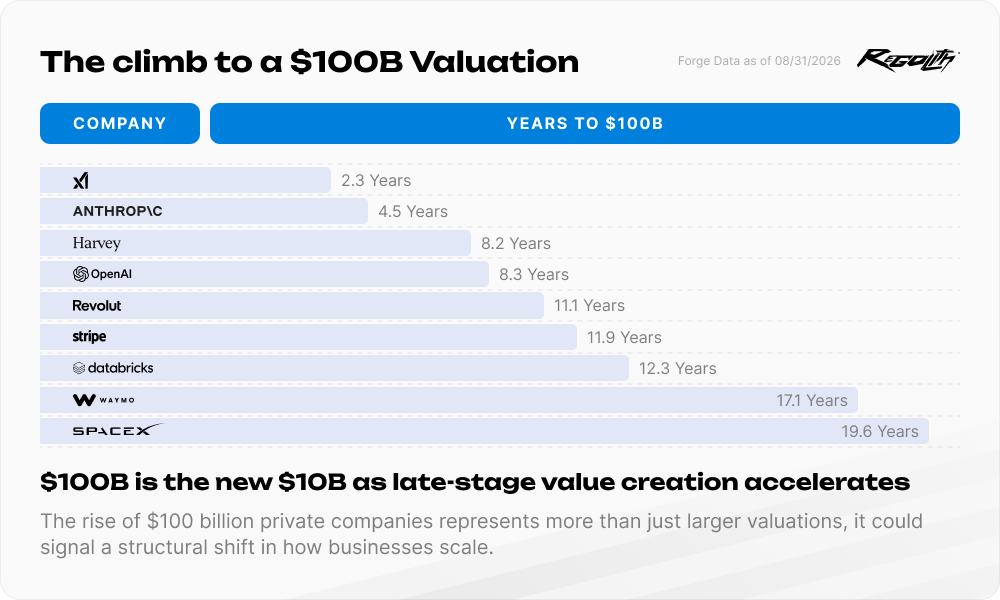
The shift is particularly striking when measured by the time it takes to reach a $100 billion valuation. SpaceX took nearly 20 years. xAI, founded by Elon Musk in 2023, took about 2.3 years.
Below, we look at why the path to $100 billion has become much shorter and what that means for private markets.
Who Reached $100 Billion the Fastest?
According to Forge data as of July 31, 2026, xAI reached a $100 billion valuation faster than any other company in the group, in roughly 2 years and 4 months from its founding. Anthropic took about 4 years and 6 months, ByteDance just over 8 years, and OpenAI roughly 8 years and 4 months.
For an earlier generation of companies, the journey was considerably longer. Revolut took around 11 years, Stripe nearly 12, Databricks just over 12, Waymo about 17, and SpaceX almost 20 years.
The gap shows how dramatically the timeline to a major private-market valuation has compressed. What once took decades can now happen within the first few years of a company’s life.
Why Companies Are Scaling Faster
The first driver is technology itself. AI companies can reach global markets quickly, acquire users at scale, and expand software sales without spending years building factories, logistics networks, or other capital-intensive physical infrastructure.
The second is access to capital. Late-stage private companies now attract funding not only from venture capital firms, but also from private equity funds, sovereign wealth funds, corporations, family offices, and other large institutional investors. The most sought-after companies can raise billions of dollars without entering the public markets.
That gives fast-growing businesses greater flexibility over when they choose to list. Companies that can fund their expansion privately can remain private for longer and time an IPO around their own strategy and market conditions.
Billions in Capital Without an IPO
In the past, large technology companies often needed to go public to fund the next phase of growth. Today, a meaningful share of that capital can be raised privately through increasingly large late-stage financing rounds.
At the same time, the secondary market is expanding. Employees, founders, and early investors can sell part of their holdings before a listing, while new investors can gain exposure to companies that have already reached significant scale.
As a result, transactions in mature private-company shares are becoming more frequent. Valuations are increasingly shaped not only by new funding rounds, but also by prices in secondary transactions.
Secondary-Market Pricing Is Moving Closer to Funding Rounds
In 2022 and 2023, private-company shares often changed hands at substantial discounts to valuations set in the latest funding round. At the weakest point, that gap reached roughly 50%.
By mid-2026, the discount had narrowed significantly. In July, the median secondary transaction on Forge was priced about 7% below the latest primary-round valuation, while in June the median price was effectively at par.
The picture still varied considerably by company. In July, a quarter of secondary transactions were priced at least 34% below the latest funding-round valuation. Among the 10% of transactions with the deepest discounts, the gap reached roughly 57%.
In other words, some private companies were already trading close to their latest funding-round prices, while investors required substantial discounts to buy others.
That points to a more selective market, where pricing increasingly depends on the quality of the individual business, investor demand, and the terms of each transaction.
Private Markets Outperformed in July
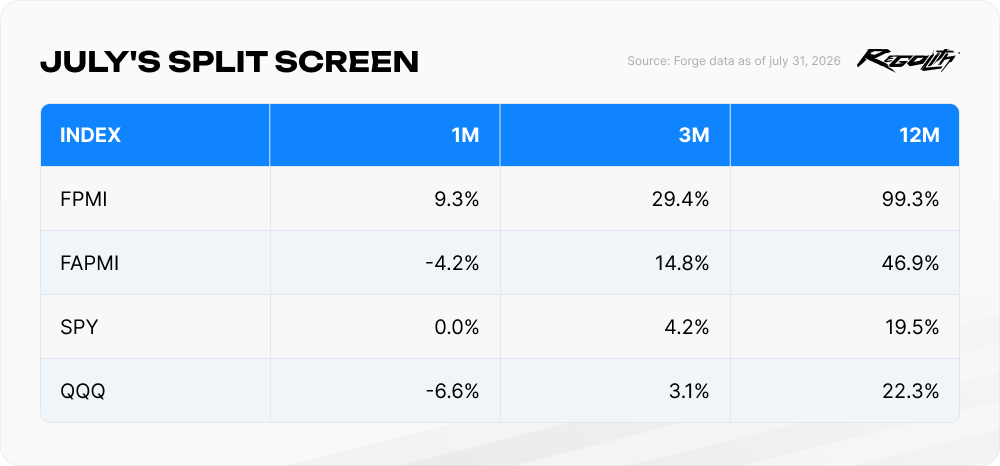
July 2026 highlighted the divergence between private and public market performance. The Forge Private Market Index (FPMI), which tracks private companies traded on Forge, gained 9.3% in one month, 29.4% over three months, and 99.3% over 12 months.
For comparison, SPY, the ETF tracking the S&P 500, gained 19.5% over the same 12-month period, while QQQ, which tracks the technology-heavy Nasdaq-100, rose 22.3%. In July itself, SPY was essentially flat and QQQ fell 6.6%.
That means companies represented in Forge’s private-market index appreciated much faster over the period than the large public companies represented by the S&P 500 and Nasdaq-100.
This does not mean, however, that every private technology company rose at the same time.
July Performance Varied Widely by Company
Private-market gains were highly uneven. The strongest performer in Forge’s July sample was SambaNova Systems, a developer of AI chips and computing infrastructure. Its valuation rose 142.9% following the first close of a $1 billion Series F at an $11 billion post-money valuation.
Several other technology companies also posted strong gains. Neuralink rose 98.4%, autonomous-delivery company Zipline International gained 59.5%, enterprise software developer Harness added 35.7%, and defense technology company Anduril rose 20%. Rippling, Ayar Labs, and Lyten also finished the month significantly higher.
Several companies moved in the opposite direction. API platform Postman fell 24.9%, Airtable declined 24.5%, Kraken dropped 19.8%, and photonic-chip developer Lightmatter lost 16.8%.
The dispersion shows that investors are differentiating sharply between individual companies. Businesses supported by strong financing rounds or operating progress can command higher prices, while weaker demand or changing expectations can push valuations lower. As secondary trading becomes more active, pricing for individual private companies becomes increasingly visible.
Sellers Are Returning to the Market
Seller activity on Forge increased noticeably in July. Buy-side interest accounted for 57% of new and updated indications of interest in June, but that share fell to 48% in July. Buyer and seller activity was therefore close to evenly balanced.
A market with more active participants on both sides tends to generate more transactions and more frequent price updates. That gives investors a clearer indication of what private-company shares are currently worth and makes the market less dependent on valuations established during the latest funding round.
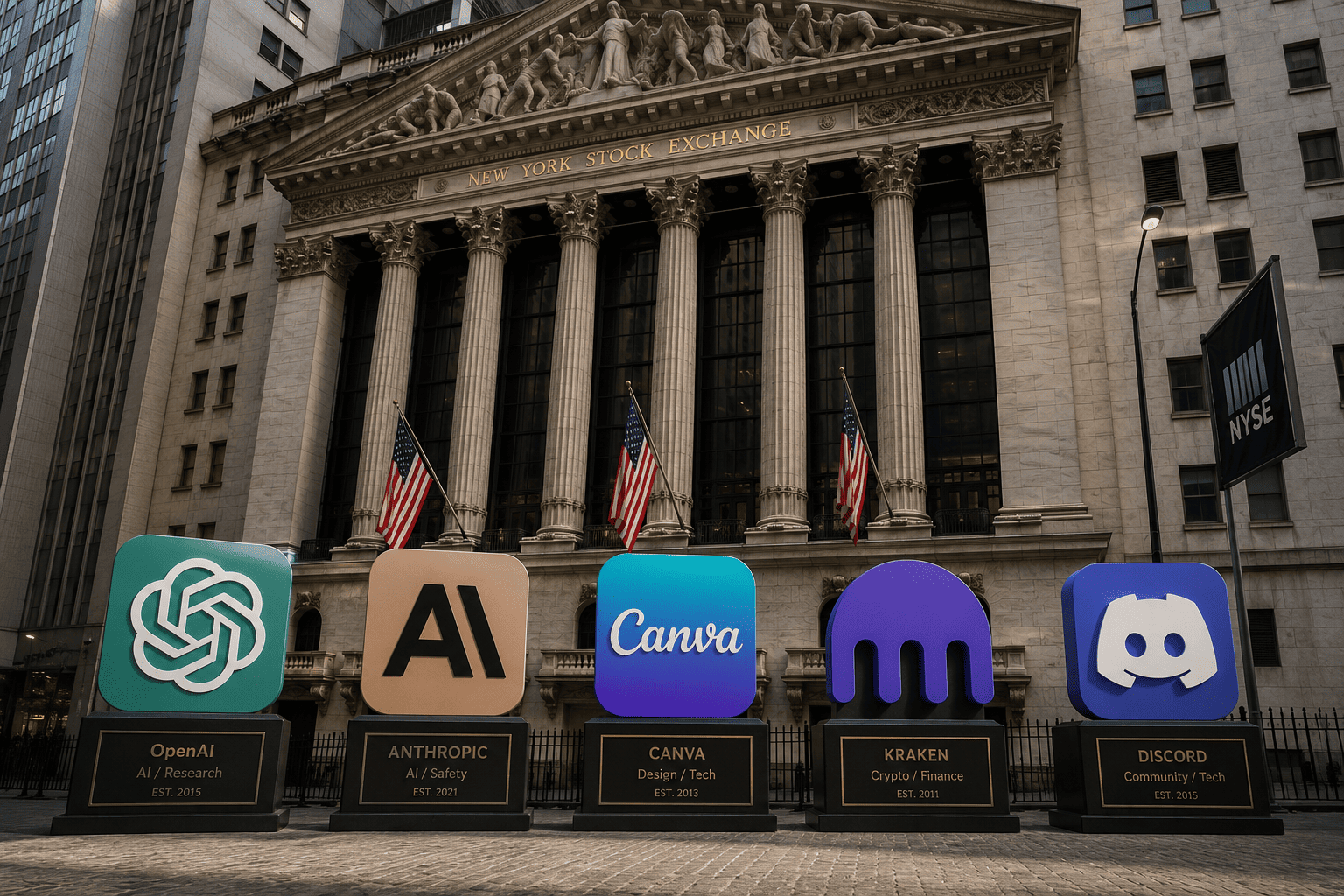
IPOs Are Moving Later in the Company Lifecycle
Technology companies once tended to go public relatively early, leaving a significant portion of their growth for the years after listing. Public-market investors gained access while the business still had years of expansion ahead.
Today, more major companies are approaching a potential IPO with valuations of $100 billion, $300 billion, or more. As a result, a much larger share of both business growth and valuation appreciation can occur while the company is still private.
The role of the IPO is therefore evolving. It remains a way for companies to raise capital and gain public-market liquidity. For early shareholders, it can provide an opportunity to realize part of their holdings after years of private-market growth. Public investors, meanwhile, may gain access at a considerably more mature stage of the company’s development.
The Next Trillion-Dollar Company Could Still Be Private
Not long ago, the idea of a privately held company worth $1 trillion would have seemed highly improbable.
Today, the scenario is easier to imagine. If large pools of private capital remain available and secondary-market liquidity continues to develop, a technology company could theoretically reach a $1 trillion valuation before an IPO or shortly after listing.
AI companies have already demonstrated how quickly private businesses can scale. SpaceX took almost two decades to reach $100 billion. xAI did it in just over two years.
But a high valuation alone says little about the quality of an investment. A company worth $100 billion can still be either an excellent or a poor entry point. Revenue quality, margins, governance, capital intensity, dilution, competitive durability, and above all the price paid still matter.
Even when an investor correctly assesses the company’s long-term prospects, buying at the wrong valuation can materially reduce future returns.
Why Investors Are Paying More Attention Before IPO
A large market of mature private companies has developed between early-stage venture funding and the public markets. Many of these businesses already have established products, large customer bases, and meaningful revenue while still growing rapidly.
Part of the interest in OpenAI, Anthropic, Revolut, Databricks, Stripe, and Neuralink comes from the fact that they have already reached significant scale while remaining private. A substantial portion of their growth is occurring before they reach the stock market.
Public investors once gained exposure to technology businesses at an earlier stage of development. Today, a company can arrive on the stock exchange already valued in the tens or hundreds of billions of dollars.
Outcomes still vary widely. Some companies list relatively quickly, others remain private for years, and high private-market valuations can be revised. That makes the underlying business, current valuation, and entry price as important as the prospect of an eventual IPO.
A decade ago, a $10 billion valuation was exceptional for a private company. Today, for a small group of technology leaders, $100 billion is increasingly becoming another stage of growth rather than the finish line. That makes it increasingly important to assess companies before IPO by looking at where they are in their development, the valuation at entry, and the potential for further growth.
This material is provided for informational purposes only and does not constitute individual investment advice. Private-market data is based primarily on Forge information as of July 31, 2026.
