

Regolith income funds: H1 2026 results, key performance highlights and major strategic developments
In the first half of 2026, Regolith’s income funds developed along different paths. TRX Staking Fund and Real Estate Rental Fund maintained regular payouts, SLAT Fund successfully launched a new strategy, Mining Fund continued to generate positive returns in challenging market conditions, while Auto Fund focused on preserving asset value until demand recovers.
The funds rely on very different sources of income. Some depend on cryptocurrency prices and blockchain network parameters, while others are driven by rental payments, trading strategies, or real assets. Each fund’s performance should therefore be assessed based on the factors behind its returns and how sustainable those factors may be in the second half of the year.
TRX Staking Fund: +19.95% including TRX appreciation
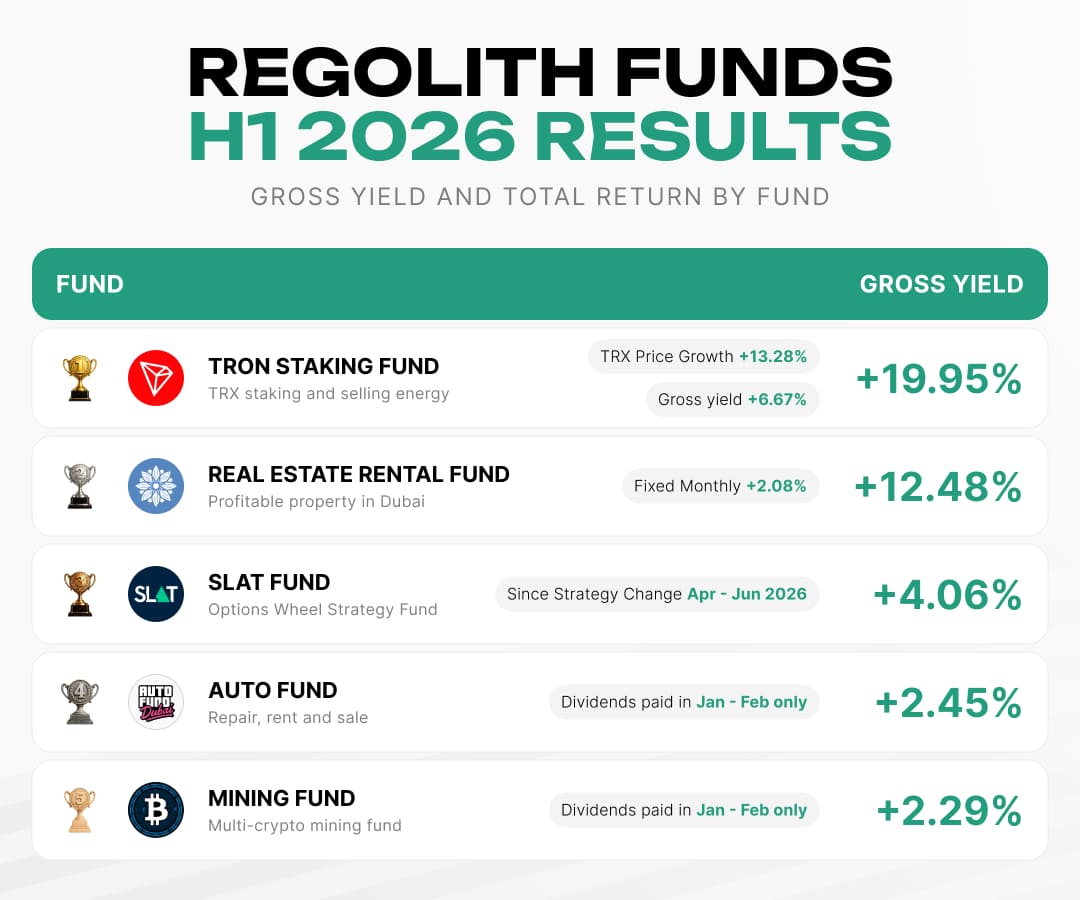
TRX Staking Fund delivered the strongest total result in the first half of the year. Since the beginning of 2026, the price of TRX has increased by 13.28%, while the fund generated an additional gross return of 6.67% from staking and energy sales. Combined, these two sources brought the position’s total return to 19.95%.
The fund generates income from two sources. TRX is placed in TRON’s native staking mechanism, earning rewards for voting for network validators. At the same time, staked tokens generate energy, a network resource required for smart contract transactions, including TRC-20 USDT transfers. The fund provides this energy to wallets, exchanges, trading platforms, and payment services, helping them reduce transaction costs.
Payout levels gradually change as network parameters are adjusted. The base staking reward has declined, while the amount of energy generated by one TRX has fallen from approximately 20 units to around 9–10 units. Energy sales still provide a meaningful uplift compared with standard staking, but the final return depends on the amount of available energy and demand from network participants.
The fund distributed 1.27% in May and 1.21% in June. Over the 15 months since launch, dividend income reached 20.09% in USD, TRX appreciated by 42.53%, and the combined result reached 62.62%.
Demand for energy is supported by high activity across the TRON network. More than $86 billion in USDT is issued on TRON, while June set new monthly records, with 26.97 million active accounts and 385.77 million transactions.
In the second half of the year, the fund’s performance will depend on the price of TRX, network reward parameters, and demand for energy. Payout levels may change as conditions within the TRON ecosystem evolve.
Real Estate Rental Fund: +12.48%
Real Estate Rental Fund generates income from residential properties in Dubai. The fund takes buildings under management, leases individual units to tenants, and distributes the resulting income to investors. It delivered the highest gross return among strategies whose performance does not include appreciation of an underlying asset.
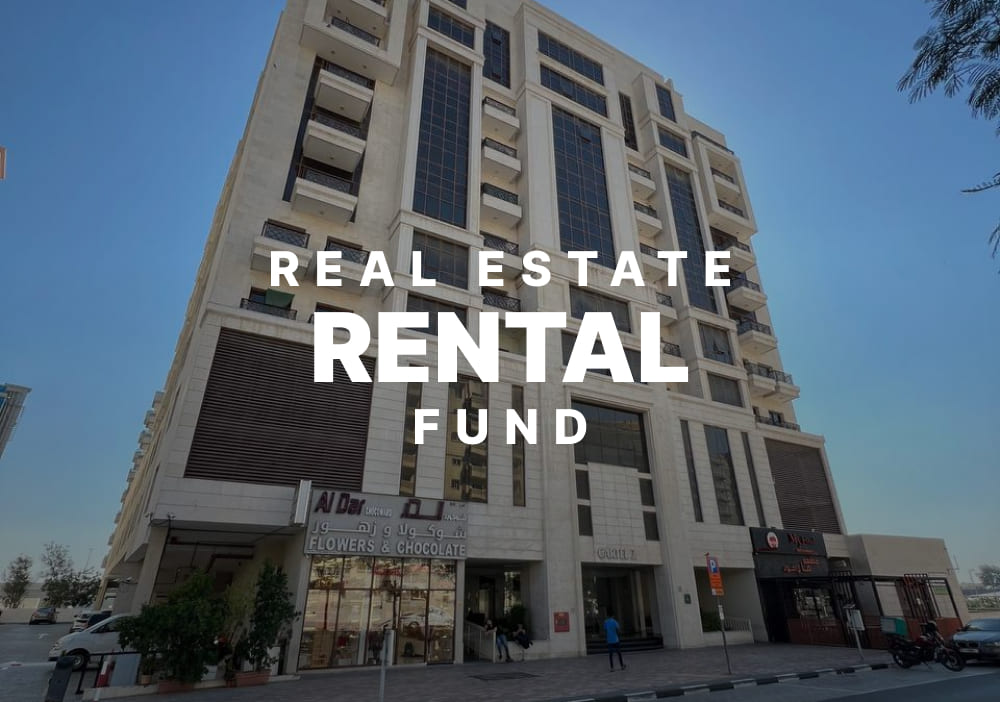
The fund distributed 12.48% in dividends during the first half of the year, equivalent to 2.08% per month. The result was supported by a stable operating model: all units remained occupied, there were no vacant apartments, and overdue rental payments stayed below 2–3%. Revenue remained stable during the first quarter. Additional resilience comes from long-term annual leases, some of which are paid directly by tenants’ employers.
Current market conditions are also creating favorable opportunities for expansion. Rental rates in Dubai are declining, while property owners are increasingly willing to offer longer grace periods during which the fund can use a property without making rental payments. For the latest building, the management company secured a seven-month grace period. According to the fund’s team, each additional month improves the property’s economics by approximately AED 500,000.
Further potential comes from growing demand among corporate tenants that are prepared to lease entire floors or buildings under contracts lasting three years or more.
In the second half of the year, the fund expects to maintain regular payouts. New properties secured on more favorable terms could provide an additional growth driver.
SLAT Fund: +4.06% following the strategy change
At the beginning of the year, SLAT Fund completed the wind-down of its previous strategy, closing positions with a 25.4% loss. The main pressure came from hedging positions opened in anticipation of a market decline. Against a backdrop of sharp and inconsistent price movements, those positions failed to provide the intended protection.
All legacy positions were closed. In April, the fund switched to an options-based Wheel strategy under the management of a new trader.
During its first three months, the new strategy generated a gross return of 4.06%: 0.71% in April, 1.34% in May, and 2.01% in June.
Returns increased each month, with June becoming the strongest period since the strategy was relaunched. The fund closed 13 trades during the month, 12 of which were profitable, producing a win rate of 92.31%. Tesla was the main contributor: all eight closed TSLA trades ended in profit.
The strategy generates income by selling options on liquid assets, including Tesla, Nvidia, Apple, SoFi, Marvell, and the S&P 500 index. At the end of June, five open positions were carried into July, so their results will be reflected once they are closed.
The first three months of the new model have been positive, although the observation period remains short. In the second half of the year, the key priorities will be maintaining positive momentum over a longer period and gradually reducing the strategy’s dependence on individual tickers.
Mining Fund: +2.29%
Mining Fund generated a gross return of 2.29% during the first half of the year. Among the funds that operated throughout all six months, this was the lowest result.
The fund distributed 0.63% in May and only 0.17% in June. The decline was caused by worsening mining economics. Bitcoin fell by around 15% in June and traded below $60,000, while electricity costs remained elevated.
Hashprice, which measures a miner’s revenue per unit of computing power, fell below $30 per PH/s. As profitability declined, some less efficient market participants began shutting down equipment, reducing the network’s total hash rate and lowering mining difficulty by approximately 10%. The fund’s equipment remained operational, while the decline in difficulty slightly improved mining conditions, although the low BTC price continued to weigh on profitability.
The fund’s equipment continues to operate profitably, although margins remain minimal. Since its launch in November 2024, Mining Fund has generated a cumulative return of 42.64%.
In the second half of the year, performance will depend directly on the price of Bitcoin, network difficulty, and electricity costs. A recovery in BTC could quickly improve returns. Should the price decline further, some capacity may be temporarily suspended.
Auto Fund: +2.45% amid a slower Dubai car market
Auto Fund generates income through the automotive business in Dubai. The fund distributed 2.45% in dividends for January and February. No payouts were made from March onward because the slowdown in the market resulted in too few completed sales to generate distributable profit.
The vehicles remain on the fund’s balance sheet, and the assets have been preserved. The management company continues to arrange viewings and conduct negotiations, but buyers remain cautious, delay decisions, or seek substantial discounts.
The fund has deliberately avoided selling vehicles materially below market value. This approach slows capital turnover but prevents unnecessary losses from being locked in during a weak market.

Additional pressure came from regional instability and the traditional summer slowdown in the UAE automotive market. At the same time, interest is gradually returning: new inquiries are coming in, viewings are taking place, and negotiations are ongoing for several vehicles.
In the second half of the year, the resumption of payouts will depend on completing new sales and generating profit. The fund is currently focused on preserving the value of its vehicle portfolio and selling assets without a significant discount.
What the first half of the year showed
TRX Staking Fund led the group in total return, delivering 19.95% during the first half of the year. A significant portion of this result came from the appreciation of TRX, while dividends from staking and energy sales contributed 6.67%. The final figure therefore reflects both the performance of the strategy and the change in the value of the underlying asset.
Real Estate Rental Fund delivered the highest gross return generated directly by the fund’s core operations. Over six months, it distributed 12.48% in dividends, equivalent to 2.08% per month. The result was supported by full occupancy, low payment arrears, and stable rental income under long-term agreements.
SLAT Fund transitioned to a new trading strategy in April and completed its first three months with a positive result. Gross return over this period reached 4.06%, with each month ending in profit. This represents a positive start, although a longer track record across different market conditions will be required for a more complete assessment.
Mining Fund maintained positive returns despite the decline in BTC, lower hashprice, and weaker mining economics. The fund’s equipment remained operational, while the reduction in network difficulty partly offset pressure on profitability. Returns remain moderate, but the result demonstrates the resilience of the operating model in an unfavorable market environment.
Auto Fund distributed 2.45% in dividends for January and February. No payouts were made in the following months because of the slowdown in Dubai’s automotive market and the absence of a sufficient number of completed sales. Rather than selling vehicles quickly at a substantial discount, the fund focused on preserving the value of its portfolio. The team continues to arrange viewings and negotiate with potential buyers, while the resumption of payouts will depend on completed sales and the generation of distributable profit.
In the second half of the year, the key factors shaping fund performance will include the prices of TRX and BTC, reward parameters within the TRON network, the stability of rental payments, the continued effectiveness of SLAT Fund’s updated strategy, and a recovery in activity across Dubai’s automotive market. Results in the second half may therefore differ materially both across the funds and from their performance during the first six months.
Gross returns are stated before applicable fees. The figures presented reflect past performance and do not guarantee future returns. Actual results depend on market conditions, strategy execution, and other risk factors specific to each fund.
