

SpaceX Nearly Doubles Revenue After IPO as Starlink Accelerates and AI Starts to Pay Off
SpaceX’s first public earnings report showed strong growth across all of its core businesses. Revenue rose 92%, Starlink’s customer base doubled, enterprise and government revenue more than doubled, and the AI segment posted positive adjusted EBITDA for the first time. At the same time, record spending on data centers and computing infrastructure made one thing clear: the next stage of SpaceX’s growth will require enormous investment.
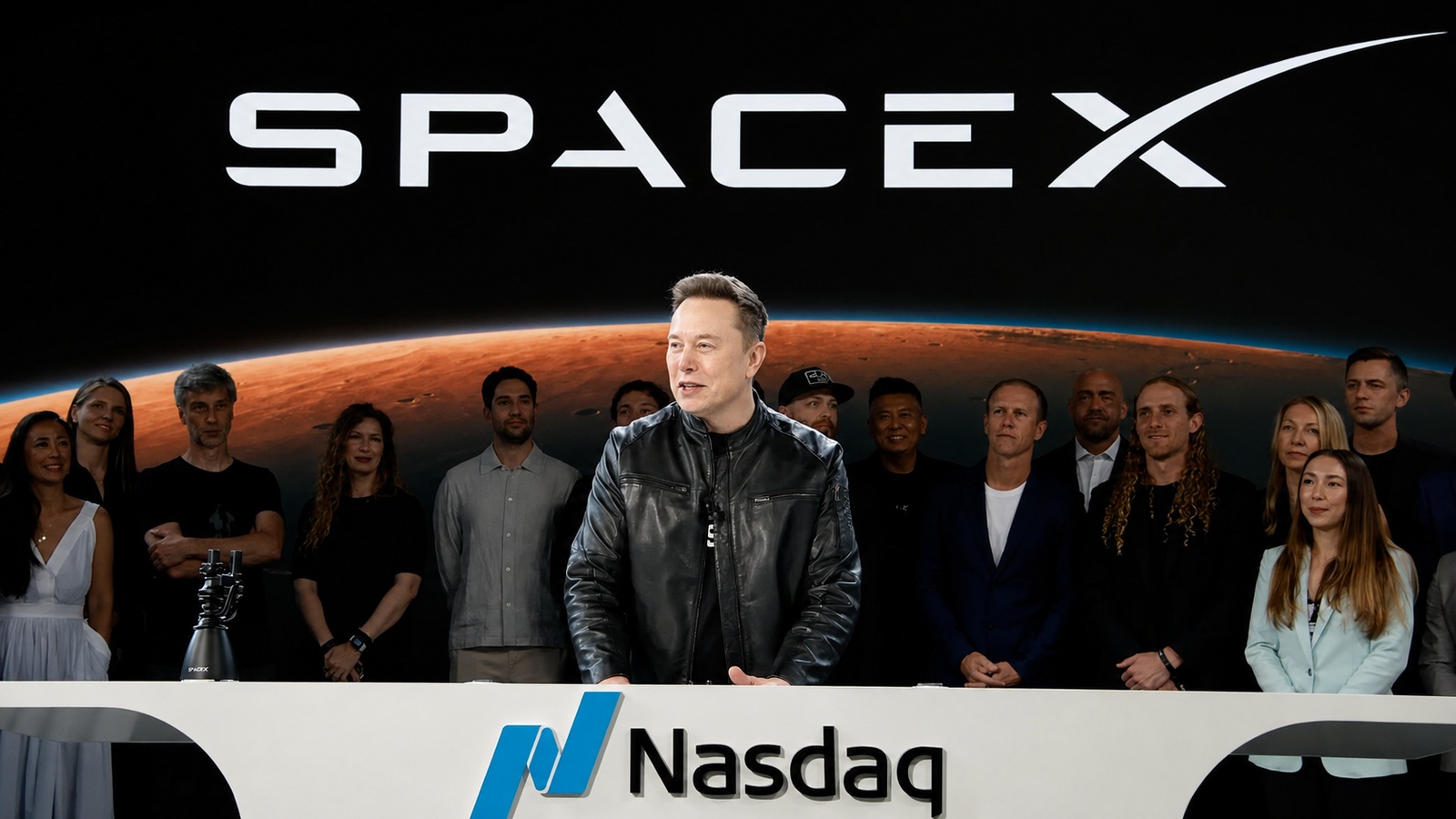
On August 4, SpaceX reported its second-quarter 2026 results. It was the company’s first financial report since its June Nasdaq listing and the first opportunity for public-market investors to take a detailed look at a business spanning rocket launches, satellite internet, government contracts, and artificial intelligence.
The results beat expectations across most major metrics. Quarterly revenue reached $7.8 billion, up from $4.1 billion a year earlier. Net loss nearly halved, from $1 billion to $541 million, while adjusted EBITDA rose 191% to $3.5 billion. For the first half of the year, SpaceX generated $12.5 billion in revenue.
Shares fell following the report. The concern was not weak operating performance but capital expenditures, which increased more than sixfold to $18.4 billion for the quarter. Most of that spending went toward AI infrastructure.
That contrast largely defined the market’s reaction. SpaceX is rapidly growing revenue, narrowing its losses, and showing early returns from new businesses, but it is also spending far more on expansion than it currently generates in revenue.
First Test After the IPO
The backdrop going into the report was challenging. After pricing its IPO at $135, SpaceX shares quickly climbed above $225 before falling back to around $108. Throughout the summer, investors were trying to determine an appropriate valuation for a company that simultaneously leads the commercial launch market, operates the world’s largest satellite network, and is building large-scale AI infrastructure.
Technology earnings season added another layer of pressure. Investors have become increasingly critical of AI spending and are demanding clearer evidence that multibillion-dollar investments are beginning to generate financial returns.
For SpaceX, that question is particularly important. Its valuation already reflects not only the existing Starlink and launch businesses, but also the long-term potential of Starship, direct-to-device satellite connectivity, cloud computing, and AI products.
The company’s first earnings report needed to show whether the underlying business could support that story. On operating performance, SpaceX gave investors several strong arguments.
Revenue Grew 92%
SpaceX generated $7.814 billion in second-quarter revenue, up 92% from $4.071 billion a year earlier and well above analyst expectations of roughly $6.8–6.9 billion.
Growth was spread across all three business segments:
- Starlink and other connectivity services generated $4.291 billion;
- AI revenue reached $2.561 billion;
- Launch services and government space programs generated $962 million.
SpaceX can no longer be viewed simply as a rocket manufacturer or satellite internet provider. More than one-third of quarterly revenue came from businesses that were either still in their early stages a year ago or represented a much smaller share of the company.
The quality of the financial results also improved. Operating loss narrowed from $970 million to $143 million. Net loss fell by $467 million to $541 million. Adjusted EBITDA nearly tripled to $3.538 billion.
Satellite connectivity remains the company’s main source of profit. But the report also showed that AI is beginning to evolve from a major cost center into a meaningful source of revenue and adjusted operating profit.
Starlink Remains the Core Business
The Connectivity segment generated $4.291 billion in revenue, up 66% year over year. Operating profit increased 79% to $1.656 billion, while adjusted EBITDA reached nearly $2.6 billion.
Starlink remains SpaceX’s largest and most mature business. By the end of June, the service had 12 million customers, roughly twice as many as a year earlier. Its network included around 10,200 satellites and was available across 167 countries and territories.
The size of the customer base matters for more than growth alone. Starlink provides recurring subscription revenue that is less dependent on launch schedules or individual government missions. That cash flow helps SpaceX finance Starship, new satellites, mobile connectivity, and part of its AI infrastructure.
The mix within Starlink is also changing. Consumer subscriptions continue to grow, but enterprise and government customers are becoming increasingly important.
Revenue from enterprise and government customers rose 108% year over year and 63% quarter over quarter. SpaceX is expanding across aviation, maritime transport, defense, and infrastructure. New partners named by the company include American Airlines, Southwest, Virgin Atlantic, Iberia, and Aer Lingus.
Another potential source of future revenue is Starshield. SpaceX reported more than $6 billion in multiyear US government contracts.
For investors, these agreements matter because enterprise and government contracts tend to be larger and longer-term than consumer subscriptions. They could make Starlink revenue more predictable and reduce its dependence on the pace of consumer customer additions.
Gwynne Shotwell said the company is particularly optimistic about demand from government and enterprise customers. Elon Musk, meanwhile, expects Starlink’s enterprise revenue to eventually significantly exceed its consumer business.
Starlink’s Next Market: Mobile Connectivity
SpaceX is gradually expanding Starlink beyond fixed satellite internet. Its next major opportunity is direct satellite connectivity to standard mobile devices.
The strategy is based on using satellite coverage to complement terrestrial mobile networks in areas where traditional infrastructure is either too expensive or technically difficult to build. That includes remote regions, maritime routes, aviation, disaster zones, and areas with limited coverage.
According to Gwynne Shotwell, SpaceX is exploring ways to combine elements of mobile base-station infrastructure with Starlink hardware. In theory, this could extend coverage without requiring extensive construction of terrestrial cell towers and help keep capital costs under control.
In this market, SpaceX will compete not only with other satellite operators but also with major telecom companies. Its advantage is vertical integration: SpaceX builds the rockets, launches the satellites, operates the constellation, and sells connectivity directly to customers.
That structure reduces reliance on third-party contractors and allows the company to increase network capacity faster. SpaceX explicitly identified vertical integration as one of the key drivers of growth across all three of its business segments.
AI Has Become a Major Business Segment
The AI segment was one of the biggest surprises in the report. Quarterly revenue increased from $737 million to $2.561 billion, up 247% year over year. In the first quarter of 2026, the segment generated just $818 million, meaning revenue more than tripled sequentially.
The segment includes computing infrastructure, cloud contracts, xAI, Grok, and related businesses. Much of the growth came from leasing computing capacity at the Colossus data centers, alongside new enterprise agreements.
SpaceX signed $14.1 billion in cloud contracts during the quarter. In the first weeks of the third quarter, it added another $6.7 billion in agreements.
Installed computing capacity reached 1.4 GW, up from 400 MW a year earlier, highlighting the speed at which SpaceX is expanding its data centers and accelerator deployments.
The AI segment remains loss-making under standard operating income. Its operating loss was $1.257 billion in the second quarter. However, that was an improvement from roughly $1.524 billion a year earlier and $2.469 billion in the first quarter of 2026.
The improvement in adjusted EBITDA was even more significant. The AI segment turned positive for the first time, generating $1.146 billion compared with a $276 million loss a year earlier and $609 million in the previous quarter. That is one of the most important takeaways from the report. AI is no longer simply a business that requires funding from Starlink. It is already generating billions of dollars in revenue and has begun producing a positive adjusted financial contribution of its own.
CFO Bret Johnsen said the initial phase of leasing out computing capacity generated $1.6 billion in revenue. He added that new cloud agreements are being signed on increasingly favorable terms, while limited computing capacity continues to support strong demand.
Why SpaceX Is Investing in Data Centers
SpaceX is building AI infrastructure at a time when demand for computing capacity exceeds supply. AI developers and enterprise customers need access to GPUs, electricity, cooling systems, and network infrastructure, while building their own data centers can take years.
The company is effectively positioning itself between chip manufacturers and end users of computing resources. SpaceX buys hardware, builds the infrastructure, uses some of the capacity for its own models, and leases the remainder to external customers.
Management says the payback period on some new investments could be less than a year, which would help explain the unusually high level of capital spending.
That assumption, however, depends on several factors. Demand for computing must remain strong, rental prices cannot fall sharply, and new infrastructure needs to reach high utilization quickly. Data centers also require continued spending on electricity, cooling, and hardware upgrades.
So far, the early results suggest that demand is there. But investors will be watching not just contract growth, but the actual cash flow generated after all associated costs.
Record Capital Spending
Capital expenditures were the main source of concern. SpaceX spent $18.369 billion during the quarter, compared with $2.825 billion a year earlier. First-half capital expenditures reached $28.476 billion.
The breakdown shows where the company’s priorities currently lie:
- $15.828 billion went to AI;
- $1.367 billion to Connectivity;
- $1.174 billion to the space segment.
A year earlier, AI capital expenditures were just $749 million. In twelve months, they increased more than twentyfold. In the second quarter alone, SpaceX spent nearly twice its total quarterly revenue on AI. That figure became the main source of pressure on the stock. Investors were less concerned about the existence of large investments than about the speed at which spending is accelerating.
Management warned that total capital expenditures could remain around current levels for the next several quarters. That means SpaceX is likely to continue consuming substantial amounts of cash even if revenue and adjusted EBITDA maintain strong growth.
The company has significant financial resources. At the end of the quarter, SpaceX held approximately $100 billion in cash, cash equivalents, and marketable securities. Contracted backlog reached $47.5 billion.
That provides considerable funding capacity for the current investment program. The key question for the market is how long spending will continue to grow faster than revenue, and when the company can begin generating sustainable positive free cash flow.
Starship Remains the Key Long-Term Bet
Despite rapid growth in Starlink and AI, the space segment accounted for a relatively small share of total revenue. Revenue reached $962 million, up from $746 million a year earlier, representing growth of 29%.
The segment remains unprofitable. Operating loss was $542 million, while adjusted EBITDA loss totaled $205 million.
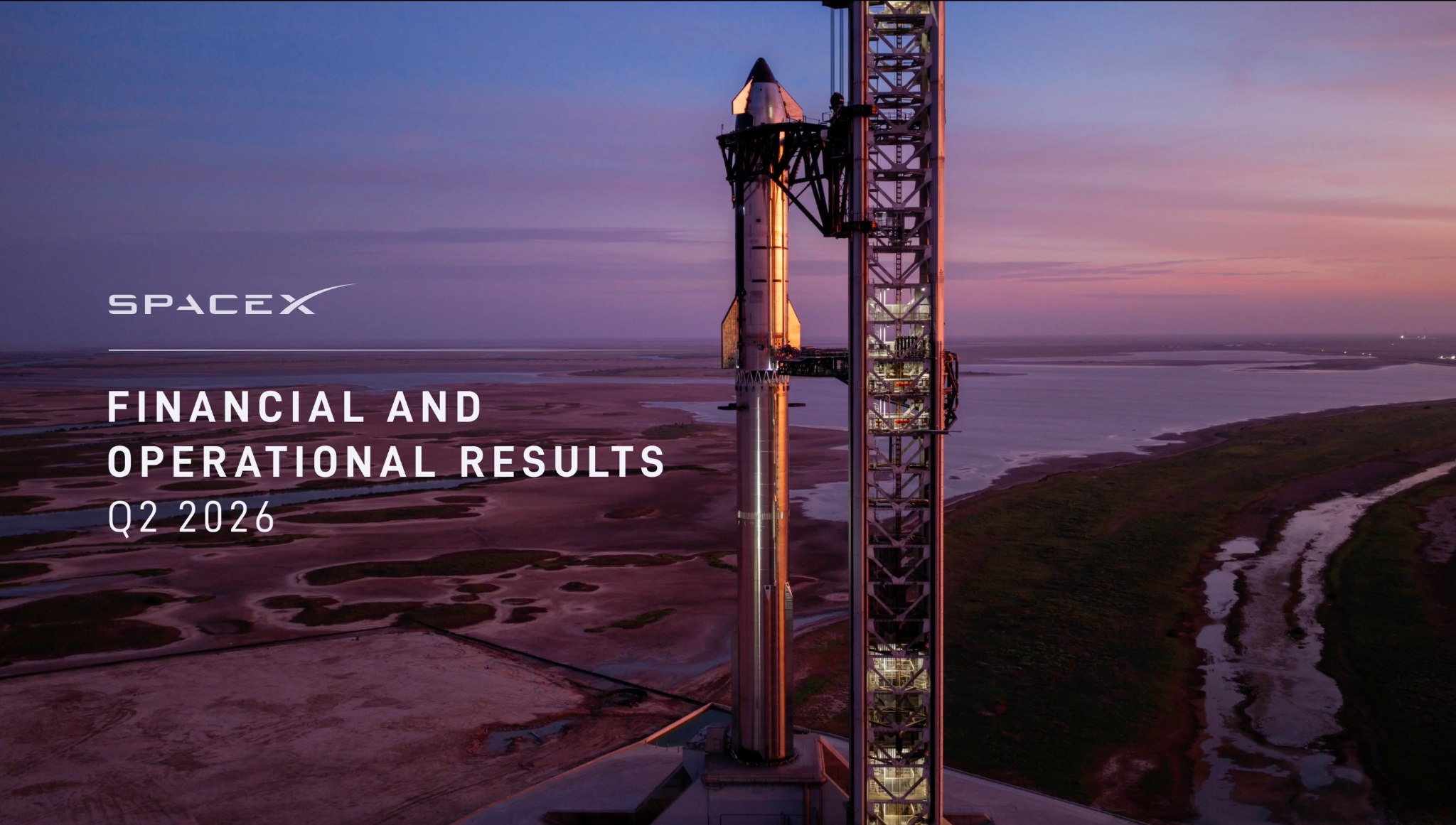
The main reason is Starship development. SpaceX continues to invest in engines, launch facilities, testing, and preparations for serial production, while the program has yet to generate meaningful commercial returns.
But Starship remains central to SpaceX’s long-term strategy. The vehicle is designed to dramatically increase payload capacity and reduce the cost per launch.
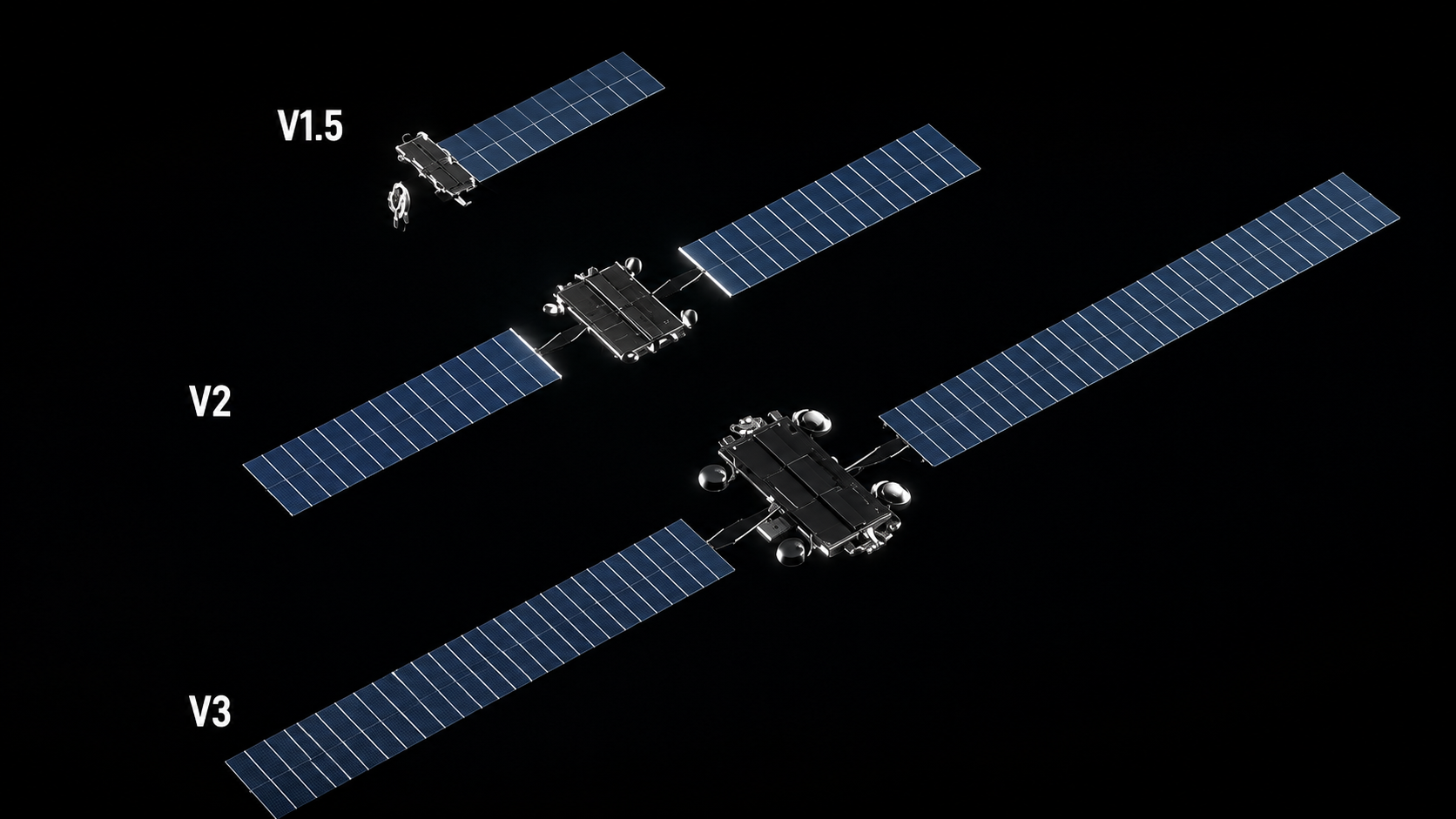
That is particularly important for deploying Starlink V3. The new satellites are expected to provide roughly ten times the capacity of the previous generation. Greater network capacity would allow Starlink to serve more customers and carry more traffic without a proportional increase in satellite count.
During the second quarter, SpaceX reported two successful Starship V3 tests within 90 days. In July, after the quarter ended, Flight 13 deployed 20 production Starlink V3 satellites and completed the program’s softest splashdown to date.
Musk also said SpaceX plans to attempt to catch both stages of the system on a future flight. Full and rapid reusability remains the key requirement for dramatically reducing launch costs.
Over the longer term, Starship is intended to support much more than Starlink. SpaceX’s plans include lunar missions, Mars exploration, large-scale cargo transport, and orbital computing infrastructure.
That is why the market largely treats current losses in the space segment as investment in a future platform. The main risk is timing: the longer it takes Starship to reach regular operations, the longer SpaceX must finance the program through its other businesses.
The $100 Billion Revenue Run-Rate Target
During the earnings call, Elon Musk said SpaceX could reach a $100 billion annualized revenue run rate by the end of 2026. This refers to the revenue pace expected in December, annualized over the following twelve months.
Growth would be supported by new cloud contracts, expansion of AI infrastructure, higher enterprise Starlink revenue, and the potential completion of the Cursor acquisition.

Musk also said the company had moved forward its internal target of reaching $1 trillion in annual revenue from 2031 to 2030. Under a more favorable scenario, he suggested the milestone could potentially be reached as early as 2029.
The target is extremely ambitious. SpaceX generated $12.5 billion in revenue during the first half of 2026. Even reaching a $100 billion annualized run rate by year-end would require a sharp acceleration in the second half, while reaching $1 trillion would require another roughly tenfold increase from there.
Musk sees Starlink V3, direct-to-device mobile connectivity, and AI as the main growth engines. In his view, the greater capacity of next-generation satellites could allow SpaceX to dramatically increase the amount of traffic it sells even as the cost per gigabyte declines.
Why a Strong Report Failed to Lift the Stock
SpaceX shares fell more than 7% in after-hours trading following the report. The decline continued during the next trading session, pushing the stock below its IPO price.
At first glance, that reaction may seem contradictory. SpaceX beat revenue expectations, narrowed its loss, nearly tripled adjusted EBITDA, and reported rapid growth across all three segments.
But markets price companies relative to expectations already embedded in their valuations. Investors had already anticipated strong Starlink growth, progress on Starship, and the emergence of AI as a major business. The real surprise was the cost of expansion. AI capital expenditures came in above analyst expectations at $15.8 billion.
Another source of pressure was the approaching first stage of the post-IPO share unlock. On August 6, early investors and some employees became eligible to sell shares. Around 912 million shares potentially became available for trading. That does not mean all of those shares will immediately be sold, but the increase in available supply could contribute to higher volatility.
The post-earnings decline therefore reflected a combination of three factors: a high valuation, record spending, and a growing number of shares becoming eligible for sale.
What the Report Changed for Investors
Before the report, one of the major concerns was that Starlink might need to fund AI and Starship indefinitely without seeing meaningful returns. The results partially reduced that concern. AI is already generating around $2.6 billion in quarterly revenue, has turned positive on adjusted EBITDA, and is securing multibillion-dollar cloud contracts. Starlink’s government and enterprise businesses are growing faster than its consumer business, while Connectivity remains consistently profitable.
At the same time, the report confirmed that SpaceX has entered the most capital-intensive phase of its development. The company is simultaneously building data centers, buying chips, deploying a new generation of satellites, testing Starship, and preparing to enter the mobile connectivity market.
That makes the next several quarters even more important. Investors will be watching whether:
- Starlink can continue adding customers without a significant decline in revenue per user;
- enterprise and government revenue can maintain its current growth rate;
- the AI segment can sustain positive adjusted EBITDA;
- cloud contracts can translate into recognized revenue and cash flow;
- capital expenditures remain near $18 billion per quarter;
- Starship moves closer to regular commercial operations;
- SpaceX continues narrowing its net and operating losses.
What SpaceX’s First Earnings Report Revealed
SpaceX’s first public earnings report gave investors a much clearer picture of the company’s business mix. The company is no longer dependent on a single growth engine. Starlink provides scale, recurring subscription revenue, and most of the company’s profit. Government and enterprise contracts are making the business more resilient. AI is rapidly becoming a standalone segment with major commercial contracts. Starship remains the technological foundation for the next phase of growth.
The key question now is whether the cost of that growth can be justified. In the second quarter, SpaceX nearly doubled revenue, significantly narrowed its loss, and accelerated the development of new businesses. But executing that strategy is already requiring tens of billions of dollars in quarterly capital investment.
For long-term investors, the report reinforced the scale of SpaceX’s potential. For the market in the near term, it also highlighted the level of risk. The next few quarters should show whether SpaceX can maintain its growth rate while turning record investment into sustainable profits and free cash flow.
This material is provided for informational purposes only and does not constitute individual investment advice. Investment decisions should be made independently based on your own objectives and risk tolerance.
