


Marketplace Regolith
Your investment opportunities


GRID ETF
GRID ETF
Energy infrastructure ETF
Updated on 9 Oct 2026

First Trust Advisors L.P.
Sponsor of the Trust
“The AI boom is turning power grids into a strategic asset: compute scales where energy is available.”

Updated on 9 Oct 2026
About
GRID (First Trust NASDAQ Clean Edge Smart Grid Infrastructure ETF) is an exchange-traded fund that provides access to companies operating at the intersection of energy, industrial equipment and digital infrastructure.
The fund aims to track the performance of companies developing infrastructure for the modern energy system: electric grids, transformers, substations, transmission and distribution equipment, load management systems, smart grid solutions, energy management and related software. The growth of AI, data centers, electrification and industrial power demand makes energy infrastructure one of the key areas of the technology economy.
Launched in 2009, GRID is now one of the largest thematic ETFs linked to grid modernization and energy infrastructure.
Sponsor of the Trust: First Trust Advisors L.P. - one of the leading independent ETF providers in the United States, managing a broad range of thematic and sector funds.
The fund is designed for investors who view energy infrastructure as a structural long-term trend and prefer to access it through an exchange-traded, transparent and regulated format, without the need to analyze and select individual companies themselves.
The fund trades on NASDAQ and is available to investors as a standard ETF instrument.
What are you actually investing in?
By investing in GRID, you invest in shares of public companies included in the Nasdaq Clean Edge Smart Grid Infrastructure Index. The fund replicates the structure of the index by following its composition and weights.
GRID’s return is generated by the growth in the market value of the companies included in the index, as well as dividends paid by these companies. If the value of the underlying assets declines, the investor’s result may be negative.
The investment is directly linked to the business performance of companies developing energy infrastructure: electric grids, power transmission equipment, transformers, substations, energy consumption management systems and smart grid technologies.
For the AI economy, this is one of the core infrastructure layers. The more data centers are built globally, the higher the demand for grid connections, modernization of network infrastructure, transformers, distribution systems and load management.
Index composition
The Nasdaq Clean Edge Smart Grid Infrastructure Index includes 120 companies covering key segments of energy infrastructure:
- Electrical equipment and components – companies producing equipment for power transmission, distribution and energy management.
Eaton, Schneider Electric, ABB, Hubbell, nVent Electric - Engineering and construction of energy infrastructure – contractors that build and modernize power lines, substations and grid connection infrastructure.
Quanta Services, MYR Group, MasTec, Primoris Services - Grid operators and energy companies – owners and operators of network infrastructure through which electricity is transmitted and distributed.
National Grid, E.ON, Terna, Hydro One, Red Electrica - Cable and distribution infrastructure – manufacturers of cables, conductors and power transmission solutions.
Prysmian, Nexans, NKT, WESCO International - Smart grids and energy management – companies developing solutions for automation, measurement, monitoring and digital management of energy infrastructure.
Johnson Controls, Cisco, Oracle, IBM, Texas Instruments
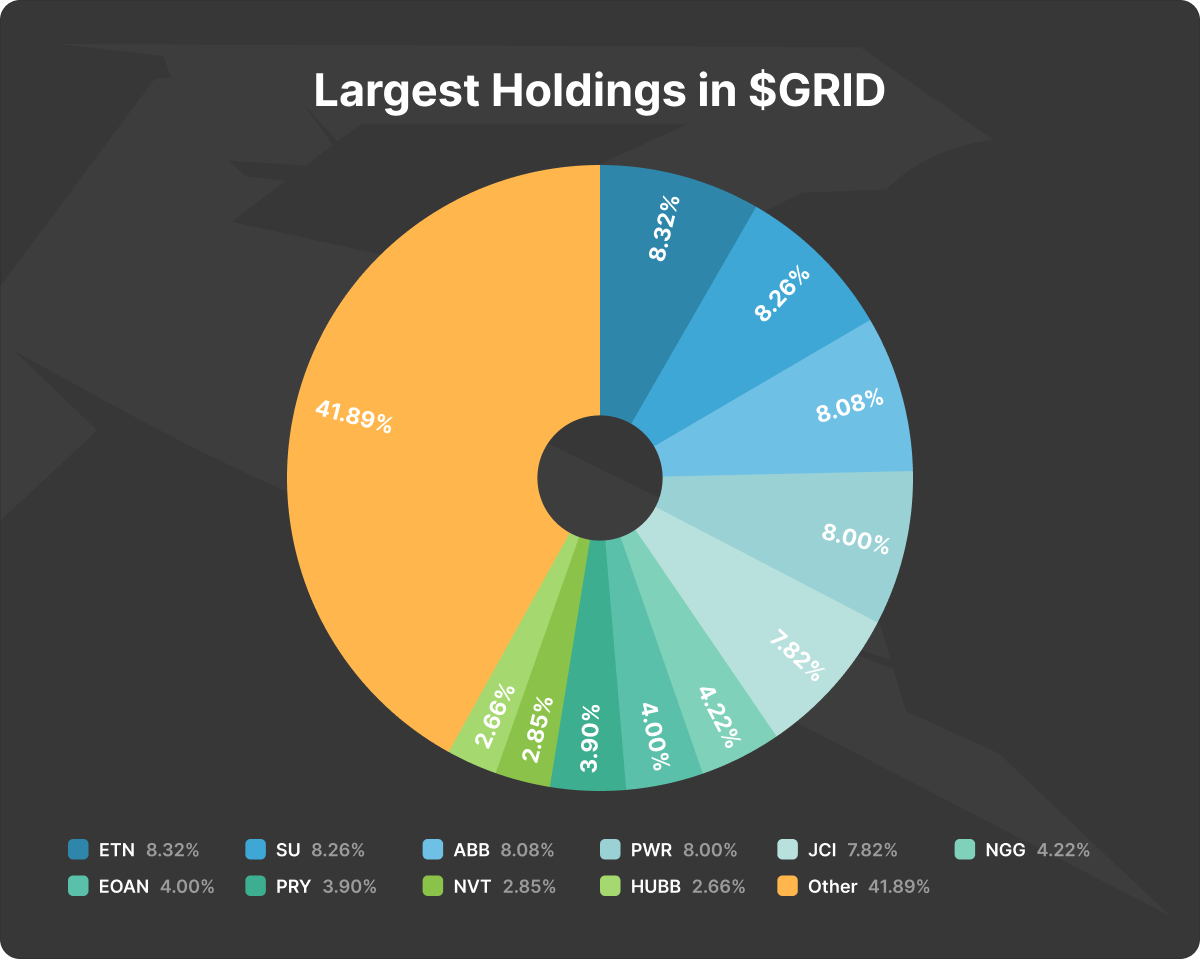
The Nasdaq Clean Edge Smart Grid Infrastructure Index includes companies developing electric grids, meters and devices, energy storage and management systems, as well as software for smart grids and energy infrastructure.
Company weights in the index are based on market capitalization with a maximum weight cap, which supports diversification and reduces dependence on individual companies.
How the structure works
GRID uses a classic ETF structure:
- shares of companies are held within the fund’s custody infrastructure through licensed custodians;
- the fund’s structure is fully transparent and regularly disclosed;
- the fund is supervised by US regulators and auditors.
GRID is among the largest thematic ETFs focused on energy infrastructure, grid modernization and smart energy systems. The fund’s assets exceed $11 billion. Its large size and regular trading support liquidity: it is generally easier for investors to enter and exit positions at prices close to the market level.
Fees and distributions
Investor returns are formed by changes in the market value of the fund and small dividend payments. You buy a share in GRID at the current price and sell it when exiting - the result depends on the asset’s price dynamics over the holding period.
Fund expense model:
- Total Expense Ratio (TER): 0.56% per year - this fee includes fund management and administration;
- Dividends are relatively small and distributed quarterly; the main source of investor return is the growth or decline in the value of the companies included in the fund.
When purchasing GRID through the Regolith platform, an entry fee of 2% of the transaction amount is charged. Performance fee: 0%.
The role of GRID in an investment portfolio
GRID is typically considered a thematic instrument for strengthening the infrastructure and technology component of a portfolio. The fund may be used for the following purposes:
- Participation in the growth of energy infrastructure demand – the development of AI, data centers, electrification and industrial power demand increases the need for grids, transformers, substations and power distribution systems.
- Thematic diversification – access to 120 companies linked to electric grids, smart grids, industrial equipment, energy companies and energy engineering within a single instrument.
- Alternative to individual stocks – instead of buying shares of Eaton, Schneider Electric, ABB, Hubbell or Quanta Services separately, the investor receives a basket of leading players in the sector.
- Strengthening the infrastructure component of a portfolio – in combination with broad index ETFs, such as SPY, GRID allows investors to selectively increase exposure to the energy infrastructure segment.
- Exposure to a structural trend – the fund’s historical compound annual growth rate, or CAGR, for 2021-2025 was around 15.0%; energy infrastructure remains one of the key areas amid the growth of AI, data centers and electrification.
Energy infrastructure: current context
The energy infrastructure sector is experiencing one of its strongest periods in recent years. In 2025, GRID ETF gained +29.65% amid rising investment in electric grids, transformers, substations and data center connection infrastructure. In 2026, the momentum remains strong: year-to-date performance stands at +23.40%. The fund’s CAGR for 2021-2025 was around +15.0% per year.
Artificial intelligence requires the growth of computing capacity, while new data centers create additional pressure on energy systems. To operate, they need grid connections, transformers, substations, transmission lines, power distribution systems and load management solutions.
An additional driver is the electrification of the economy. The development of industry, electric vehicles, energy storage systems, renewable energy sources and digital infrastructure requires grid modernization. In many countries, electric grids are becoming a bottleneck for technological growth, which supports demand for the equipment and services of companies included in GRID.
The AI economy grows together with energy infrastructure. The higher the demand for compute, the more valuable companies become that deliver power to data centers and support the scaling of energy systems.
GRID looks like a resilient sector for long-term observation: demand is supported by investment in AI infrastructure, data centers, electrification, grid renewal and energy security. At the same time, the sector remains sensitive to capital expenditures by energy companies, interest rates, raw material costs and overall market conditions.
Risks
Investments in GRID involve a number of factors typical for the infrastructure and technology sectors:
- Market volatility - shares of energy infrastructure and industrial equipment companies may fluctuate significantly along with the broader market and expectations for capital expenditures.
- Dependence on infrastructure budgets - demand for equipment, grids, transformers and substations is linked to investment programs of energy companies, industrial companies, data centers and governments.
- Interest rates - infrastructure and energy companies are sensitive to the cost of capital; high interest rates may put pressure on valuations and slow down investment projects.
- Valuation risks - amid strong interest in AI and data centers, some energy infrastructure companies may trade at elevated multiples, which increases the risk of a correction.
- Operational and raw material risks - equipment production depends on metal prices, supply chains, component availability and the execution timelines of large projects.
- Single-theme concentration - GRID invests in energy infrastructure and smart grids, while the largest positions account for a significant share of assets, which limits diversification across economic sectors.
As an equity instrument, the fund is exposed to market fluctuations and does not guarantee a positive result. The investor may lose part or all of the invested capital.
Instrument parameters
- Ticker: GRID
- Type: ETF focused on energy infrastructure and smart grids
- Exchange: NASDAQ
- ISIN: US33737A1088
- Index: Nasdaq Clean Edge Smart Grid Infrastructure Index
- Number of companies: 120
- AUM: approximately $11.65 billion
- Expense Ratio: 0.56%
- Morningstar Rating: ★★★★★
- ETF provider: First Trust
- Investment Advisor: First Trust Advisors L.P.
- Launch date: November 16, 2009
GRID distributes small dividends quarterly. The main source of investor return is the change in the fund’s market value.
Deposits and withdrawals through Regolith
Purchases of GRID are carried out through Regolith in regular operating mode and are not tied to a fixed date. Transactions are formed 1-3 times per week depending on market conditions and the platform’s operational schedule.
- Minimum investment period - 1 week
- Minimum amount - $50
- Entry fee - 2%
- Performance fee - 0%
Withdrawals are processed according to the platform’s standard procedure after the minimum investment period has ended.
Frequently Asked Questions about GRID ETF (FAQ)
1. What is GRID?
GRID is an exchange-traded fund (ETF) that allows investors to gain exposure to 120 companies connected to energy infrastructure, electric grids and smart energy system technologies through a single purchase. The fund provides access to a sector that is becoming one of the key beneficiaries of AI growth, data centers, electrification and energy system modernization.
2. Who manages the fund?
The fund is issued and managed by First Trust Advisors L.P., one of the leading independent ETF providers in the United States. First Trust manages a broad range of thematic, sector and index funds.
3. What exactly am I investing in when I buy GRID?
By purchasing GRID, you invest in shares of 120 public companies operating in electric grids, energy infrastructure, transformers, substations, transmission and distribution equipment, load management systems and smart grid technologies. This gives investors exposure to the combined performance of companies that build and modernize the infrastructure of the modern energy system.
4. Is this an actively managed fund?
No. GRID is a passive index fund. It tracks the Nasdaq Clean Edge Smart Grid Infrastructure Index. The index includes companies connected to electric grids, electric meters, devices and grid equipment, energy storage and management systems, as well as software for smart grids and energy infrastructure.
5. Which companies are included in the fund?
- Leading manufacturers of electrical equipment: Eaton, Schneider Electric, ABB, Hubbell, nVent Electric
- Engineering and construction of energy infrastructure: Quanta Services, MYR Group, MasTec, Primoris Services
- Grid operators and energy companies: National Grid, E.ON, Terna, Hydro One, Red Electrica
- Cable and distribution infrastructure: Prysmian, Nexans, NKT, WESCO International
- Smart grids and energy management: Johnson Controls, Cisco, Oracle, IBM, Texas Instruments
6. Does the fund’s composition change?
Yes. The fund’s composition is updated in accordance with the methodology of the Nasdaq Clean Edge Smart Grid Infrastructure Index. Companies are added or removed based on industry classification, market capitalization, liquidity and relevance to electric grids, energy infrastructure, energy management and smart energy systems.
7. What are the fund’s fees?
When purchasing GRID through the Regolith platform:
- entry fee - 2%
- performance fee - 0%
The fund’s Expense Ratio is 0.56% per year.
8. What role does GRID play in an investment portfolio?
GRID is used as a thematic instrument for participating in the growth of energy infrastructure. The fund provides exposure to the sector that supports the connection and scaling of data centers, AI infrastructure, industrial power demand and electrification. Instead of betting on a single company, the investor receives a diversified basket of 120 players.
9. Why is energy infrastructure considered a long-term trend?
AI and data centers require growth in computing capacity, and computing capacity requires access to electricity. Connecting new data centers requires electric grids, transformers, substations, transmission lines and load management systems. At the same time, electrification is growing across transport, industry and cities. This makes energy system modernization one of the key areas of the technology economy.
10. What are the risks of investing in GRID?
GRID remains an equity ETF and is exposed to market volatility. The fund depends on capital expenditures by energy companies, grid modernization investment programs, interest rates, raw material costs and the condition of supply chains. Some companies may trade at elevated multiples due to investor interest in AI and data centers, which increases correction risk. In addition, the fund is focused on a single theme - energy infrastructure and smart grids.
11. How is GRID different from funds focused on AI, chips or data centers?
GRID does not invest in AI model developers or chip manufacturers, but in the infrastructure layer that makes AI growth possible: electric grids, transformers, substations, power transmission systems and load management. While chip-focused funds provide access to computing hardware, GRID provides access to the energy infrastructure that powers data centers.
12. Where is GRID traded?
The fund trades on Nasdaq in the United States. The fund’s AUM exceeds $11 billion, making GRID one of the largest thematic ETFs in the energy infrastructure and smart grid segment.
13. How does the process of buying GRID through Regolith work?
Purchases of GRID through the Regolith platform are carried out in regular operating mode and are not tied to a fixed date. Transactions are formed 1-3 times per week. After an order is submitted, the funds are reserved, and the purchase is executed in the nearest available trading window at the actual transaction price.
14. What is the minimum investment period?
The minimum investment period is 1 week. After that, the investor may continue holding the position or exit the instrument without any platform-side fee.
First Trust Advisors L.P.
Sponsor of the Trust
“The AI boom is turning power grids into a strategic asset: compute scales where energy is available.”
Performance
Return for 2021
+27.64%Return for 2022
-13.89%Return for 2023
+21.56%Return for 2024
+15.18%Return for 2025
+29.65%Return for 2026 YTD (6 months)
+23.40%Terms
Deal Fee
2%Carried Interest
0%Minimum investment period
1 weekRisk potential
Low