

Anthropic pulls ahead of OpenAI in the race for the biggest AI IPO – with trillion-dollar valuations on the line
2026 has become the year of the big technology IPOs. Anthropic has filed confidentially with the SEC, OpenAI is preparing its own listing and pushing for a valuation near $1 trillion, AI-chip designer Cerebras has already debuted on Nasdaq, and CoreWeave's surge showed that AI infrastructure has become a public sector in its own right. A new lineup of companies valued in the hundreds of billions is forming at the exchange doors. But the first IPOs have already shown one thing: investors are willing to pay up for fast growth, yet strong demand at the open is no guarantee of steady gains after listing. Shares of these companies can spike in their first days of trading and then correct just as quickly.
Anthropic pulls ahead
Anthropic has emerged as one of the front-runners for the biggest AI IPO of this cycle among foundation-model developers. On June 1, 2026, the maker of Claude confidentially submitted a draft S-1 registration statement to the SEC and, according to media reports, is eyeing a Nasdaq listing as early as this fall. Goldman Sachs, JPMorgan and Morgan Stanley are working on the deal, and the offering could raise more than $60 billion.
Investor interest comes down to more than the company's profile – it is also about the trajectory of the business. In May, Anthropic closed a $65 billion Series H at a valuation of around $965 billion and, according to media reports, overtook OpenAI in value for the first time. It has also moved ahead on revenue: its annualized run-rate is estimated in the $30–47 billion range, against roughly $24–25 billion for OpenAI.
Another advantage is access to computing infrastructure. Anthropic is locking in capacity with its largest technology partners well in advance: agreements with Amazon, Google and Broadcom could give it multi-gigawatt compute capacity, including next-generation TPUs from 2027, and it was separately reported to have secured access to SpaceX's GPU infrastructure. This matters to investors: in the AI-model race, a shortage of compute is becoming as much a driver of value as revenue and market share.
The regulatory backdrop has also improved. The US lifted some export restrictions on Anthropic's most powerful models, which could expand its ability to serve large enterprise and government clients. That reduces one of the key pre-IPO risks – limited access to international markets and critical infrastructure.
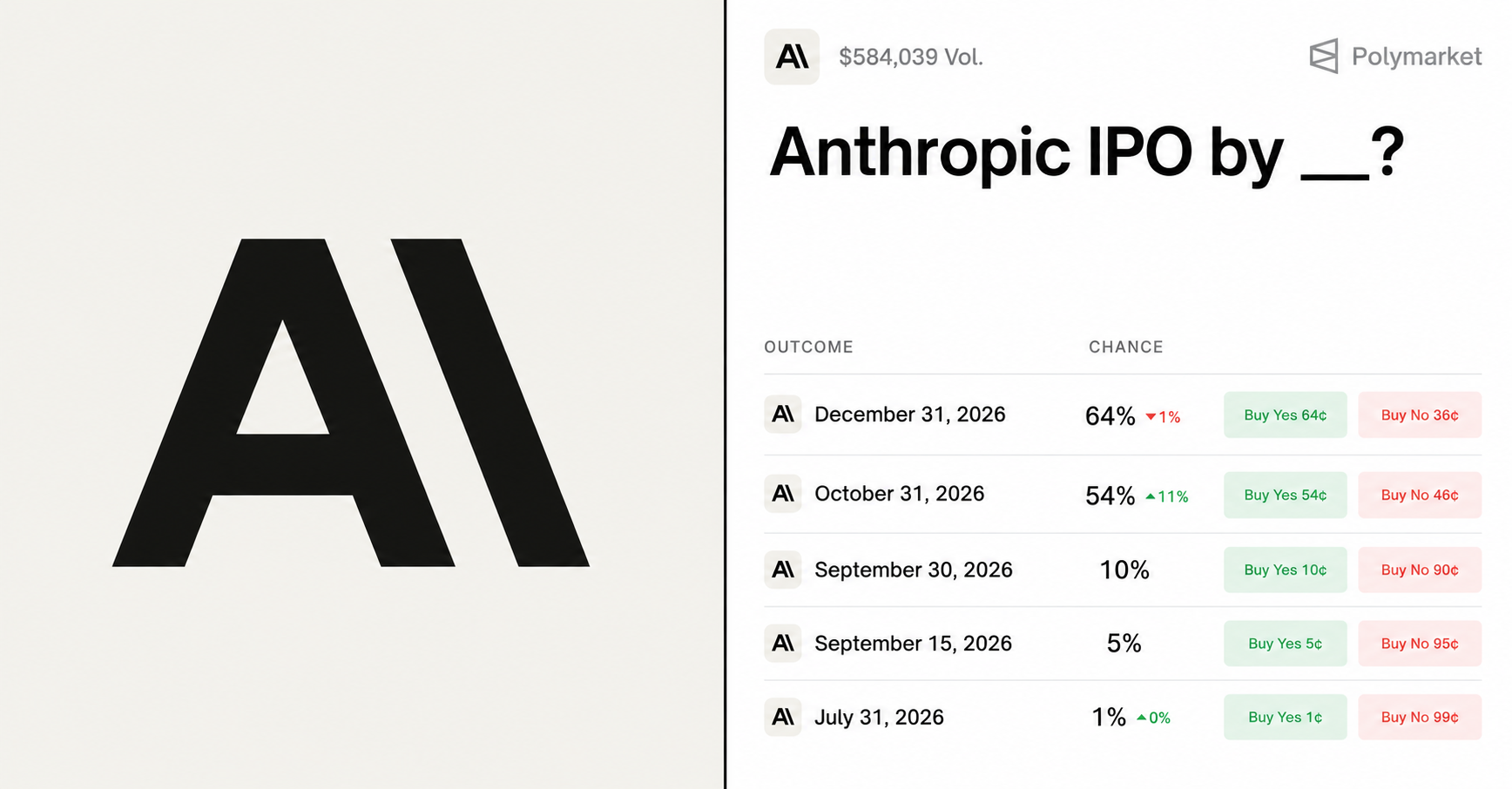
For now, the market is betting on Anthropic. On Polymarket, on the question of who will IPO first – Anthropic or OpenAI – traders put Anthropic's odds at around 87% and OpenAI's at around 13%. Trading volume on that market is about $222,000.
OpenAI takes a pause
OpenAI is also moving toward an IPO, but it is taking a more cautious stance. According to media reports, the company filed confidentially a week after Anthropic – on June 8 – and is discussing a listing at a valuation of around $852 billion. A quick debut, however, is not the base case for now: OpenAI is reportedly weighing a move to 2027.
The main issue is valuation. Sam Altman, according to media reports, is unwilling to take the company public below $1 trillion. For OpenAI, waiting may be more attractive than an IPO priced at a discount to private-market expectations – especially now that, after the first big technology listings, investors are scrutinizing not only revenue growth but also the durability of the business model, spending on compute and future margins.
A separate factor is possible government involvement. According to the Financial Times, cited by Reuters, OpenAI has discussed a structure under which the US government could take a 5% stake in the company. At OpenAI's last confirmed valuation of $852 billion, that stake would be worth roughly $42.6 billion. According to the FT, the idea also envisioned other major US AI developers ceding similar stakes to Washington – but this is a proposal under discussion, not an agreed deal.
For investors, this adds a new layer of uncertainty. On one hand, government involvement can be read as strategic support for the sector. On the other, it raises questions about ownership structure, the state's future regulatory role and its potential influence on OpenAI's corporate governance ahead of the IPO.
Cerebras and CoreWeave: the first tests of the AI IPO market
n May 2026, Cerebras Systems went public on Nasdaq – a designer of AI chips and a rival to Nvidia in specialized computing. The company listed under the ticker CBRS, raised about $5.6 billion, and on its first trading day the shares rose 68% above the IPO price. That made Cerebras one of the most notable technology listings of 2026.
Another example is CoreWeave, a cloud infrastructure operator for AI. It went public on Nasdaq in March 2025 under the ticker CRWV, priced its shares at $40 and raised about $1.5 billion. By its third trading day the stock closed at $52.57 – 42% above the IPO price. Today the shares trade around $90, roughly 125% above the IPO price, though the post-listing path has been highly volatile.
Both cases showed strong investor appetite for AI infrastructure – chips, cloud capacity and computing for new models. But they were also a reminder of the risks. After a strong start, such stocks can correct quickly: investors weigh not only the pace of growth but also dependence on large customers, capital spending, margins and a company's ability to justify public-market valuations.
Who's next: Databricks, Cohere, Mistral, Perplexity
After Cerebras and CoreWeave, the market is waiting for the next wave of large AI listings, but the IPO queue is moving unevenly. Highly valued companies are in no rush to lock in a price on the public market: what matters to them is not only investor demand but also timing, multiples and sentiment after the first trades.
Databricks is one of the leading candidates among enterprise-data and AI companies. The business is growing about 65% a year, revenue is estimated at around $5.4 billion, and its most recent valuation is about $175 billion. But CEO Ali Ghodsi has signaled that Databricks will not go public in 2026. For the company, waiting looks logical: at this scale, it matters more to hit a strong window than to rush the IPO itself.
In Europe, Cohere and Mistral are also watching the market. In April, Cohere merged with Germany's Aleph Alpha, and the combined group is valued at around $20 billion, according to media reports. The company may see the second half of the year as a potential window to list. Mistral, in turn, is looking at a broader horizon of 2026–2027.
Perplexity is choosing an even more distant path. The AI search company, according to media reports, is targeting an IPO closer to 2028 and does not tie its plans directly to how the Anthropic or OpenAI listings go. This shows the AI IPO market has already split: some companies are trying to catch the current window, while others are willing to wait for a more mature financial track record.
Another potential AI IPO candidate – Elon Musk's xAI – has effectively dropped out of the standalone queue. In February 2026, the company was absorbed by SpaceX in a major deal, and its AI assets, including Grok and X, were consolidated under the SpaceXAI brand.
For the market, that is an important signal: not every large AI asset will necessarily go public on its own. Some companies may take a different path – a sale to a strategic player, a merger with an infrastructure platform, or a listing inside a larger group. In xAI's case, Musk's bet is shifting toward integrating AI with SpaceX's space and computing infrastructure, including the idea of orbital data centers. So a standalone xAI IPO is no longer something to expect.
The SpaceX lesson
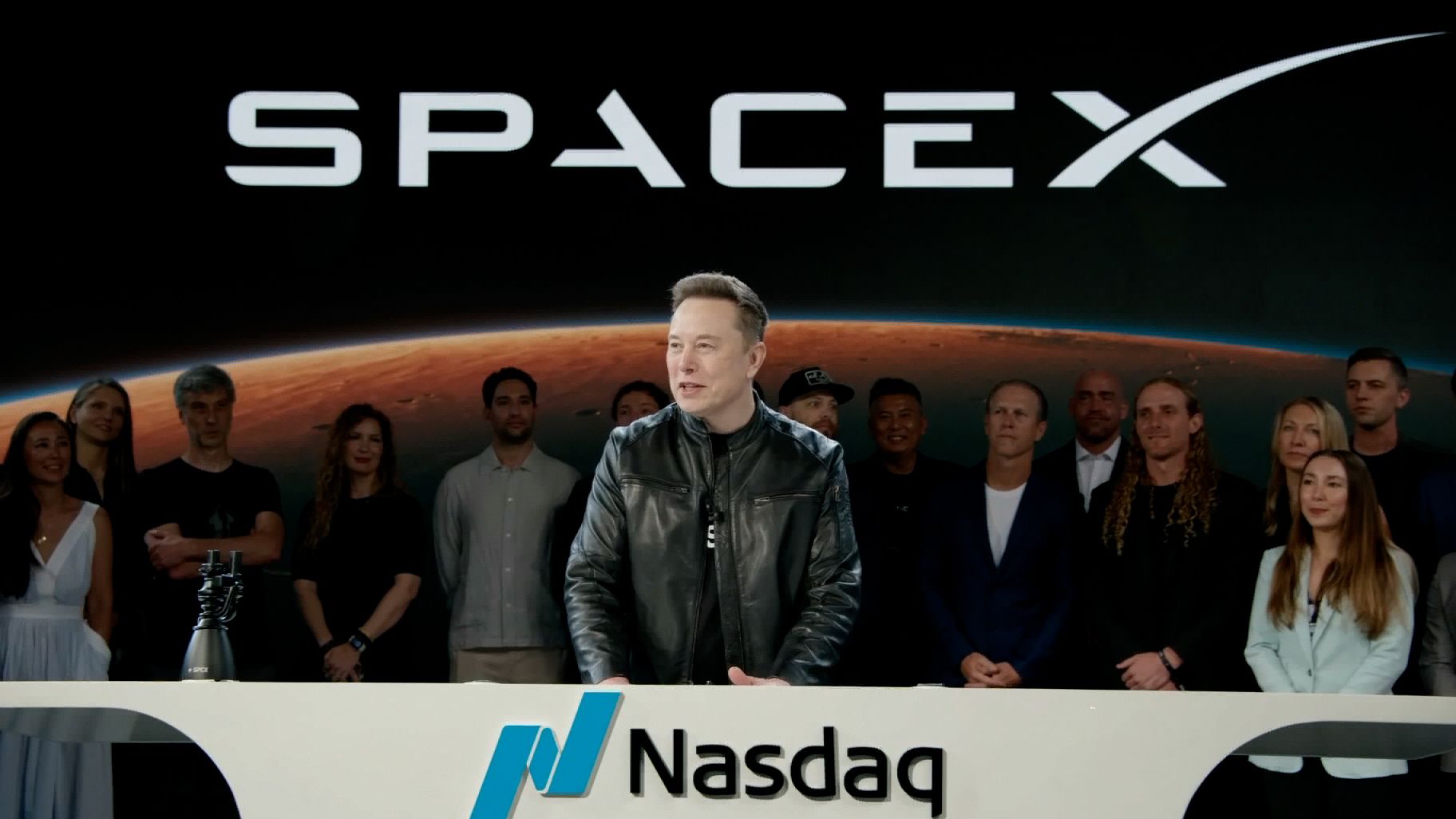
SpaceX has become the main reference point for the new wave of technology IPOs. On June 12, the company pulled off the largest offering in history: it raised about $75 billion at a valuation of $1.77 trillion. Demand stayed high on the first trading day, and the company's market cap briefly topped $2 trillion.
But what followed showed that even a record IPO does not shield a stock from a correction. After the initial run-up, SpaceX shares pulled back from highs above $225 to around $150. For the market, that was an important signal: public investors are willing to pay for scale and leadership, but they reprice quickly when a stock gets too far ahead of itself.
That is why the next issuers will be more careful about timing and deal terms. For OpenAI, Anthropic and other large private companies, the question is no longer only whether they can raise capital, but what valuation they can hold once trading begins.
What the next big IPO will decide
Right now the market is looking not just at individual companies but at the entire valuation scale of the new technology cycle. SpaceX already trades with a market cap of around $2 trillion. Anthropic, according to media reports, may be targeting a valuation on the order of $1 trillion. OpenAI is valued at $852 billion and is reportedly also aiming for the trillion-dollar mark. Databricks is worth about $175 billion, and Cerebras, after its IPO, has become one of the main public benchmarks for the AI-chip sector.
The next big offering will be a test for the whole market. If the IPO goes well and the shares hold up after trading starts, it will confirm that public investors are ready to pay for the largest AI companies almost as if they were next-generation infrastructure platforms. If the debut is weak or the shares correct quickly, the window for new AI IPOs could narrow again.
What matters for investors
Today's valuations already bake in very high expectations. Companies need to do more than grow fast – they must prove their business model can withstand competition, the capital cost of compute, regulatory pressure and the fight for enterprise clients. For the public market, a growth story alone is no longer enough: investors will look at revenue, margins, customer concentration, infrastructure costs and the ability to turn technological leadership into durable profit.
The main risk is that valuations can outrun the real economics of the business. AI leaders may indeed become the new infrastructure giants, much like Nvidia in the early stage of its growth. But the higher the starting valuation, the less room for error. Cerebras, CoreWeave and SpaceX have already shown that demand for these offerings can be enormous, yet after the IPO the market quickly tests how well the price matches the facts.
This material is for informational purposes and is not investment advice. Past performance does not guarantee future results.
