

SpaceXAI launches Grok 4.5 with a focus on faster performance and significantly lower usage costs

SpaceXAI has introduced Grok 4.5 – a new flagship AI model designed primarily for coding, enterprise data workflows and autonomous tasks. The company is not trying to outperform rivals solely through benchmark scores. Its main goal is to offer businesses performance comparable to leading models at a substantially lower cost.
Grok 4.5 is priced at $2 per 1 million input tokens and $6 per 1 million output tokens. By comparison, Anthropic’s Claude Opus 4.8 costs $5 and $25 respectively. This makes Grok’s output tokens more than four times cheaper. The difference may be negligible for an individual user request, but at enterprise scale it could translate into millions of dollars in savings.
Why AI model pricing matters more than ever
AI usage is typically priced by tokens – small units of text or code that a model receives and generates. Input tokens include the user’s prompt, documents, conversation history and the contents of a software project. Output tokens include the model’s response, generated code, reports or analytical results.
A single request to a basic chatbot may use relatively few tokens. AI agents operate differently. They can plan tasks, open files, search for information, use external tools, check their own work and correct errors. One assignment may involve dozens of consecutive steps.
For businesses, the key metric is therefore not the cost of one short answer, but the total cost of completing an entire workflow. The longer an agent works and the more often it calls the model, the faster expenses increase.
This is where SpaceXAI is seeking an advantage. The company says Grok 4.5 can complete comparable tasks in roughly half as many steps as several leading models. According to SpaceXAI, Grok 4.5 used 4.2 times fewer output tokens than Claude Opus 4.8 in SWE-bench Pro, although these results still need to be confirmed through independent testing.
Grok moves beyond the chatbot market
Grok has long been viewed primarily as a consumer AI product integrated into the X social platform. Grok 4.5 signals a broader strategic shift as SpaceXAI expands further into enterprise software.
The new model is designed for coding, autonomous multi-step tasks, data and document analysis, and working with external tools and corporate systems.
It supports text and images, function calling, structured outputs and multiple reasoning levels. Its context window reaches 500,000 tokens, allowing Grok to process large documents and substantial sections of software codebases. Its stated generation speed is up to 80 tokens per second.
Grok 4.5 is already available through the SpaceXAI API, Grok Build and Cursor. Integration with Cursor could become one of the model’s main advantages because developers can access Grok directly within the environment they use to write and edit code.
How Cursor strengthens SpaceXAI’s position
Grok 4.5 was developed together with Cursor using data that reflects how developers work with code and AI tools in real-world settings. This data captures the full development process – which files engineers open, how they identify errors, which changes they reject and how they correct the final result. As a result, Grok can better understand not only finished code, but also the logic behind a programmer’s workflow.
The partnership gives SpaceXAI access to specialized developer data, allows Grok to be trained and tested in real coding scenarios and simplifies distribution among users of one of the largest AI development platforms.
In June, SpaceX announced the acquisition of Anysphere, the company behind Cursor, for $60 billion in stock. The transaction showed that SpaceX views AI tools for businesses as a separate strategic direction rather than simply an extension of X.
According to Artificial Analysis, the cost of completing one benchmark task through Grok Build was estimated at $2.49. The same figure was $5.07 for GPT-5.5 in Codex and $11.80 for Anthropic’s more powerful model in Claude Code. However, Grok still trailed Anthropic’s strongest model in overall quality and performed roughly in line with GPT-5.5.
This distinction matters: Grok 4.5 is not yet the undisputed leader in intelligence. Its potential advantage lies in the balance between performance and cost.
Why SWE-bench Pro matters
SWE-bench Pro is a benchmark that measures how well an AI model handles tasks similar to the real work of a software engineer. Instead of receiving a simple assignment, the model is given an existing software project. It must understand the project’s structure, identify the problem, account for dependencies and make changes without breaking the rest of the system.
The benchmark includes 1,865 tasks from 41 real software projects. Some are complex enough that an experienced developer could spend hours or even days completing them. This makes SWE-bench Pro a better indicator of whether AI is ready for practical software work, although no public test can fully reproduce the conditions inside a company.
SpaceXAI says Grok 4.5 works faster and uses fewer tokens than Anthropic’s Claude Opus 4.8. But a low price matters only when quality remains high enough. If the model makes more mistakes, the savings quickly lose their value. The real test for Grok will therefore come in practical business use rather than benchmark tables.
Anthropic’s response: a focus on reliability
Anthropic holds a strong position in coding and autonomous workflows. With Claude Opus 4.8, the company has emphasized the model’s ability to identify its own mistakes, communicate uncertainty and reliably complete long sequences of actions.
According to Anthropic, Opus 4.8 is around four times less likely than the previous version to leave flaws in generated code undetected. The model can also coordinate parallel AI agents and carry out migrations of large software codebases.
Competition between Grok and Claude is therefore more complex than a simple choice between cheap and expensive. SpaceXAI offers a faster and more affordable model, while Anthropic argues that the premium is justified by stronger reliability and performance on difficult tasks. Should Grok approach Opus-level quality at its current price, Anthropic may need to lower prices or create a clearer distinction between premium and lower-cost products.
Pressure on OpenAI
OpenAI is also facing pressure. According to Reuters, GPT-5.6 Luna costs $1 per 1 million input tokens and $6 per 1 million output tokens. Its generation price therefore matches Grok 4.5, while input processing is cheaper.
This means SpaceXAI is not the absolute price leader across all new models. Its offer is particularly competitive against Claude Opus, but OpenAI is also actively participating in the pricing race.
The market is gradually moving away from the simple question of which company has the smartest model. Businesses are now evaluating a broader set of factors:
- task completion quality;
- response speed;
- total workflow cost;
- integration with popular tools;
- access to computing capacity;
- ability to serve large corporate customers;
- protection of enterprise data.
The winner will not necessarily be the company with the highest score in a single benchmark. It will be the one able to combine a strong model, computing infrastructure, a convenient product and effective enterprise sales.
SpaceXAI’s infrastructure advantage
Grok 4.5 was trained on tens of thousands of Nvidia GB300 graphics processors – another sign of how capital-intensive the frontier AI market has become.
Following the integration of xAI into SpaceX, the company gained an unusual combination of assets:
- proprietary AI models;
- computing infrastructure;
- X as a distribution channel;
- Cursor as a product for developers;
- the Starlink satellite network;
- access to public capital markets.
This vertical integration could allow SpaceXAI to spread costs across several business lines and launch products globally at a faster pace.
At the same time, it creates a potential conflict. SpaceXAI is developing its own models while also renting computing capacity to competitors. As Grok expands, the company will need to decide whether it is more profitable to use the infrastructure internally or continue selling capacity to other AI developers.
Why the low price may be an aggressive market strategy
Grok 4.5’s low price may reflect more than technical efficiency. It could also be part of a strategy to gain market share quickly.
SpaceXAI may temporarily accept lower revenue per request to attract more developers, increase Cursor usage and embed Grok into corporate workflows. The more real tasks the model completes, the more data the company can collect to improve it.
Lower pricing also helps SpaceXAI compete with more expensive models and increase utilization of its own computing infrastructure. Over time, the company could monetize users through its API, enterprise plans and other products within its ecosystem.
This is a familiar platform strategy – make the product widely accessible first, build adoption and then monetize customers through additional tools, corporate subscriptions and infrastructure services.
However, this approach requires substantial resources. Training, operating and continuously updating AI models costs billions of dollars. If prices are set too low, higher usage may increase operating losses rather than profits. Investors should therefore monitor not only Grok’s user numbers, but also revenue per customer, infrastructure utilization and the profitability of SpaceXAI’s AI operations.
What the launch means for SpaceX
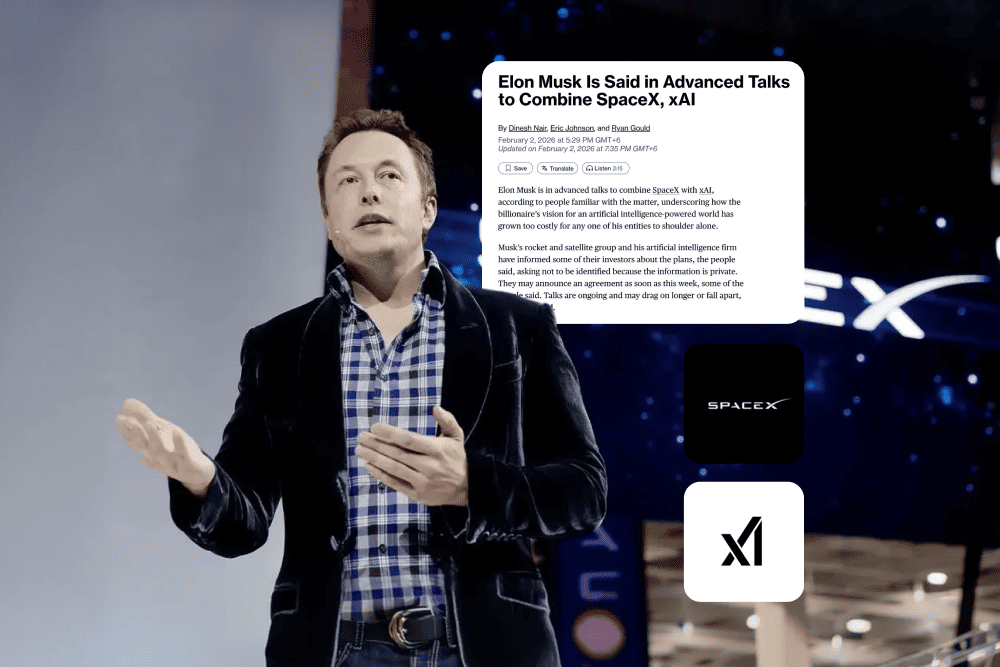
Grok 4.5 is the first major AI model launch since SpaceX went public and integrated xAI into the company. This makes the release an important test of the broader SpaceXAI strategy.
Investors are now assessing SpaceX not only as a space and satellite company, but also as a major participant in the AI market.
This business could generate new revenue through API usage and subscriptions, increase the value of Cursor and improve utilization of the company’s computing capacity. Grok could also be integrated with X, Starlink and other SpaceXAI products.
Should the strategy succeed, SpaceXAI would gain exposure to the fast-growing market for automating software development and other knowledge-based tasks.
The strategy also introduces additional risks:
- high equipment and energy costs;
- pricing pressure from OpenAI, Anthropic and Google;
- rapid model obsolescence;
- the need for continued capital expenditure;
- security risks and errors made by autonomous agents;
- pressure from AI-related losses on the group’s financial performance.
Grok could become an important driver of SpaceX’s valuation if the company proves that it can turn competitive models into a sustainable, high-margin business.
SpaceX on the public market
As of July 13, 2026, SpaceX shares were trading at approximately $145.30 – around 7.6% above the $135 IPO price and 813.8% above Regolith’s pre-IPO entry price of $15.90.
After a strong market debut, the shares corrected significantly from their local highs. This suggests that investors are no longer willing to value the company solely on the scale of the SpaceX story. They now want evidence that newer business lines, including AI, can generate revenue and justify the company’s high valuation.
What investors should monitor
Several indicators will be important for assessing Grok 4.5 in the coming months.
- Real-world adoption. How many developers and companies switch to Grok through the API, Cursor and Grok Build.
- Independent testing. Whether third-party platforms confirm SpaceXAI’s claims about performance and efficiency.
- Cost per successful task. Whether the price advantage remains after accounting for retries and human review.
- Enterprise contracts. Whether SpaceXAI can attract large companies with strict security and reliability requirements.
- Financial efficiency. Whether growth in AI improves the group’s economics or increases losses and capital expenditure.
- Competitor response. Anthropic and OpenAI may react with lower prices, more efficient models or bundled enterprise offerings.

The bottom line
Grok 4.5 does not need to become the most powerful AI model on the market to succeed commercially. SpaceXAI only needs to offer performance close to the leading models at a meaningfully lower cost.
For developers and businesses, this means more choice and lower automation expenses. For Anthropic and OpenAI, it means greater pressure on pricing. For SpaceX investors, the launch will test whether the company can turn its vast computing infrastructure and integrated product ecosystem into a profitable AI business.
The key question is no longer whether Grok can outperform competitors in individual benchmarks. What matters is whether SpaceXAI can prove that the model performs real work at a lower cost while remaining reliable enough for companies to trust it with their code, data and business processes.
This material is provided for informational purposes only and does not constitute investment advice. Past performance is not indicative of future results.
