

MetaMask Turns 10: From Crypto Wallet to a Truly Global Financial Platform
MetaMask’s tenth-anniversary artwork. Source: MetaMask
On July 14, MetaMask marked its tenth anniversary. What began as a browser extension for interacting with Ethereum has grown into one of the crypto market’s largest consumer platforms. MetaMask has now been downloaded more than 100 million times, is available in roughly 190 countries, and has facilitated trillions of dollars in transactions.
To mark the anniversary, the team unveiled the next phase of its strategy: Open Money. MetaMask aims to move beyond the traditional crypto-wallet model and become an integrated financial platform where users can receive salaries, hold and transfer funds, make payments, earn yield, and invest.
At the same time, MetaMask’s parent company, Consensys, is preparing for a potential public listing. According to media reports, the company has engaged JPMorgan and Goldman Sachs to advise on an IPO that could take place in fall 2026, subject to market conditions. No final decision has been announced, however, and the company has yet to disclose a filing, valuation target, offering size, or listing venue.
How MetaMask Began
MetaMask’s history began almost simultaneously with the launch of Ethereum.
On July 31, 2015, one day after Ethereum’s genesis block was created, developer Aaron Davis, known online as Kumavis, opened the MetaMask repository and uploaded its first 598 lines of code. The wallet’s first public version launched on July 14, 2016. MetaMask was also developed by co-founder Dan Finlay.
MetaMask open on a smartphone. Photo: appshunter.io / Unsplash
The original goal was to make Ethereum accessible to mainstream users. Before browser-based wallets emerged, interacting with a blockchain often required users to run their own node, install specialist software, and understand the network’s underlying technical architecture.
MetaMask moved that complexity into the browser. Users could install an extension, create a wallet, and connect to decentralized applications in much the same way they accessed conventional websites.
That model eventually became an industry standard. Today, a similar connection flow is used across most self-custodial wallets and decentralized applications.
Key Milestones in MetaMask’s Development
Over the past decade, MetaMask has evolved through several distinct stages.
2016: Browser Extension Launch
The first version of MetaMask was built specifically for Ethereum. It allowed users to manage blockchain addresses, sign transactions, and interact directly with decentralized applications through a web browser.
2020: Mobile Expansion
The launch of MetaMask for iOS and Android extended the platform beyond desktop browsers. The wallet became a mobile gateway to decentralized finance, NFTs, and a broader range of blockchain services.
2021: Rapid User Growth
By November 2021, MetaMask had reached 21 million monthly active users, representing 38-fold growth in one year. At the time, users could connect to approximately 3,700 Web3 applications, while cumulative transaction volume through MetaMask Swaps had surpassed $10 billion.
2022: More Than 30 Million Monthly Users
By March 2022, MetaMask’s monthly active user base had exceeded 30 million. During the same period, Consensys raised $450 million in a Series D round that valued the company at more than $7 billion.
2023–2025: Transition to a Multichain Platform
MetaMask was originally designed around Ethereum and Ethereum-compatible networks. It later expanded its strategy to support additional blockchain ecosystems, including Bitcoin and Solana.
The platform also introduced swaps, cross-chain bridges, staking, transaction-protection tools, developer infrastructure, and integrated options for purchasing crypto with fiat currency.
2025–2026: Moving Into Payments and Everyday Finance
MetaMask expanded into payment cards, stablecoin yield products, perpetual futures, prediction markets, rewards, and its Money Account offering.
The MetaMask Card enables users to spend crypto through the Mastercard network. Assets remain under the user’s control until the moment of payment, preserving the wallet’s self-custody model. In 2026, the virtual card was available across selected markets in Europe, North America, and Latin America.
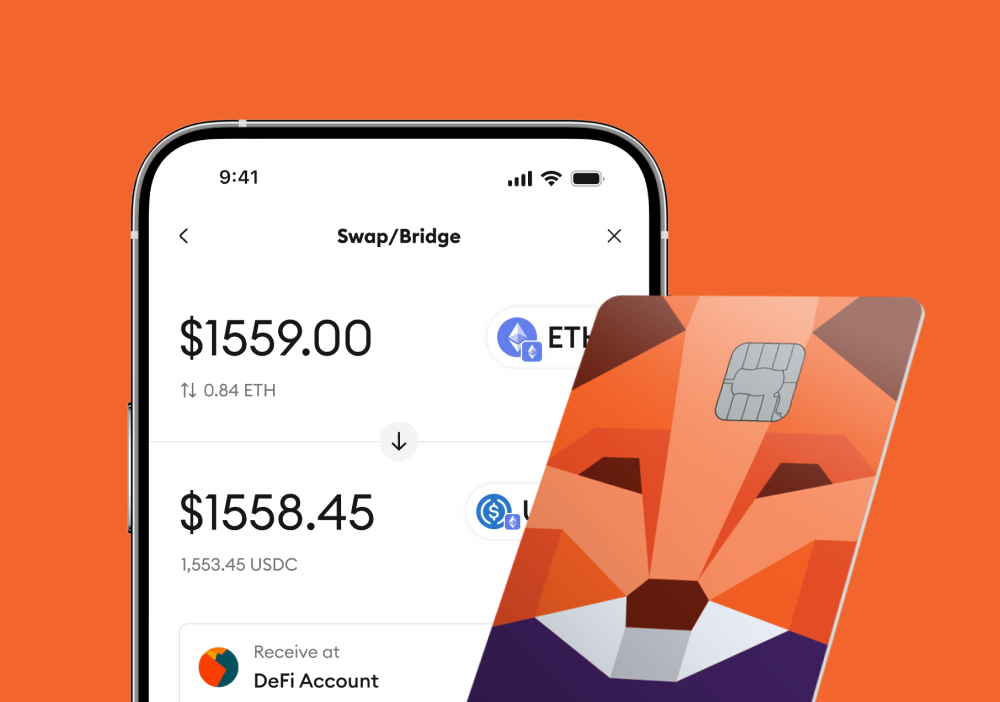
MetaMask’s swap, bridge, and payment-card services
What Is Open Money?
The main announcement tied to MetaMask’s tenth anniversary was its Open Money strategy. MetaMask wants to evolve from a crypto-storage interface into a broader alternative to banking, brokerage, and payment applications. The long-term objective is to allow users to manage a significant share of their financial activity through one platform, including:
- receiving salary payments;
- holding funds in stablecoins;
- earning yield on idle assets;
- purchasing digital and tokenized assets;
- paying for goods and services by card;
- transferring funds to other users;
- trading crypto assets and derivatives;
- accessing financial applications from third-party developers.
The key distinction from a traditional bank is the custody model. MetaMask does not directly control user funds or operate as the sole owner of the underlying financial infrastructure. Users retain control of their assets, while transactions settle through open blockchain networks.
Under the company’s vision, a user could receive a salary directly into MetaMask, allocate part of that income to yield-generating products, make card payments, and invest without repeatedly moving funds between banks, brokers, and crypto exchanges.
The expansion is supported by the rapid growth of the stablecoin market. According to MetaMask, total stablecoin supply exceeded $300 billion in 2026, more than doubling over three years.
Stablecoins increasingly serve as the bridge between conventional money and blockchain infrastructure. They allow users to hold digitally denominated value, make cross-border transfers, and access decentralized financial products without taking on the full price volatility associated with Bitcoin or Ethereum.
Inside the Consensys Business
MetaMask is owned by Consensys, one of the largest infrastructure companies in the Ethereum ecosystem.
Consensys develops MetaMask and blockchain infrastructure for the Ethereum ecosystem
Founded by Ethereum co-founder Joseph Lubin, Consensys operates across several layers of the blockchain market.
MetaMask
A self-custodial wallet and consumer financial platform.
Infura
Cloud infrastructure that allows applications to connect to Ethereum and other blockchain networks without operating their own nodes.
Linea
An Ethereum Layer 2 network designed to support faster transactions at lower cost.
Consensys Staking
Infrastructure for institutional and enterprise Ethereum staking.
Diligence
Smart-contract auditing and security services.
Developer and Enterprise Tools
A broader suite of products for building wallets, blockchain applications, networks, and institutional solutions.
For prospective investors, Consensys therefore represents more than exposure to a single crypto wallet. It is a vertically integrated blockchain platform serving consumers, developers, decentralized applications, and institutional clients.
Funding History and Valuation
Consensys completed several major funding rounds before beginning preparations for a potential IPO.
In November 2021, the company raised $200 million at a valuation of $3.2 billion. Investors included Third Point, Marshall Wace, ParaFi Capital, Coinbase Ventures, HSBC, Animoca Brands, and others.
In March 2022, Consensys closed a $450 million Series D round at a valuation above $7 billion, more than doubling its valuation in roughly four months. The round was led by ParaFi Capital, with Microsoft, SoftBank Vision Fund 2, and Temasek among the new investors.
Consensys has not publicly disclosed an updated valuation since 2022. Its eventual IPO valuation will therefore depend on the company’s latest financial performance, crypto-market conditions, Ethereum activity, and investor confidence in MetaMask’s transition from a wallet into a broader financial platform.
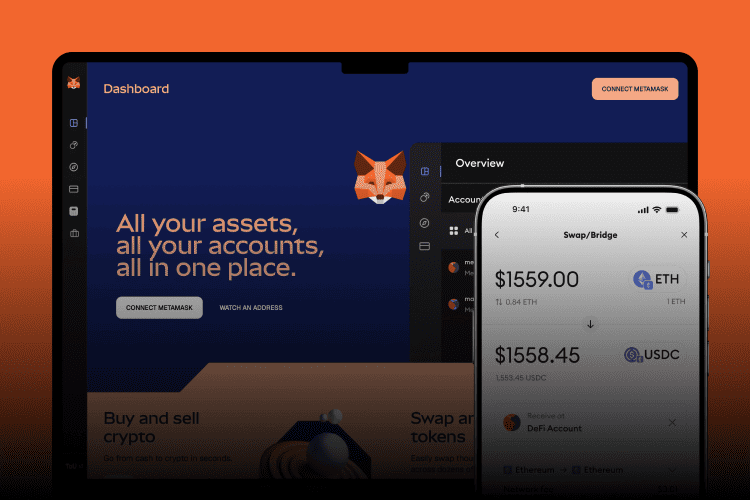
MetaMask across desktop and mobile interfaces
What Is Known About the IPO Preparations
The first specific reports that Consensys was preparing for a public listing emerged in October 2025.
According to media reports, the company selected JPMorgan and Goldman Sachs as advisers. A 2026 listing was initially discussed, with later reports pointing to fall 2026 as a possible window. The timing remains dependent on market conditions.
Hiring major investment banks generally indicates that a company has moved into a more advanced phase of IPO preparation. At this stage, companies typically:
- bring financial reporting in line with public-market requirements;
- determine the legal and corporate structure of the offering;
- assess a potential valuation range;
- develop the equity story presented to investors;
- conduct preliminary discussions with institutional buyers;
- prepare registration documents for the SEC;
- evaluate the most favorable listing window.
Bank appointments do not guarantee that an IPO will proceed. Consensys could delay the transaction, revise its structure, or abandon the listing if market conditions deteriorate.
As of July 2026, Consensys had not publicly announced an S-1 filing, exchange, ticker, offering size, or target valuation.
Why a Consensys IPO Could Draw Investor Interest
Most listed crypto companies are concentrated in exchange operations, mining, or stablecoin issuance.
Consensys offers exposure to a different segment of the market: the infrastructure through which users and developers access Ethereum and other blockchain networks. Several parts of the investment case could attract public-market investors.
- MetaMask Is a Major Gateway Into the Crypto Economy
More than 100 million downloads give MetaMask substantial consumer reach. The wallet is already integrated across thousands of crypto applications and remains one of the sector’s most recognizable brands. - The Business Has Multiple Monetization Channels
MetaMask earns fees from swaps, bridges, crypto purchases, staking, trading, and related services. Its payment card, Money Account, yield products, and tokenized-asset offering could broaden monetization beyond conventional wallet activity.
Infura and other enterprise products add an infrastructure-based revenue stream serving developers and institutional clients. - Consensys Operates Across Several Layers of the Market
When user activity rises, MetaMask benefits. When blockchain application development expands, demand for Infura can increase. If Ethereum activity continues moving to Layer 2 networks, Linea provides exposure to that transition. - Open Money Expands the Addressable Market
Historically, MetaMask competed primarily with other crypto wallets. Its new strategy brings it into closer competition with neobanks, payment applications, crypto exchanges, and brokerage platforms. That expands the company’s addressable market, but it also increases execution, competition, and regulatory risk.
MetaMask’s official tenth-anniversary artwork. Source: MetaMask
The Regulatory Factor
One of the most significant issues facing Consensys ahead of a potential IPO was its dispute with the US Securities and Exchange Commission.
In June 2024, the SEC sued the company, alleging that certain functions offered through MetaMask Swaps and MetaMask Staking could fall under US securities laws.
In 2025, the SEC and Consensys agreed to end the litigation, and the regulator dismissed its civil enforcement action.
The closure of the case removed one of the company’s most visible legal uncertainties ahead of a possible listing. Nevertheless, the regulatory framework for self-custodial wallets, staking, stablecoins, and digital-asset trading continues to evolve.
In May 2026, Consensys submitted additional proposals to the SEC, calling for clearer treatment of self-custodial wallets that allow users to transact without transferring control of their assets to an intermediary.
What Is Known About the MASK Token
Another potential catalyst is the launch of a native MetaMask token.
In September 2025, Joseph Lubin confirmed that a MetaMask token was in development and suggested that it could arrive sooner than many expected. He later said that Consensys planned to introduce tokens across the economies of several of its products.
The token is widely expected to use the ticker MASK, although MetaMask has not officially disclosed:
- a launch date;
- total supply;
- tokenomics;
- the token’s utility;
- eligibility criteria for any distribution;
- participation requirements;
- details of any potential airdrop.
It is therefore too early to state that MASK will definitely launch before the end of 2026. Management has confirmed that work is underway, but no formal timetable has been published.
Potential uses could include governance, ecosystem rewards, user incentives, or a more decentralized operating model. The actual structure will remain unclear until MetaMask makes an official announcement.
MetaMask branding displayed on digital screens
Key Risks Ahead of a Potential IPO
Despite MetaMask’s scale, an investment in Consensys would carry several material risks.
- Exposure to Crypto-Market Cycles
Transaction volume, trading activity, and fee revenue can decline sharply during periods of weaker crypto-market activity. - Competition
MetaMask competes with Trust Wallet, Phantom, Coinbase Wallet, Rabby, OKX Wallet, and other wallet providers. Its expansion into payments and investing also brings it into competition with fintech platforms, neobanks, and brokerages. - Regulation
Rules governing stablecoins, staking, self-custodial wallets, tokenized assets, and digital-asset trading remain subject to change. - Security
MetaMask does not directly custody user assets, but it remains a critical interface for signing transactions. Phishing, malicious applications, smart-contract exploits, and user error can still damage trust in the brand. - Limited Financial Disclosure
Consensys remains privately held and does not disclose financial information to the standard required of a listed company. Until an offering document is published, investors cannot fully assess current revenue, margins, expenses, profitability, customer concentration, or business-segment performance. - Uncertain IPO Timing
The preparation process could take longer than expected. The transaction will depend on both equity-market conditions and sentiment toward crypto-related companies.
What MetaMask’s First Decade Means for Investors
MetaMask’s first ten years were largely defined by making Ethereum more accessible and helping establish the self-custodial wallet category.
Its next stage is considerably more ambitious. The company is attempting to build a comprehensive financial platform spanning payments, savings, investing, and digital assets.
For Consensys, the strategy creates an opportunity to expand its user base and increase revenue per customer. For investors, a future IPO could provide a relatively rare route to public-market exposure to Ethereum infrastructure.
The central question, however, will be monetization. More than 100 million downloads and strong global brand recognition provide a compelling foundation, but public-market investors will require detailed evidence on revenue growth, profitability, user engagement, customer retention, and sensitivity to crypto-market cycles.
Those metrics, rather than headline download figures alone, will ultimately determine how the market values Consensys.
A pre-IPO position in Consensys/MetaMask is available to investors through the Regolith platform.
Investments in private companies involve elevated risk and limited liquidity. A potential IPO, its timing, and future returns are not guaranteed.
