

SpaceX valuation hits $1.25 trillion in xAI merger – the largest deal in history
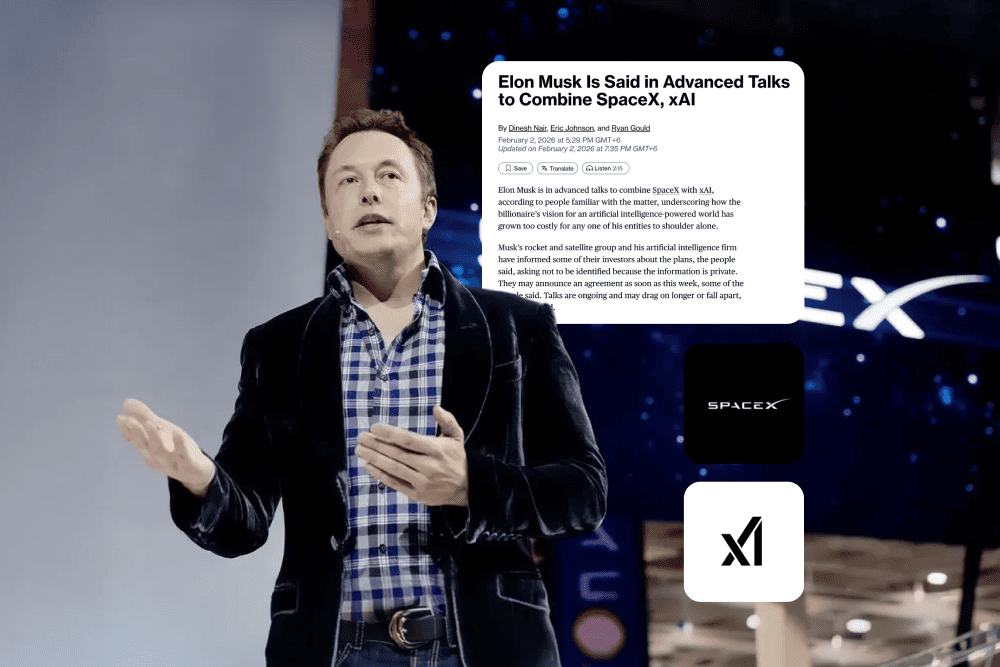
Shares priced at $526 apiece as IPO shapes up to be the biggest ever.
A historic deal
Elon Musk's space company SpaceX and AI startup xAI have officially merged. According to Bloomberg and The Wall Street Journal, the combined valuation reached $1.25 trillion – with SpaceX valued at $1 trillion and xAI at $250 billion. This marks the largest private company merger in history.
The deal was structured as a stock-for-stock transaction: xAI shareholders received equity in the combined company in the form of SpaceX shares. The share price was set at $526.59, with a conversion ratio of 0.1433 – meaning each xAI share converts into 0.1433 SpaceX shares.
xAI employees have the option to exit: they can sell their shares back to the company at the set price if they prefer not to remain invested in the combined entity.
Both companies saw significant valuation increases compared to previous rounds. In December 2025, SpaceX was valued at $800 billion during an insider share sale. In January 2026, xAI raised funding at a $230 billion valuation from Founders Fund, Fidelity Investments, and Google Ventures.
Space-based AI: the driving force behind the merger
In a memo to employees, Musk explained the rationale: to create a vertically integrated company combining AI, rocket engineering, satellite internet, and media – "the most ambitious innovation engine on Earth and beyond."
The core idea is to deploy AI data centers in space. Musk believes this will become the cheapest way to scale AI computing power within two to three years.
"Current advances in AI depend on large terrestrial data centers that require immense amounts of power and cooling. Global electricity demand for AI simply cannot be met with ground-based solutions without harming communities and the environment. In the long run, space-based AI is the only way to scale," the company stated.
On January 30, SpaceX filed a request with the U.S. Federal Communications Commission (FCC) to launch up to 1 million satellites into low Earth orbit. These solar-powered satellites will supply energy to orbital computing centers.
"The capabilities we unlock through space-based data centers will fund and enable self-sustaining bases on the Moon, an entire civilization on Mars, and ultimately – expansion across the Universe," Musk wrote.
What is xAI and the Grok chatbot
xAI is an artificial intelligence startup founded by Elon Musk in 2023. Its flagship product is Grok, a chatbot competing with OpenAI's ChatGPT and Google's Gemini.
Key features of Grok:
• Real-time integration with the internet and social network X
• Advanced reasoning and analytical capabilities
• Image and video generation via Grok Imagine API
• Specialized grok-code-fast-1 model for programming
In 2026, xAI plans to release Grok 5 with 6 trillion parameters and native video understanding. The company also launched xAI For Government – a suite of AI products for U.S. government agencies.
xAI started as a division of social network X (formerly Twitter), using platform data to train its models. By spring 2025, it was spun off as a separate entity and attracted investments that exceeded X's own valuation.
What the combined company controls
Following the merger, SpaceX now controls a vast technology ecosystem:
Space assets:
• Falcon 9 and Falcon Heavy rockets – the workhorses of commercial launches
• Dragon spacecraft for cargo and astronaut transport to the ISS
• Starship heavy-lift rocket – key to Mars colonization
• Starlink satellite network with over 9 million users worldwide
• Direct-to-Cell technology for satellite-to-smartphone connectivity
AI and media:
• Grok chatbot and xAI infrastructure
• Social network X with hundreds of millions of users
• Colossus data center in Memphis – one of the world's largest AI clusters
Starlink accounts for 65% of all active satellites in orbit. The company adds over 20,000 new users daily and ranks as the seventh-largest internet provider in the U.S.
Mars ambitions
Слияние с xAI ускорит реализацию главной мечты Маска – колонизации Марса. The xAI merger will accelerate Musk's ultimate dream – colonizing Mars. SpaceX plans to send its first uncrewed Starship missions to the Red Planet by late 2026, taking advantage of a favorable launch window.
Under optimistic projections, up to five uncrewed Starships could head to Mars in 2026. The key milestone is a successful orbital refueling demonstration scheduled for this year.
Musk puts the odds of meeting the 2026–2027 window at 50%. If timelines slip, the company will target the next launch window. The long-term goal remains building a self-sustaining city on Mars.
Tesla's role in the new structure
Although Tesla wasn't part of the merger directly, it remains closely tied to the combined company. In January 2026, Tesla announced a $2 billion investment in xAI.
Musk envisions xAI as an "orchestra conductor" for Tesla factories equipped with autonomous robots. The company made a dramatic pivot: discontinuing production of Model S and Model X in favor of manufacturing Optimus humanoid robots.
Optimus production is set to begin before the end of 2026. Tesla's Fremont, California plant will be repurposed to support new initiatives. Musk has said that Optimus robots will "unlock a world without poverty."
Tesla is already using a limited number of Optimus robots at its facilities and plans to begin production for external customers in 2026.
The largest IPO in history
SpaceX is planning to go public in June 2026. According to the Financial Times, Musk wants to time the IPO with his birthday (June 28) and an astronomical event – the conjunction of Jupiter and Venus.
The offering is expected to raise up to $50 billion at a valuation of approximately $1.5 trillion. This would make it the largest IPO ever, surpassing Saudi Aramco's $29 billion listing in 2019.
Emily Zheng, senior analyst at Pitchbook, explained the logic behind pre-IPO consolidation: "The sheer cost of compute, infrastructure, and energy is why the largest venture-backed startups are preparing to go public. Consolidation allows SpaceX to present public investors with a differentiated growth narrative."
Emma Wall, chief investment strategist at Hargreaves Lansdown, noted: "Musk is the market leader in two cutting-edge technologies: AI and space exploration. These valuations reflect a multi-decade vision for the company." However, she cautioned that potential benefits "won't materialize on Earth for 10, 20, or even 30 years."
What remains outside the merger
Neuralink (brain-computer interfaces) and The Boring Company (tunnel construction) are currently the only Musk ventures not integrated into larger structures. They may eventually join the combined ecosystem as well.
What this means for investors
SpaceX dominates the commercial launch market and holds major contracts with the U.S. government. Starlink is experiencing explosive growth and is approaching global coverage. The integration with xAI opens opportunities in the space-based AI market, which is projected to grow exponentially.
The merger creates a uniquely vertically integrated company – spanning rocket manufacturing, AI systems, satellite internet, and social media. No competitor has anything like it.
Regolith offers access to pre-IPO deals – the opportunity to acquire shares in high-potential companies before they go public. SpaceX shares are not yet available on the open market, but Regolith provides access at the pre-IPO stage.
The retail allocation for SpaceX is currently sold out. However, if you're looking to invest, participation is available starting at $50,000. Contact your manager for details.
