

The Entire Market in One Trade: How ETFs Changed the Game for Individual Investors

In the past, building a diversified portfolio required retail investors to analyze quarterly earnings, compare valuation multiples, and manually select dozens of individual stocks. Meaningful diversification was largely the domain of institutional funds with multi-million-dollar capital and dedicated research teams.
Today, that challenge is solved by ETFs — Exchange-Traded Funds. An ETF holds a basket of securities and trades on an exchange like a regular stock.
This structure has effectively removed the barrier between retail and institutional investors. On the Regolith platform, investors can access ETFs that provide exposure to Apple, Microsoft, Amazon, and other global market leaders within a single, structured investment strategy.
 What Is an ETF?
An ETF is an exchange-traded investment vehicle that tracks a predefined basket of assets — equities, bonds, commodities, or a combination thereof — and issues shares backed by that portfolio. By purchasing a single ETF share, an investor gains proportional exposure to all underlying holdings.
For example, buying the SPY ETF provides exposure to the S&P 500 Index — representing 500 of the largest publicly traded U.S. companies. This is the core advantage of ETFs: broad diversification through a single transaction, without the operational complexity of building a portfolio stock by stock.
Structurally, ETFs are similar to traditional mutual funds in that both pool investor capital into a collective portfolio. The key difference lies in liquidity and pricing. Mutual funds are priced once per day at net asset value (NAV), whereas ETFs trade intraday on exchanges at market prices — just like individual equities. This provides flexibility: investors can enter or exit positions at any time during market hours and observe real-time pricing without being constrained by end-of-day NAV calculations.

Why Investors Choose U.S. ETFs
While ETFs are globally available, the U.S. market remains the benchmark in terms of infrastructure, liquidity, transparency, and product depth.
- Liquidity and execution speed.
The largest U.S. ETFs are among the most actively traded instruments worldwide. SPY alone averages over $30 billion in daily trading volume. Investors can open or close positions within seconds at tight bid-ask spreads. - Low expense ratios.
Competition among major providers — Vanguard, iShares, SPDR, Schwab — has driven expense ratios down to 0.03–0.10% annually. By comparison, European equivalents often range from 0.20–0.40%. Over a 10–20 year horizon, this difference materially impacts net returns. - Breadth of choice.
More than 3,000 ETFs trade on U.S. exchanges, spanning index, sector, country, fixed income, commodity, and thematic exposures. No other market offers comparable product diversity. A fully diversified portfolio can be constructed exclusively through ETFs. - Transparency and regulation.
U.S. ETFs operate under SEC oversight. Portfolio holdings are typically disclosed daily, index methodologies are public, and reporting standards follow US GAAP. Investors maintain clear visibility into underlying exposures. - Access to global leaders.
Through a single ETF, investors gain exposure to Apple, Nvidia, Amazon, Google, and hundreds of other companies shaping the global economy. Many of these corporations derive more than half their revenue internationally — making U.S. ETFs effectively global investment vehicles.
ETF Investment Strategies
ETFs function as modular building blocks, enabling investors to construct portfolios aligned with specific objectives: capital growth, income generation, inflation hedging, or risk balancing.
- Index ETFs.
Track broad benchmarks such as the S&P 500 or NASDAQ-100. Frequently used as the core of long-term “buy and hold” strategies. - Sector and thematic ETFs.
Instead of attempting to identify a single winner in artificial intelligence, cybersecurity, or robotics, investors gain exposure to the entire sector — reducing single-stock risk. Examples include AIQ and BOTZ. - Dividend ETFs.
Focus on companies with consistent dividend payouts and stable financial profiles — suitable for income-oriented strategies. - Defensive ETFs.
Funds linked to gold (e.g., GLTR) or government bonds help preserve capital during periods of market stress and elevated inflation.
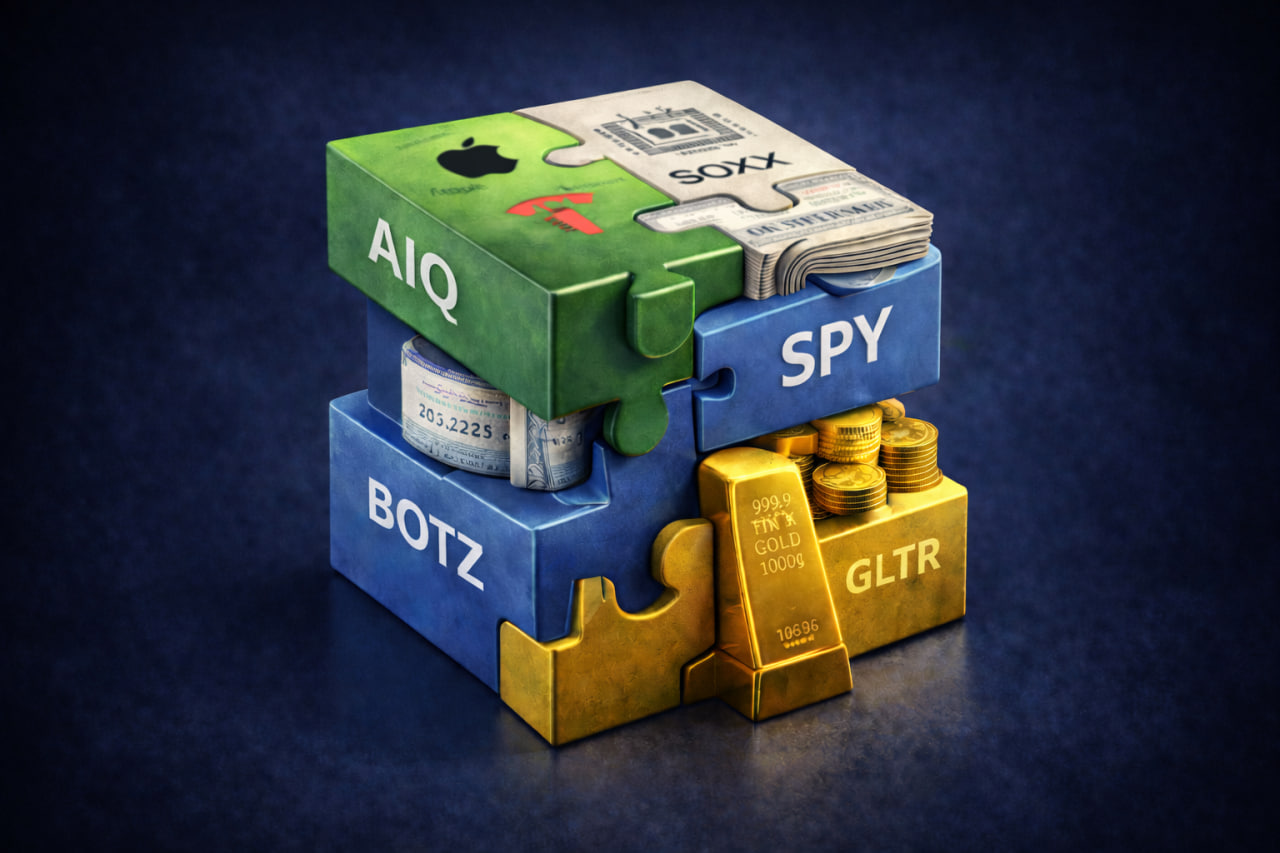
On Regolith, ETFs span these categories. SPY serves as a foundational exposure to 500 leading U.S. corporations. Thematic funds such as BOTZ (robotics), SOXX (semiconductors), and AIQ (artificial intelligence) provide targeted exposure to high-growth technology trends. Meanwhile, GLTR — backed by a basket of physical precious metals — adds a defensive layer to mitigate portfolio volatility.
This combination offers investors a core growth engine, targeted upside potential, and downside protection within a single integrated framework.
ETF Risks: What to Consider
ETFs simplify market access but do not eliminate investment risk.
- Market risk.
An ETF mirrors the performance of its underlying index or sector. While diversification reduces company-specific risk, it does not protect against broad market downturns. - Tracking error.
An ETF may deviate slightly from its benchmark due to fees, portfolio structure, or rebalancing mechanics. This risk is typically more pronounced in niche funds and less significant among large providers. - Currency exposure.
If your base currency is not U.S. dollars, total returns will be influenced by exchange rate fluctuations. Currency movements can either enhance or detract from performance.
Liquidity can also be lower in highly specialized ETFs. For this reason, marketplace curation and selection of structurally sound, actively traded funds remain essential.

Building Your First ETF Portfolio
Constructing a portfolio is not about selecting a single ticker — it is about strategic capital allocation across functions: core stability, growth, and protection.
A widely adopted framework is the Core & Satellite model:
Step 1: Define Allocation
Divide your portfolio into:
- Core (50–70%) — broad market exposure that grows alongside the economy.
- Satellites (20–40%) — thematic ETFs targeting high-growth sectors such as AI, robotics, and semiconductors.
- Defensive (5–15%) — stabilizing assets such as precious metals or bonds.
Step 2: Build the Core
Start with a broad index exposure. SPY, for instance, provides diversified access to 500 leading U.S. companies and serves as a long-term foundation.

Step 3: Add Satellites
Allocate capital to high-potential sectors:
- AIQ — artificial intelligence and advanced technologies
- BOTZ — robotics and automation
- SOXX — semiconductors and AI infrastructure
This approach enhances growth potential without concentrating risk in a single company.
Step 4: Add Protection
Incorporate defensive exposure — such as GLTR (precious metals) — to buffer volatility during market downturns.
Step 5: Maintain Discipline
Consistent contributions and systematic allocation matter more than perfect market timing. A disciplined approach mitigates volatility and supports long-term capital compounding.
ETFs make institutional-grade diversification accessible to individual investors. A single fund can replace dozens of individual trades, providing transparent, liquid exposure to entire sectors of the global economy.
Only a few years ago, such portfolio construction was primarily the domain of asset managers overseeing multi-million-dollar mandates. Today, through ETFs and platforms like Regolith, private investors can apply the same strategic frameworks — choosing their preferred allocation and managing risk with precision.
