

What Is an ETF and How to Choose a Fund for Your Investment Goals, Time Horizon, and Risk Tolerance

An ETF, or exchange-traded fund, is an investment fund that holds a basket of assets such as stocks, bonds, commodities, or a combination of different securities. In simple terms, an ETF allows investors to gain exposure to a group of assets through a single investment rather than buying each security separately.
ETF shares trade on a stock exchange throughout the trading day, much like shares of public companies. Investors can buy or sell them through a brokerage account at the current market price. The value of an ETF generally reflects the value of the assets held in its portfolio.
Many ETFs track a specific index, sector, or investment theme. For example, SPY tracks the S&P 500, SOXX focuses on semiconductor companies, BOTZ provides exposure to robotics and artificial intelligence, while GLTR invests in a basket of precious metals.
How ETFs Differ from Mutual Funds
ETFs and mutual funds follow a similar basic structure: investors pool their capital, and the fund allocates that money across a portfolio of assets. The main difference is how investors buy and sell their holdings.
ETF shares trade on an exchange and their prices move throughout the trading session. Investors can see the current quote and place buy or sell orders while the market is open.
Traditional mutual funds usually work differently. Investors buy or redeem shares through the fund or its provider, with transactions typically processed based on the fund’s calculated net asset value rather than a continuously changing intraday market price.
In this sense, an ETF combines the diversified structure of an investment fund with the trading mechanics of a publicly listed security.
History of ETFs
ETFs were developed to combine the diversification of investment funds with the ability to trade shares freely on a stock exchange.
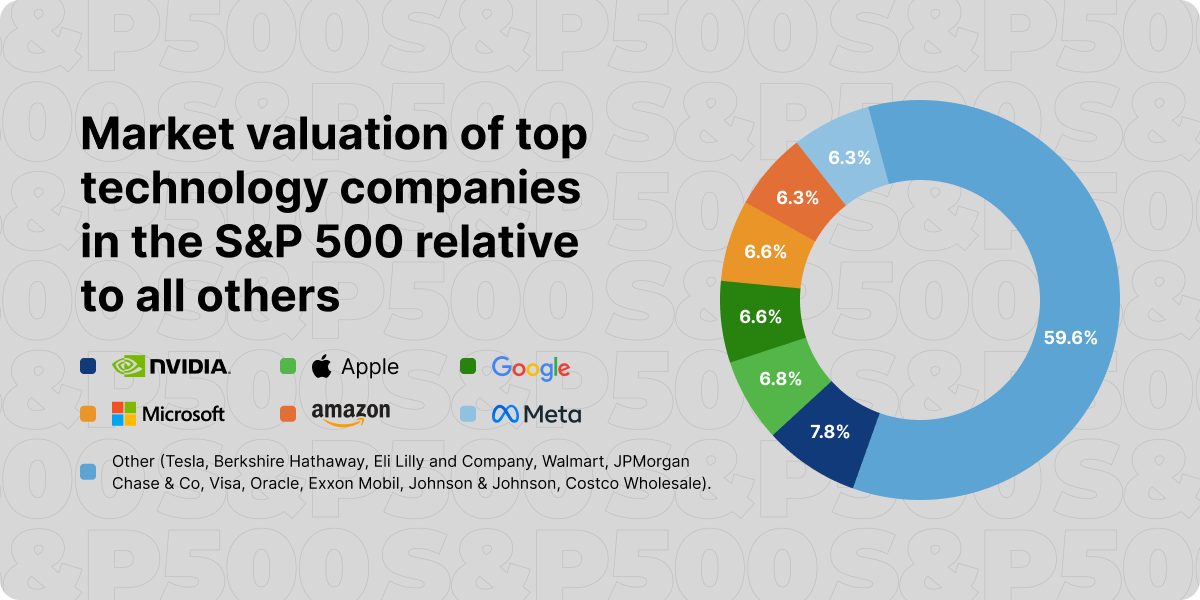
One of the key milestones came in January 1993 with the launch of the SPDR S&P 500 ETF Trust, or SPY. It became the first ETF listed in the United States and gave investors a way to gain exposure to the S&P 500 through a single security.
The market later expanded into funds covering individual countries, industries, bonds, commodities, and specific investment themes. Today, ETFs can provide exposure to everything from the broad US stock market to semiconductors, cybersecurity, robotics, nuclear energy, and power-grid infrastructure.
Actively managed ETFs have also become more common, allowing portfolio managers to select investments rather than simply replicate an index.
What Assets Are Included in ETFs?
The assets inside an ETF depend on its strategy. Equity ETFs invest in stocks and can hold hundreds of companies or focus on a relatively small group within one industry.
Bond ETFs invest in government or corporate debt. Commodity funds provide exposure to assets such as gold, silver, and other raw materials. ETFs can also focus on real estate, infrastructure, technology, or other asset classes.
ETF options available on Regolith include:
- SPY – the broad US equity market through the S&P 500;
- SOXX and SMH – semiconductors;
- AIQ – artificial intelligence and technology;
- GRID – power grids and energy infrastructure;
- ARKG – genomics and biotechnology;
- BOTZ – robotics and artificial intelligence;
- VDE – the energy sector;
- URA и NLR – uranium and nuclear energy;
- RING и GLTR – gold and precious metals.
Two ETFs can therefore have very different risk profiles even though both are exchange-traded funds.

Types of ETFs
ETF funds differ by asset class, investment strategy, and portfolio composition.
One of the most common types is a broad-market index ETF. These funds track major indexes and spread investments across a large number of companies. SPY, for example, tracks the S&P 500.
- Sector ETFs focus on one industry. SOXX and SMH provide exposure to semiconductor companies, while VDE invests in the energy sector.
- Thematic ETFs are built around long-term trends such as artificial intelligence, robotics, cybersecurity, or power infrastructure.
- There are also bond ETFs and commodity ETFs, while both passive and actively managed strategies are available across different categories.
Broad-market ETFs generally provide greater diversification, while sector and thematic funds are more concentrated and therefore more sensitive to developments in a particular industry.
How ETF Prices Are Determined
An ETF has two related values: its net asset value, or NAV, and its market price.
NAV is calculated based on the value of the fund’s assets minus its liabilities. The market price, meanwhile, is determined by supply and demand on the exchange.
The two values may differ slightly. An ETF can trade above its NAV, known as a premium, or below it, known as a discount.
For investors, the bid-ask spread also matters. More liquid ETFs generally have narrower spreads, which can reduce trading costs.

How ETFs Are Traded on the Exchange
ETF shares are securities that represent an interest in the assets held by the fund. They can be bought and sold through a brokerage account while the exchange is open. The mechanics are similar to trading individual stocks: an ETF has a ticker, a market price, and buy and sell orders.
Investors can purchase SPY, SOXX, or another ETF at the current market price or use a limit order to set the maximum price they are willing to pay.
Other factors to consider include trading volume, liquidity, the bid-ask spread, and the fund’s expense ratio, which represents its annual operating costs.
Risks of Investing in ETFs
ETFs provide diversification, but they still carry investment risk.
- Market risk means that a broad-market fund can decline when the overall market falls.
- Concentration risk is more relevant for sector and thematic ETFs, where performance can depend heavily on a single industry or investment trend.
- Investors should also consider currency risk, liquidity risk, changes in bid-ask spreads, and tracking error – the difference between an ETF’s actual performance and the index it is designed to follow.
The performance of ETFs available on Regolith in 2026 illustrates these differences. Some funds gained more than 40% over the same period, while other sectors went through significant corrections. The risk profile of an ETF therefore depends largely on the assets and industries it holds.
ETF Returns
ETF returns primarily come from changes in the value of the underlying assets. Some funds may also distribute dividends or other income, depending on their structure.
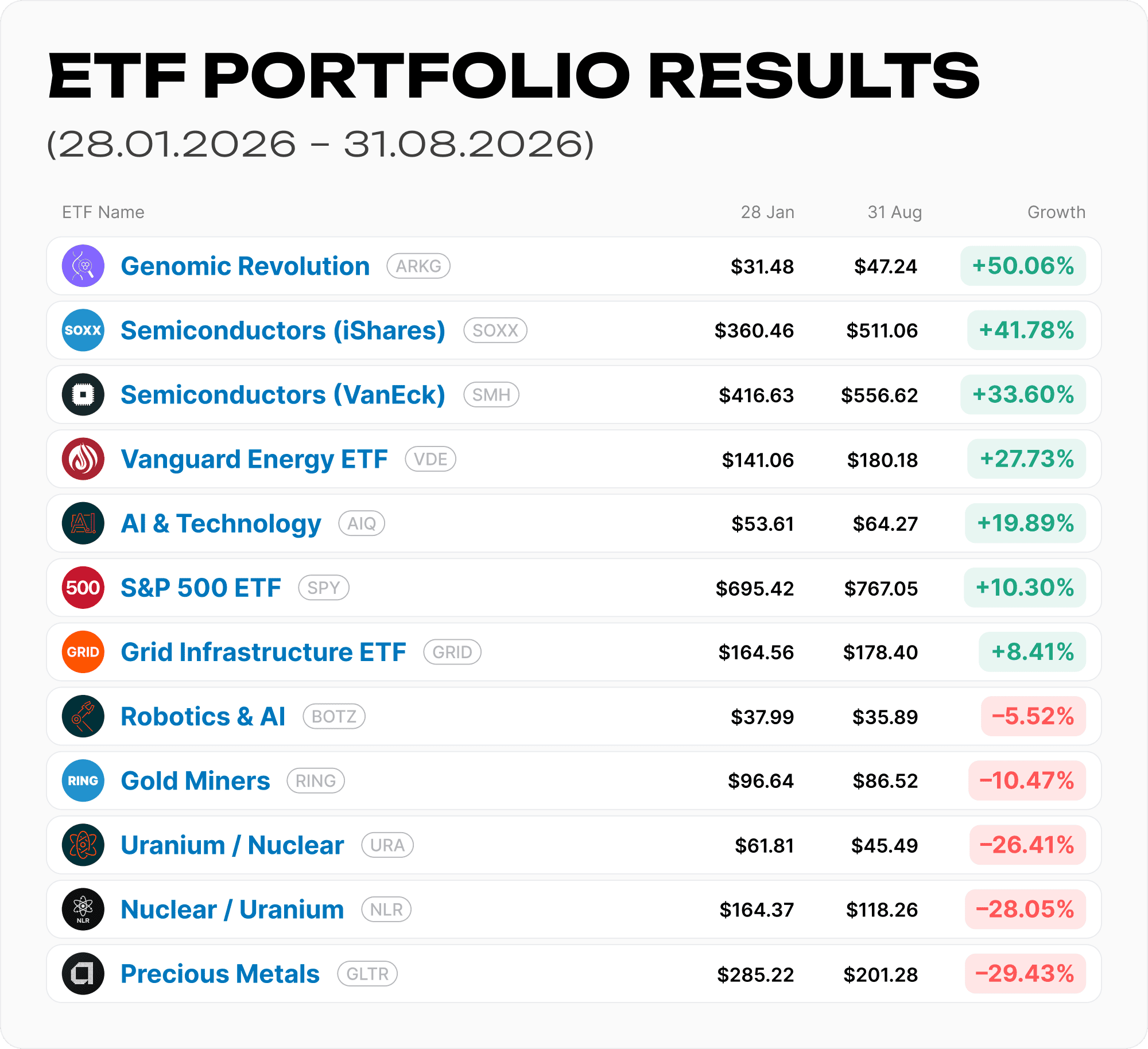
ETFs became available on Regolith on January 28, 2026. As of August 31, performance since launch varied significantly across sectors.
AI, Semiconductors and Infrastructure
SOXX +41.78% | SMH +33.60% | AIQ +19.89% | GRID +8.41%
SOXX delivered the strongest performance in this group, gaining around 41.8% since launch. Semiconductor stocks benefited from continued demand for AI infrastructure and computing capacity, despite a correction in the second half of August.
Genomics and Biotechnology
ARKG +50.06%
ARKG gained around 50% since its launch on Regolith. The genomics and biotechnology sector was supported by positive clinical developments and regulatory decisions, although the fund gave back part of its gains in the second half of August.
Robotics
BOTZ −5.52%
BOTZ showed weaker performance than AI and semiconductor ETFs. Robotics remains at an earlier stage of commercial adoption, which has contributed to more moderate performance.
Energy and Nuclear
VDE +27.73% | URA −26.41% | NLR −28.05%
Traditional energy performed better than uranium and nuclear-focused funds over the period. VDE benefited from higher oil prices, while URA and NLR showed weaker performance following strong gains in 2025.
Gold and Precious Metals
Precious metals rose strongly at the beginning of the year before giving back part of those gains. Higher interest rates and a stronger US dollar weighed on the sector, although prices partially recovered later in August.
Broad US Market
SPY +10.30%
The S&P 500 advanced at a more moderate pace than the strongest thematic ETFs. Large technology companies and continued investment in AI remained important drivers of the broader US market.
Across the first seven months since ETFs launched on Regolith, biotechnology and semiconductors produced the strongest results. Performance also differed significantly within related themes: AI chips outperformed robotics, while traditional energy performed better than nuclear-focused funds.
How to Buy an ETF
To buy an ETF, investors need a brokerage or investment account that provides access to the exchange where the fund is listed. The next step is to select the ETF by ticker, choose the amount to invest, and place a buy order.
Before purchasing a fund, investors should review its holdings, benchmark or strategy, expense ratio, liquidity, bid-ask spread, and historical performance. Regolith offers access to broad-market ETFs such as SPY, as well as sector and thematic funds including SOXX, AIQ, ARKG, BOTZ, and others.
ETFs can be used as a diversified core allocation or to gain exposure to a specific industry or investment theme. The appropriate choice depends on the investor’s objectives, time horizon, and tolerance for risk.
This material is for informational purposes only and does not constitute individual investment advice. Past performance does not guarantee future returns. Investing involves risk, including the possible loss of invested capital.
