

Inside Discord's Path Toward a Potential IPO: New CEO, 10-for-1 Stock Split, and Top-Tier Bookrunners

Discord – one of the largest communication platforms in the world – has spent more than a year making moves that the financial press has interpreted as steps toward going public. Over this period, the company changed its CEO, completed a 1-for-10 forward stock split, and engaged two of the largest investment banks for a potential offering.
In this article, we unpack three key corporate moves Discord has made over the past year, look at what they suggest about a potential path to the public market, and explain what's happening with the Discord pre-IPO position on the Regolith platform.
A Strategic Reset: New CEO in April 2025
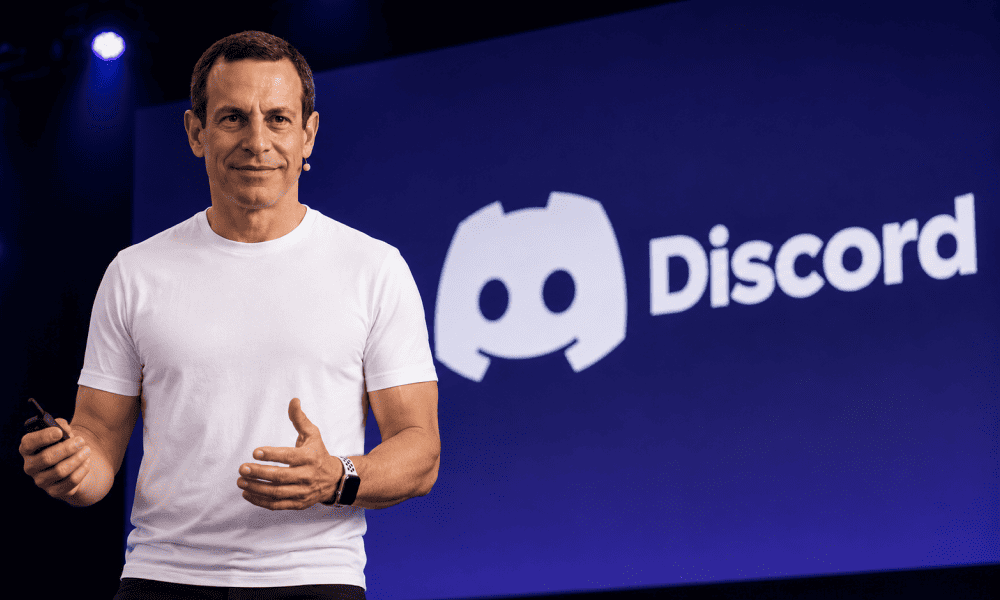
The first and arguably most significant move in this sequence was the leadership change. On April 28, 2025, Discord announced that Jason Citron – the company's co-founder and CEO since inception – was handing over management to Humam Sakhnini, the former Vice Chairman of Activision Blizzard. Citron stayed on the Board of Directors, transitioning into an advisor role to the new CEO.
Sakhnini brings more than 15 years of experience in the gaming industry to Discord. At Activision Blizzard, he oversaw a multi-billion-dollar portfolio of franchises – Call of Duty, World of Warcraft, Candy Crush. Before that, he served as CFO of Activision Blizzard.
Citron, at the time of the announcement, said Discord had hired Sakhnini "to lead Discord through our next chapter of growth and someday becoming a public company."
The financial press often reads such appointments as a corporate signal of preparation for the public market: a founder stepping aside in favor of a manager with experience scaling mature businesses and working with public markets.
1-for-10 Stock Split: February 2026
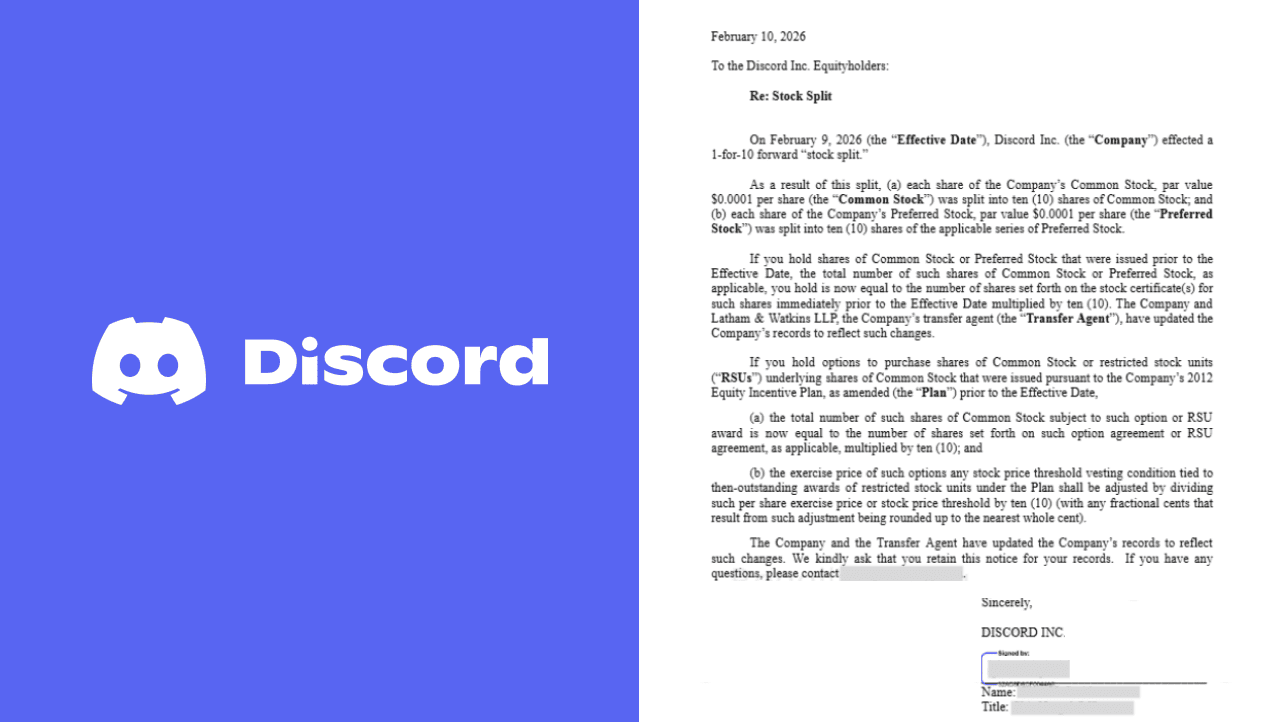
The second notable move was a corporate procedure to restructure the share capital. According to Discord Inc.'s filing dated February 10, 2026, the company officially completed a 1-for-10 forward stock split. The effective date was February 9, 2026. After the split, every share of Common Stock and Preferred Stock automatically divided into 10 new ones. The same adjustments applied to RSUs, options, and other equity instruments held by employees.
How it works in practice: if a shareholder held 100 Discord shares before the split, they now hold 1,000 shares. The total value of the position stays the same; the price per share decreases proportionally.
he Split in Regolith Accounts
The same split has already been automatically mirrored in the personal accounts of every pre-IPO Discord holder on the Regolith platform.
Example of the recalculation:
- Before: 10 shares purchased at $830 = $8,300 (total cost)
- After: 100 shares at $83 = the same total of $8,300
Share count multiplied by 10, price per share divided by 10. The total value of each holder's position remains unchanged.
Why Companies Run Splits Ahead of a Potential Public Offering
A split on its own doesn't increase the value of a business. But it makes the capital structure more suitable for the public market:
- Prepares the cap table for a listing
- Streamlines secondary market trading
- Improves share liquidity
- Lowers the entry threshold for retail participants after a potential offering
Historically, most large technology companies have run splits shortly before going public, or during periods of scaling liquidity.
Where Discord Stands on Public Market Preparation as of Late May 2026
The third move involves the actual prep for filing a prospectus and engaging with investment banks. The timeline looks like this:
- January 2026 – Discord filed a confidential S-1 with the SEC. This is the first formal step toward a public listing.
- March 2026 – according to the Financial Times, Discord is in active discussions with banks. Among the lead bookrunners are Goldman Sachs and JPMorgan – two of the largest investment banks with deep experience taking technology companies public.
- February 2026 – the 1-for-10 stock split was completed.
- May 2026 – the public version of the S-1 has not yet been filed. Analysts note that four months have passed since the confidential submission. According to Polymarket, prediction markets are pricing the probability of Discord not going public by June 30, 2026, at around 74.5 percent. That suggests the window may shift to the second half of the year or early 2027.
Some sources point to October 16, 2026 as a possible listing date, but it has not been officially confirmed.
 Valuation: Somewhere Between $7B and $25B
Discord's valuation varies significantly across different markets:
- The last primary funding round – September 2021, $500M raised at a $15B valuation
- Microsoft offered to acquire Discord for $12B in 2021 – the company turned the offer down, choosing to stay independent
- The secondary market in 2026 values Discord at $7–10B – below the 2021 peak, reflecting the broader cooldown in the tech sector across 2022–2024
- Analysts cite $25B as a possible target at IPO, based on a 20–25x multiple applied to estimated annual revenue of $800–900M
By analyst consensus, the $25B figure is considered "ambitious but achievable" under favorable market conditions.
Discord by the Numbers
Discord was founded in 2013 by Jason Citron and Stanislav Vishnevskiy as a voice communication platform for gamers. Over a decade later, it has grown into one of the largest communication services in the world:
- More than 200M monthly active users
- Estimated annual revenue of $800–900M, growing at double-digit rates year over year
- Around 200,000 partner servers
- Nitro paid subscription – the company's primary revenue source
- New monetization streams – advertising, microtransactions, and in-app purchases
Since 2021, Discord has expanded its audience well beyond gaming. Startup communities, education projects, creative teams, businesses, and crypto communities now make up a significant share of the user base.
Back to Gaming Roots
In the press release announcing the new CEO, Discord confirmed that it is once again leaning into its "gaming roots." Sakhnini sees further monetization coming through advertising, microtransactions, and deeper gamer engagement. This is a turn away from the 2021–2023 strategy, when Discord was trying to broaden into non-gaming audiences.
By analyst consensus, a sharper focus on gaming may be strategically sound ahead of a potential IPO: gaming is a clear, scalable category for public market analysts, with transparent user retention economics.
Why This Matters Right Now
The IPO market in 2026 is gradually reopening after a prolonged cooldown. Names like SpaceX, Anthropic, OpenAI, Databricks, and Discord are coming up more often in conversations about the next wave of major listings. By analyst consensus, Discord's moves on the cap table, the CEO change, and the engagement with two of the largest investment banks can be read as part of broader preparation for a public market debut.
Discord remains one of the most talked-about private tech companies in the world. With more than 200M users and an estimated $800–900M in annual revenue, the platform has long been on shortlists of major technology IPO candidates.
Pre-IPO Discord on the Regolith Platform
Pre-IPO access to Discord is open on the Regolith platform at the updated price of $83 per share. After the split, the entry threshold dropped by a factor of 10, making the position significantly more accessible to new participants.
At the moment, a limited allocation in Discord is available on the platform – approximately $100,000.
As a potential listing draws closer, available allocations decrease. The Regolith team continues to closely follow the situation and will share timely updates on any key developments.
This material is for informational purposes only and does not constitute investment advice. Any decision to go public is made by the company itself – timing and terms may change. Any decisions regarding pre-IPO positions should be made independently, with consideration of individual financial circumstances and risk profile.
