

SpaceX before its IPO: the long road to the largest stock market offering in history
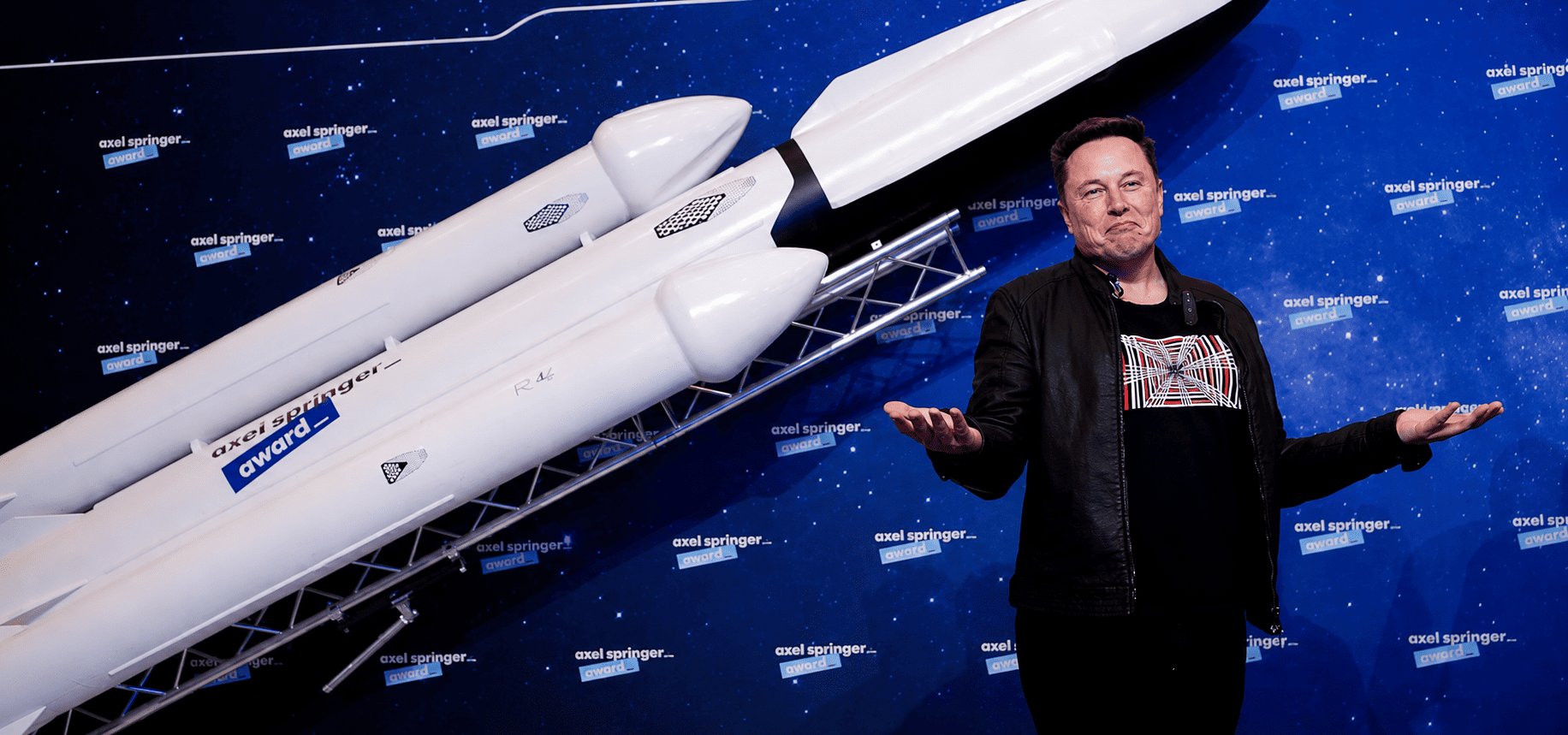
SPCX is set to begin trading on the Nasdaq in early June – the ticker for Space Exploration Technologies Corp, better known as SpaceX. At a stated valuation of $1.75–2 trillion and a planned raise of around $75 billion, this would be the largest offering in stock market history, beating Saudi Aramco's previous record by more than double.
In just three months, SpaceX absorbed xAI, restructured its capital, filed an S-1 with the SEC, carried out a 5-for-1 stock split, and signed a multibillion-dollar deal with Anthropic. In three months, the company closed a pre-listing agenda that usually stretches over years.
The long road to the public market
SpaceX's path to the public market began long before the S-1 filing. As early as 2022, blocks of its shares were changing hands on secondary platforms at a valuation of around $100 billion – the market saw a Starlink IPO as only a matter of time. But Elon Musk kept putting off a listing, explaining that the company had not yet reached steady profitability and was not ready for public reporting.
The valuation has come a long way since. By early 2024, tender offers to employees and option holders were running at around $350 billion. In December 2025, SpaceX held a tender offer at $421 per share, implying a valuation of roughly $800 billion – already on par with giants like Visa and ExxonMobil. On secondary platforms such as Forge Global and Hiive, transactions were going through at even higher prices, reaching $595–674 per share: the market was pricing in a premium for the coming listing.
Everything changed in February 2026, when SpaceX closed its merger with xAI. According to Bloomberg, the combined company was valued at $1.25 trillion – $1 trillion for SpaceX and $250 billion for xAI – and Musk himself called it the largest deal in history. From there, events moved fast: over fifteen weeks, the target IPO valuation doubled to $1.75–2 trillion.
The stock split as a signal of the public offering
On May 16, 2026, SpaceX shareholders approved a 5-for-1 stock split, and the operation was completed by May 22. A single share now costs around $105 instead of the previous $526, while the number of shares in each position grew fivefold. The total value of a portfolio stayed the same. Regolith clients can already see the change in their portfolios.
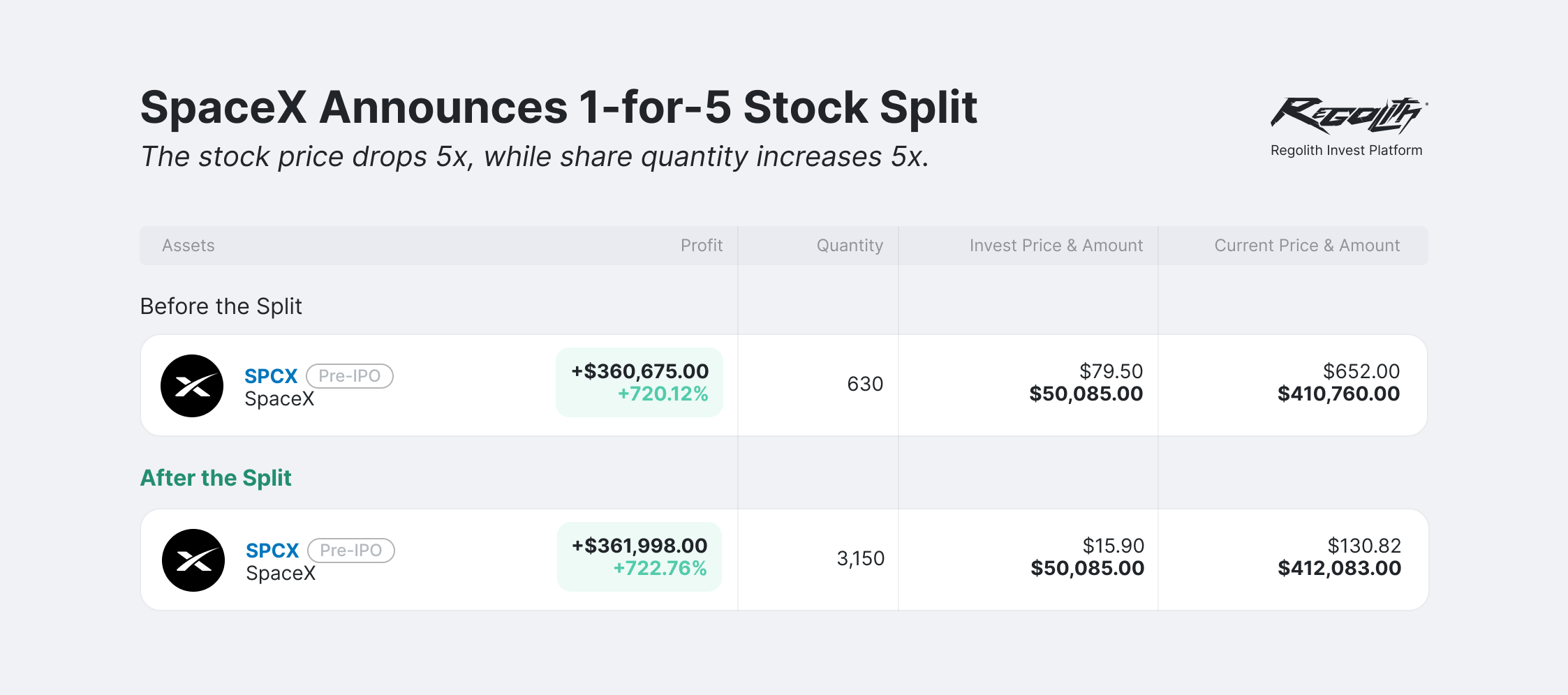
The move makes sense in the run-up to the biggest IPO of our time. A share priced at $500–700 would be out of reach for the average retail investor. For millions of people in the US, the comfortable psychological range sits around $100–300 per share – especially for students, the middle class, and young investors who want to be part of the SpaceX story.
Apple took the same path in 2020 (a 4-for-1 split) and Tesla in 2022 (3-for-1) – both are seen as standard preparation for broadening the retail shareholder base.
The S-1 at the SEC: a first public look at the financials
On May 20, SpaceX filed its S-1 registration statement with the SEC – the document that revealed the company's detailed financials for the first time. Until then, outside investors could only judge the business from leaks and analyst estimates.
The prospectus captured a mixed financial picture. In 2025, revenue reached $18.7 billion, up from $13.1 billion a year earlier – a 43% increase. At the same time, the consolidated net loss came to $4.94 billion: the main drag was the xAI segment, whose $6.35 billion operating loss for the year wiped out the profit of the core divisions.
Starlink remains the key revenue driver. According to Morningstar, the satellite internet service brought in $11.39 billion in 2025 – 48% more than a year earlier. The segment accounted for roughly 61% of the group's total revenue.
The segment's operating profit came to $4.4 billion, making Starlink the company's main profit engine. By the time the S-1 was filed, the service had more than 10 million active subscribers across 164 countries, with around 9,600 satellites in orbit. In Redmond, according to GeekWire, SpaceX turns out roughly 70 new Starlink satellites a week – a pace that lets the company hold more than 80% of all mass launched to orbit worldwide since 2023.
Capital spending tells the clearest story about shifting priorities. In the first quarter of 2026, SpaceX put $10.1 billion into it, of which $7.7 billion went to integrating xAI and only $1 billion to space operations. The company is increasingly taking the shape of a technology holding company with two core pillars – space and artificial intelligence.
The Anthropic deal: the main bet on AI
A few days after the prospectus was filed, news broke of a deal that largely shaped the reaction of institutional investors. According to Axios on May 20, Anthropic agreed to pay SpaceX around $45 billion over three years – $1.25 billion a month through May 2029 – for access to computing power. The deal covers Colossus 1, one of the largest AI supercomputers in the world, which stayed with SpaceX after the xAI integration.
Analysts immediately read the contract as structural confirmation of the merged company's business model: the AI segment, loss-making on paper, had landed a guaranteed, Anthropic-grade customer with a predictable monthly payment. By Axios's math, that comes to about $15 billion in revenue a year – on par with a mid-cap public company.
A week later, though, Musk added a clarification that changed the tone. In his words, the current arrangement is a 180-day lease of capacity with an exit option, not a rigid multi-year contract. An analysis by Parameter.io notes that this caveat undercuts confidence in the stability of the cash flow: technically, Anthropic could end the lease in as little as six months if it finds alternative capacity or changes plans. Even so, a short-term lease of this scale is rare for AI infrastructure, and it shows that SpaceX has capacity it can monetize – and that real demand for it is building.
The IPO calendar and how demand is taking shape
According to CNBC, The Motley Fool, and other sources, the SpaceX offering is moving on a tight schedule. The roadshow for institutional investors starts on June 8, final pricing is expected on June 11, and the first day of trading on the Nasdaq under the ticker SPCX is set for June 12. Morgan Stanley and Bank of America are the lead underwriters, with Goldman Sachs and JPMorgan also in the syndicate.
Якорные инвесторы уже частично сформированы. Канадский управляющий активами Brookfield подтвердил вход на $2 млрд. По сообщениям СМИ, обсуждается участие саудовского Public Investment Fund на $5 млрд – фонда, который был ранним инвестором Tesla и имеет прямые отношения с Маском. После выхода на Nasdaq SpaceX почти автоматически попадает в индекс NASDAQ-100Anchor investors are already partly lined up. Canadian asset manager Brookfield has confirmed a $2 billion commitment. Per media reports, the Saudi Public Investment Fund (PIF) is in talks over a $5 billion stake – a fund that was an early Tesla backer and has direct ties to Musk. Once on the Nasdaq, SpaceX would almost automatically enter the NASDAQ-100 and major broad-market ETFs, bringing steady demand from index and pension funds – buyers that purchase shares mechanically, in line with their portfolio weights.
Retail demand promises to be comparable. A company followed by millions of people worldwide is going public for the first time – and right away under a ticker tied to Musk, Starlink, and Mars. Analysts at TradingKey expect a significant FOMO effect in the first trading sessions.
What the deal means for early investors
Among SpaceX's early investors are Regolith clients, who opened positions in 2022 at a valuation of around $100 billion. For them, the coming listing will close a long wait for the public offering.
A $50,000 position in SpaceX in 2022 could now be showing a gain of around $360,000+ at current market valuations, with a total return of more than 700%. And that is before public trading has even begun.
For early investors, a staged lock-up applies after the IPO – a phased mechanism for lifting the ban on selling shares, standard for large offerings. Based on preliminary data, the restriction will last around six months, with the first sales by longtime holders starting toward the end of 2026. Until then, pressure on the share price from existing stakes will be minimal – an important factor for anyone watching how the first trading sessions unfold.
Risks worth knowing about
SpaceX's S-1 runs to 47 pages of risk factors – an unusually large set of warnings even for a tech IPO. Some of the risks are inherited from xAI: lawsuits over the Grok product, potential fines, and restricted access to certain markets. The filing separately flags how concentrated the business is around Musk – its dependence on his decisions, his public behavior, and his parallel roles at Tesla, X, and other companies is named as a material factor.
What comes next
Over the next three weeks, the market will get answers to three key questions. What price range the underwriters set after the roadshow. How strong institutional demand turns out to be for an offering of this size. And how the stock behaves on its first day of trading – the session that usually sets the mood for the months ahead.
SpaceX today is no longer just a space company. After the merger with xAI and the Anthropic deal, it is laying claim to a market value above Berkshire Hathaway and on par with the world's seven largest companies. Whether the stated valuation holds will be decided by the June trading.
This material is for informational purposes only and is not investment advice. The decision to go public rests with the company; timing and terms may change.
