

Kraken Is 80% IPO-Ready: What's Driving the Most Anticipated Crypto Listing of 2026
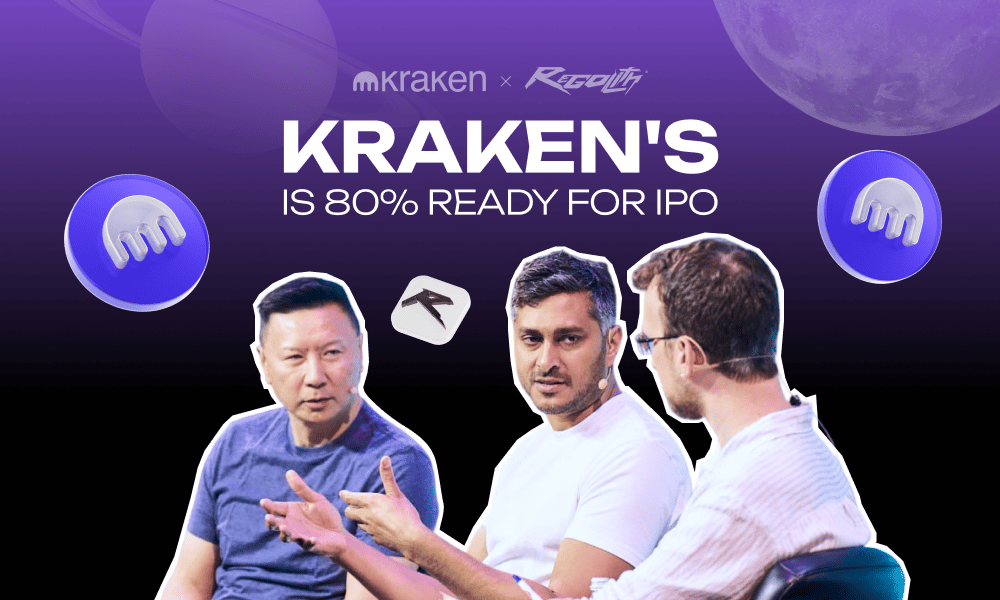
At Consensus Miami on May 5, Kraken co-CEO Arjun Sethi said the exchange is roughly 80% ready to go public. This marked the company's first public acknowledgment that its internal processes and regulatory requirements are largely complete, with management now waiting for more favorable market conditions to launch the listing. The target window is Q3 2026.
About Kraken
Founded in 2011 by Jesse Powell, Kraken ranks among the top three crypto exchanges in the world. The platform supports more than 200 cryptocurrencies, with average daily trading volume between $1.5 billion and $2 billion. Kraken is widely regarded as one of the most secure exchanges in the industry – in 14 years of operation, the platform has never suffered a major breach of client funds.
In 2025, Kraken posted revenue of $2.2 billion, up 33% year over year. Adjusted EBITDA reached approximately $380 million. The company is consistently profitable – a rarity in the crypto sector.
A New CEO and a Reshaped Leadership Team
In May 2024, Kraken appointed two CEOs for the first time in its history. Arjun Sethi – founder of Tribe Capital and former partner at Social Capital – joined the company alongside David Ripley. Before Kraken, Sethi spent a decade investing in technology companies and early-stage crypto projects, with portfolio names including Slack, Carta, Bolt, and Lightning Labs.

Sethi's appointment signaled a clear shift in priorities. From that point on, Kraken accelerated its preparations for the public market, expanded its institutional product line, and pursued strategic acquisitions.
IPO Timeline
- 2024. Initial reports of Kraken's IPO preparations surfaced in Bloomberg and Reuters. The valuation target was discussed in the $10–15 billion range.
- November 2025. Kraken filed its first confidential S-1 with the SEC. At the same time, the company raised $800 million at a $20 billion valuation. Participants included Citadel Securities, Jane Street, and Tribe Capital – the largest private fundraise in the crypto industry in two years.
- March 2026. The IPO process was paused. The reason: a weakening crypto market and reduced risk appetite among institutional investors. Bitcoin corrected from $108K to $72K, and the CoinShares index lost 18% over the quarter. Listing in those conditions would have required a steep discount.
- April 2026. Kraken resumed the process. Deutsche Börse announced the purchase of a 1.5% stake for $200 million – a deal expected to close in Q2 2026, valuing the company at $13.3 billion. The lower valuation reflects revised multiples across the crypto sector.
- May 2026. At Consensus Miami, Sethi publicly confirmed 80% IPO readiness. Target: Q3 2026.
Why the IPO Was Delayed
Preparing for a public listing typically takes a crypto company 18 to 24 months. Kraken's path took longer for several reasons:
- Regulatory pressure in the U.S. Until 2024, the SEC was actively litigating against Coinbase, Binance, and Kraken over the classification of tokens as securities. After the change in administration and the appointment of a new SEC chair in 2025, the regulatory environment eased – several cases were closed, including the investigation against Kraken.
- Crypto market volatility. Listing during a correction is disadvantageous for existing shareholders and can damage reputation after the listing. The company chose to wait for a more stable phase.
- Internal restructuring. In preparation for the IPO, Kraken restructured its corporate group, expanded its board of directors, brought in Big Four auditors, and engaged Goldman Sachs, JPMorgan, and Citi as lead bookrunners.
Why the IPO Was Revived
By spring 2026, the market had gradually recovered. Bitcoin returned to the $75–80K range, and inflows into crypto ETFs reached $1.9 billion in April – the first positive month of the year. BlackRock's IBIT alone attracted $214 million in a single day, its strongest reading since January.
In parallel, Kraken continued to build out its infrastructure. In 2025, the company acquired NinjaTrader – a futures broker with 1.5 million users – for $1.5 billion, along with Backed Finance, a tokenized equities platform. These deals transformed Kraken from a pure exchange into a full-scale financial institution offering equities, futures, options, and tokenized assets in a single interface.
In May, Kraken announced a partnership with MoneyGram, enabling crypto-to-cash conversion through a global retail network spanning more than 200 countries. The move is a clear step toward positioning Kraken as a payments infrastructure provider for billions of users.
What Kraken's IPO Means for the Market
Coinbase went public in April 2021 at the peak of the crypto cycle and remained the only major U.S. crypto exchange on the public market for years. In 2025, it was joined by Bullish (NYSE, August) and Gemini (Nasdaq, September). However, neither comes close to Kraken in terms of revenue, trading volume, or user base.
If Kraken successfully completes its listing in Q3 2026, it would mark:
- the largest crypto IPO since Coinbase
- a clear signal of institutional maturity for the industry
- a new valuation benchmark for other private crypto companies (Bitstamp, Crypto.com, OKX)
At a valuation of $13.3 billion, Kraken trades at roughly 6x its 2025 revenue. For comparison: Coinbase trades at around 12x, Gemini post-IPO at about 18x, and Bullish at more than 30x. The high multiples at Gemini and Bullish reflect their relatively modest revenue – $167–180 million versus Kraken's $2.2 billion. As a result, Kraken is heading to the public market with the most attractive revenue-to-valuation ratio in the sector. Analysts expect the multiple to gradually move closer to Coinbase's level after the listing.
Pre-IPO Kraken on the Regolith Platform
Kraken shares are available for Pre-IPO investment on the Regolith platform. The current price is $68 per share. As the IPO approaches, the available pool is shrinking – at the time of publication, only a limited number of shares remain.
