

Semiconductors Beyond Nvidia: How SMH, SOXX, and AIQ Performed Over Three Years
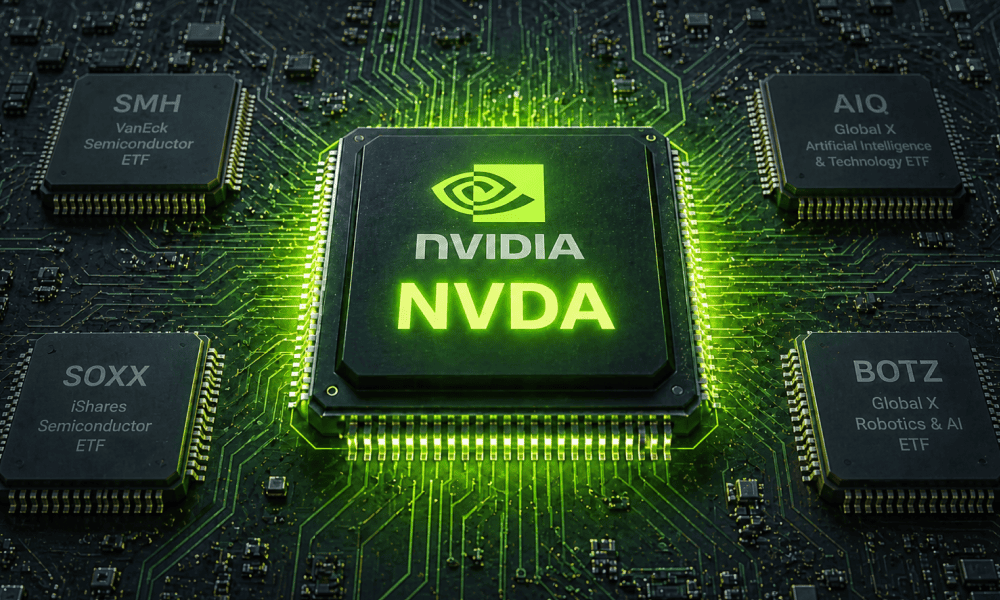
Nvidia's market cap topped $5 trillion at the height of the AI boom – and the company became the heaviest position in four major chip ETFs. What about the other names in the basket?
An investor who bought SMH (VanEck Semiconductor ETF) at the start of 2023 had nearly tripled their capital by the end of 2024. The same investor in SOXX (iShares Semiconductor ETF) saw a return of "only" +130-150%. The 30-50 percentage point gap was entirely the work of one company – Nvidia – and the way these two ETF baskets weight it differently.
In 2026, the picture has flipped. Year-to-date, SOXX is up 46.5% and SMH is up 33.8%. Over the past 12 months, SOXX has outperformed SMH by 36 percentage points (+156% vs. +120%). The same concentration in Nvidia that delivered a premium for two years has now become a drag.
The Four Main Chip ETFs
There are four main chip ETFs on the market, and each is built differently.
- SMH (VanEck Semiconductor ETF). 25 companies, aggressively concentrated. Nvidia, TSMC, Broadcom, Intel, AMD, Qualcomm. As of early 2026, Nvidia accounts for 17.75% of the SMH portfolio, TSMC for 10.66%, Broadcom for 8.05%. The top 10 positions together make up 71.73% of fund assets. This effectively turns SMH into a "Nvidia plus everyone else" index. It works brilliantly while Nvidia is rising – and painfully when it corrects.
- SOXX (iShares Semiconductor ETF). 30 companies, more evenly distributed. Nvidia is also among the leaders, but its weight is capped by fund limits (around 8-9% per company). The broader approach also includes Intel, Texas Instruments, Analog Devices, and other "veteran" players in the industry. More resilient to AI-segment swings.
- AIQ (Global X Artificial Intelligence & Technology ETF). 86 companies, a wider concept. It covers chips, cloud, and software alike. Microsoft, Meta, Alphabet, Nvidia, TSMC. This is not a pure semiconductor fund – it's exposure to the AI theme as a whole.
- BOTZ (Global X Robotics & Artificial Intelligence ETF). 45 companies, a different focus. Robotics, automation, industrial AI. Japanese names like Fanuc and Keyence. Less tied to the Nvidia cycle.
Of the four ETFs, the largest overlap is between SMH and SOXX. They duplicate roughly 70% of their top 10 positions – holding both at the same time is not actual diversification.
True diversification starts where the baskets are built differently. AIQ and BOTZ follow a different logic, draw on different geographies, and apply different selection rules. Any ETF in another industry strengthens the effect further.
What These ETFs Have Shown Over Three Years
From the start of 2023 through the end of 2024, chip ETFs moved in lockstep with Nvidia.
- SMH gained +73.4% in 2023 and another +39.1% in 2024 – nearly 2.4x from the starting point
- SOXX over the same period – around +130%
- AIQ – around +90%
- BOTZ – +39% in 2023 and +12% in 2024
Then the divergence began. In 2025, Nvidia corrected on news of slowing investment in AI infrastructure. Microsoft, Meta, and Alphabet – the largest buyers of Nvidia chips – simultaneously cut spending on data center construction. Nvidia fell 20%, SMH followed with a 15% drop, SOXX with 10%.
The correction gave way to a new rally. By the end of April 2026, Nvidia's market cap reached an all-time high of $5.4 trillion – but capital is now distributed more broadly. Year-to-date in 2026:
- SOXX is up 46.5%
- SMH is up 33.8%
Over 12 months, the result is even sharper:
- SOXX +156%
- SMH +120%
The 30+ percentage-point gap is the work of the "second wave" of chips. AMD launched its MI350 series in 2025 – a line of AI chips that runs 35x faster than the previous generation on workloads with already-trained models. In 2026, AMD is releasing the MI400 with 432 GB of memory – a direct competitor to Nvidia's top chips. ASML, the world's only manufacturer of equipment for the most advanced lithography, has continued to grow alongside orders from TSMC. Broadcom has cemented its lead in networking chips for data centers and continues to grow steadily.
The result: SOXX and AIQ are outperforming SMH since the start of 2026, because they are less concentrated in any single company – and Nvidia is now growing more slowly than the other large chipmakers.
The Story Behind the Gap
In 2021, when AI was not yet mainstream, Morgan Stanley analyst Joseph Moore wrote that Nvidia had an "18-24 month window" before competitors caught up. Moore was right in his diagnosis, but he underestimated the length of the window. By 2026, the competition has become real on every front.
The largest cloud companies have built their own chips: Google with the Tensor Processing Unit, Amazon with Trainium and Inferentia, Meta with MTIA. Apple launched its own inference chips for on-device AI. AMD released the MI350 in 2025 and is rolling out the MI400 in 2026 – the first credible challenger to Nvidia in two product cycles on the model training side. In China, Huawei has covered a significant share of domestic demand with its Ascend series. Even DeepSeek and other Chinese AI developers have shown that top-tier models can be trained on second-tier chips.
So far, none of this has hit Nvidia's revenue directly. In April 2026, the company set a new all-time high market cap of $5.4 trillion. But capital is now spreading wider: ASML, AMD, Broadcom, and TSMC are growing faster than Nvidia year-to-date. That's exactly why SOXX – where these companies have a more even share – is outperforming SMH (where Nvidia accounts for 17.75%).
The story is straightforward. When one player dominates 90% of the field, concentrated ETFs win. When the market starts distributing, balanced baskets take the lead.
What This Means for Investors
A few practical takeaways.
- A single chip ETF is not diversification. It's a bet on one industry, which is currently cyclical. It can be added to a portfolio – just as a specific, deliberate position rather than as broad sector exposure.
- The Nvidia risk is already priced in. Nvidia currently trades at a lower forward P/E than the average semiconductor company (24 vs. 34). The market has already priced in concerns – slowing AI investment and rising competition. Even a weak earnings print is unlikely to drive a deep selloff. A serious revenue slowdown, however, would still trigger a correction.
- The second tier deserves attention. ASML (lithography), AMD (Nvidia alternative), Broadcom (networking), Marvell (AI infrastructure), TSMC (manufacturing). Each is in both SOXX and SMH, but with different weights. SMH leans on TSMC (10.66%); SOXX gives more room to Broadcom (8.01%), Micron (7.83%), and AMD (7.70%). These differences are exactly what produces the divergent performance between two seemingly similar ETFs.
- Geopolitics. TSMC – Taiwan. Samsung – Korea. ASML – the Netherlands. U.S. export restrictions on chips to China shift the cash flows of the entire industry every 6-9 months. In January 2026, the U.S. imposed a 25% tariff on the export of advanced AI chips and revised its licensing regime. Nvidia's share of the Chinese AI market has dropped from 90% to 50% over two years. This is a political risk, and it is here to stay.
Where Regolith Fits In
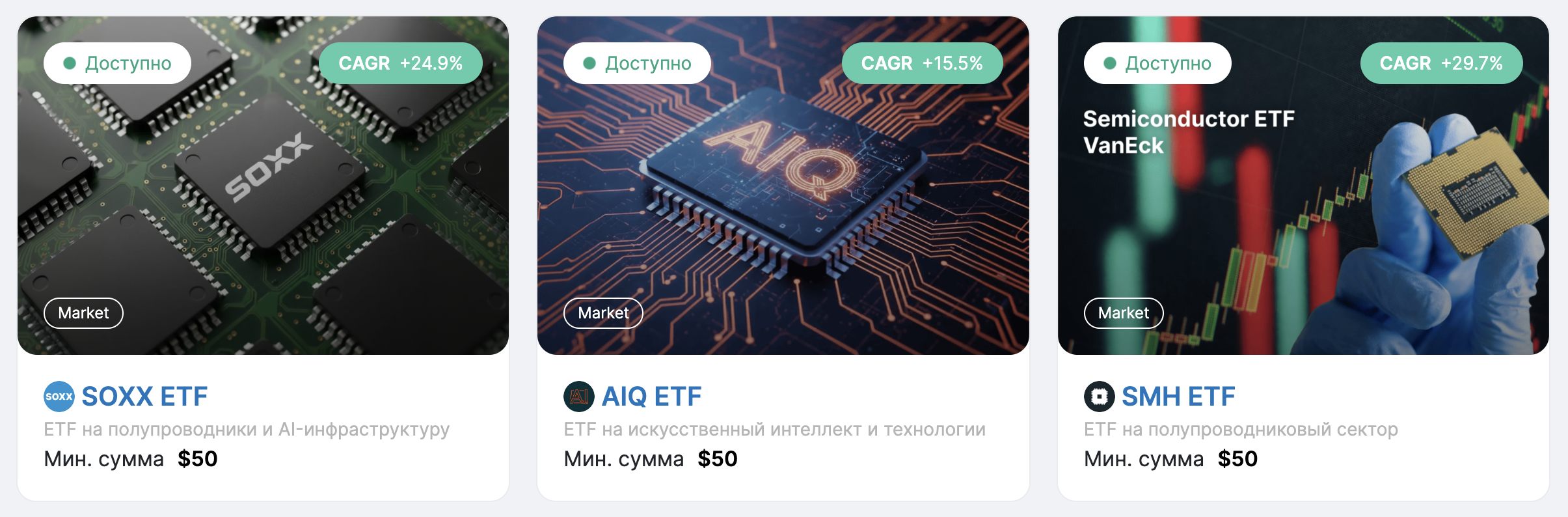
The Regolith app gives access to SMH, SOXX, AIQ, BOTZ, and other ETFs. An investor in the UAE, the CIS, or Southeast Asia can build a position in the semiconductor industry on a single platform – without opening a U.S. brokerage account.
Risks
- Cyclicality of the sector. The chip industry has historically gone through a major correction every 5-7 years: demand outpaces supply, then drops sharply.
- Concentration on a single company. With Nvidia at 17.75%, SMH is effectively a near-direct bet on Nvidia. If its shares fall 30%, SMH loses around 20%.
- Geopolitics. U.S. export restrictions on chips to China shift the revenue of TSMC, ASML, and Nvidia by 10-15% between quarters. These rules are revised every 6-9 months.
- AI cycle slowdown. Microsoft, Meta, and Alphabet together account for about 60% of Nvidia's orders. If these companies cut their AI infrastructure spending, the industry would enter a correction lasting 2-4 quarters.
- Currency risk. ETFs are denominated in U.S. dollars and trade on American exchanges. For investors from other currency zones, exchange rate moves add volatility in the local currency.
- Liquidity in extreme conditions. Under normal conditions, SMH and SOXX are highly liquid – spreads stay within 0.05%. During market stress (COVID 2020, the tariff shock of 2025), the gap between buy and sell prices can widen from 0.05% to 1-2%.
Conclusion
Chip ETFs are a way to buy an entire industry without making a single-company bet. With a caveat: any basket still carries concentration in 3-5 companies. For AI exposure with less dependence on a single position, AIQ – or a combination of SOXX and BOTZ – is the more balanced choice.
A simple rule: before buying any ETF, always check the top 10 positions. These ten names typically determine 60-70% of the basket's movement.
The Regolith app provides access to SMH, SOXX, AIQ, BOTZ, and other ETFs. Before placing a trade, open the fund's profile and review the weights of its largest positions along with the expense ratio – the annual management fee, usually 0.3-0.7%.
Disclaimer
This material is for informational and educational purposes only and does not constitute an investment recommendation, an offer, or a solicitation to buy or sell securities. Investing involves risk, including the possible loss of capital. Past performance does not guarantee future results. Each investor should review the relevant documents and make their own decision.
