

Kraken ahead of its IPO: two new products, an M&A spree and a $20B valuation
Kraken is preparing for one of the most anticipated listings of the year. The exchange hasn't named an exact date, but it is approaching its market debut thoroughly – methodically rebuilding the business itself. On May 27, 2026, it launched two products at once: Bitcoin Vault for passive income on bitcoin and Kraken Prop for trading with the exchange's own capital. On their own these are small launches, but together they point to a single goal: to arrive at its IPO no longer as a crypto exchange, but as a full financial institution with diversified revenue.
Bitcoin Vault: earning on BTC without selling
The idea is simple and answers a real customer demand: bitcoin should work while the investor holds it. Bitcoin Vault lets users earn passive income on BTC without selling their coins. Rewards accrue automatically in bitcoin itself, the rate is up to 2.5% APY, and full price exposure to the asset is preserved. The holder doesn't exit the position, doesn't lose the upside, and earns on top.
The product runs within Kraken Earn and is available to Kraken and Krak account holders – by the company's promise, you can get started "in seconds." It targets long-term holders, those who don't plan to sell their bitcoin any time soon anyway.
"Many bitcoin holders on Kraken have made it clear they want simple ways to earn on the bitcoin they already plan to hold," said John Zettler, Director of Product at Kraken Earn & Trade. "Bitcoin Vault is built for that mindset. It gives customers access to rewards through a simple, easy experience grounded in the trust Kraken has built over the years." The company notes that bitcoin ownership is moving beyond the simple buy-and-hold strategy.
How it works
Behind the yield sits DeFi infrastructure. Bitcoin Vault is a pooled product: customer funds are combined and deployed across established onchain lending protocols – Aave, Morpho, and Tydro – where bitcoin effectively works in lending systems earning interest. The technical infrastructure of the onchain vaults is provided by Veda, while risk management and allocation strategy are handled by the institutional DeFi firm Sentora.
A few important details. Providers take a 25% performance fee on what's earned – it is already included in the stated rate, meaning the up-to-2.5% is what the client receives net. Funds can be withdrawn within five days.
Why through DeFi and not as a deposit
The form of the product was chosen deliberately. Crypto exchange yield programs have repeatedly drawn regulators' fire. Gemini Earn was wound down after the FTX collapse in 2022–2023, and customers were allegedly misled about the risks. Under the Biden administration, the SEC investigated BlockFi's high-yield lending products. To avoid repeating that path, Kraken structured Bitcoin Vault not as a classic deposit with a promised rate, but through transparent onchain infrastructure where it is clear where the yield comes from. That lowers regulatory risk – which matters especially for a company on the eve of its IPO.
Kraken Prop: trading with the exchange's capital
On May 27, Kraken also launched a second product – Kraken Prop, a funded-trader program. The exchange became the first major crypto platform to run a retail prop program directly inside its own platform.
The principle is this: a trader trades not with their own money, but with the exchange's capital. They pay an evaluation fee (from $20, non-refundable), pass an evaluation by proving their skill within risk limits, and receive a funded account. The trader keeps the profits – 80%, and up to 90% on meeting the terms – while Kraken covers the losses. The trader's only financial risk is the evaluation fee itself.
The parameters: six account tiers from $5,000 to $200,000, more than 60 crypto pairs (including BTC and ETH), up to 5x leverage, and Kraken Pro's tools. There are no time limits, no profit caps, and no rules on strategy.
The program grew out of the acquisition of the prop firm Breakout and relies on the infrastructure of NinjaTrader – a brokerage with a pool of around 2 million retail traders that Kraken bought in 2025. For the exchange, it is another revenue stream and a way to attract an active trading audience ahead of the IPO.
Part of a broader push into onchain finance
Bitcoin Vault and Kraken Prop aren't one-off launches, but the latest steps in a systematic expansion. In recent months Kraken rolled out Mastercard cards for users in the UK and Europe, launched managed yield strategies together with Bitwise, and added AVAX staking. The exchange is steadily turning into a platform where the customer not only trades, but also earns on assets, pays, and stores funds.
This course answers the main question for investors ahead of the IPO – is the revenue durable. The more services an exchange has beyond trading, the less its income depends on trading volumes, which swing sharply with the market.
Expansion through acquisitions: $2.6B in a year
The most visible engine of the transformation is aggressive expansion through acquisitions. Over the past year, Kraken has spent more than $2.6B buying infrastructure businesses:
- NinjaTrader – $1.5B (March 2025). The largest TradFi-crypto deal at the time. The platform brought a CFTC license that opened the US futures and derivatives market to Kraken.
- Backed Finance – the xStocks platform with tokenized stocks and ETFs: already more than 60 products and over $10B in volume, with plans to expand to 500+ instruments.
- Bitnomial – $550M (April 2026). A CFTC-regulated derivatives exchange.
- Reap – $600M (May 2026). A stablecoin payments platform.
Each deal closes off a separate market segment – futures, derivatives, tokenized stocks, payments.
MoneyGram: a bridge between crypto and cash
A separate bet for Kraken is payments in emerging markets. A partnership with MoneyGram allows converting cryptocurrency into cash in more than 100 countries through a network of nearly 500,000 retail locations. Kraken handles onboarding and customer verification, while MoneyGram provides licensed money transmission. The rollout is phased: the US, Europe, Latin America, Africa, and part of the Asia-Pacific region.
Where Kraken stands on its path to IPO
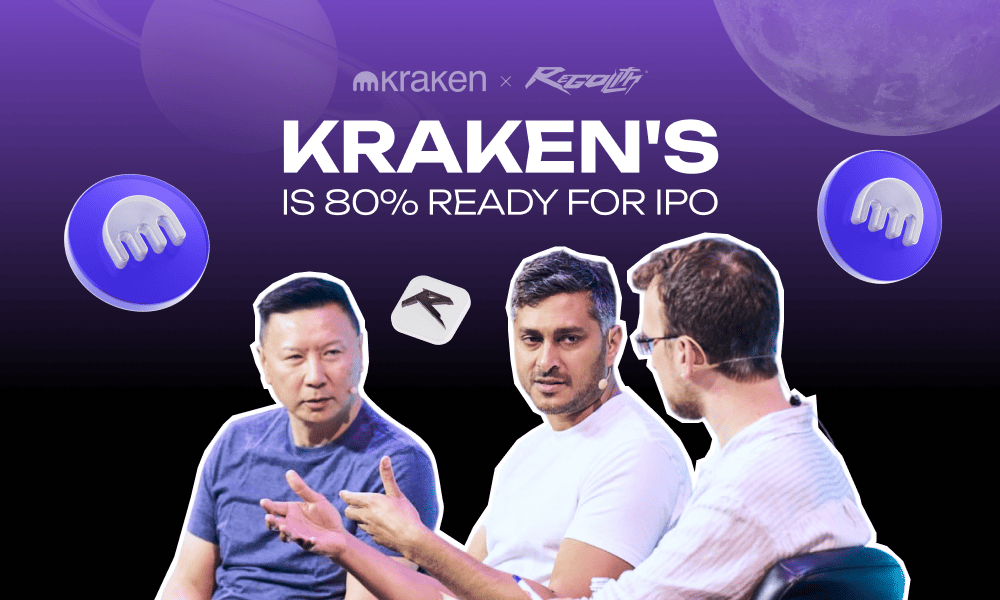
The company confirms its progress publicly. At the Consensus Miami conference on May 5, 2026, Kraken co-CEO Arjun Sethi said the exchange is about 80% ready to go public. Its parent company, Payward, is raising capital at a target valuation of $20B, and the listing itself is expected in the third quarter of 2026 – as soon as suitable market conditions take shape. Analysts say it could become the largest crypto exchange IPO since Coinbase.
The path hasn't been straight. The company filed confidentially with the SEC back in November 2025 and was aiming for a debut in the first quarter of 2026. But in March the plans had to be frozen – the crypto market pulled back from its late-2025 highs. By May the market window opened again.
In April 2026, Germany's Deutsche Börse bought 1.5% of Kraken from existing shareholders for $200M – which corresponded to a valuation of the whole company of around $13.3B. But secondary deals, where an investor buys a stake from existing owners, usually price at a discount to primary rounds, in which money flows into the company itself. So the $13.3B in April and the $20B IPO target reflect two different types of deal: a secondary sale versus a primary round.
How Kraken got here
To understand the current pivot, it's worth recalling where Kraken started. The exchange was founded in 2011 by Jesse Powell and Thanh Luu in San Francisco – one of the first in the industry. Powell got into the project after seeing security problems at Mt. Gox, and made protecting funds the foundation of the platform. For more than a decade, Kraken remained first and foremost a crypto exchange.
The turning point came with a change of leadership. Powell ran the company until April 2023, and in October 2024 Arjun Sethi became co-CEO – a co-founder of the venture fund Tribe Capital who had sat on Kraken's board since 2021. It was with his arrival that the exchange set a course toward becoming a full-service financial business – the very one we see today in its string of launches and acquisitions.
Risks worth keeping in mind
A growth story doesn't cancel out the risks. Crypto yield products remain an area of heightened regulatory attention, and even a careful onchain structure offers no full guarantee. Kraken's revenue is still sensitive to the state of the crypto market – it was precisely that pullback that forced the IPO to be postponed in the spring. Finally, the timing and valuation of the offering depend on the market window and may change – the company has already put its plans on pause once.
What it means for investors
Kraken approaches its IPO in a new status – not as a niche crypto exchange, but as a diversified financial platform: spot, futures, derivatives, tokenized stocks, payments, cash-out via MoneyGram, and yield on bitcoin. The bulk of the valuation growth, as often happens, falls in the period while the company is still private: from $13.3B in the secondary deal to the $20B target.
On Regolith, access to pre-IPO Kraken is open – entry from $68 per share. It's a chance to enter the company's capital before the listing, while its valuation is still being set on the private market.
This material is for informational purposes only and is not investment advice. The timing and terms of the IPO depend on the company and market conditions and may change.
