

SpaceX Buys AI Coding Startup Cursor for $60 Billion: The Largest Acquisition Ever
The SpaceX and Cursor logos. Photo: NurPhoto / Getty Images
Right after its record IPO, SpaceX made a move no one expected from a space company: it announced the acquisition of Anysphere – the developer behind the popular AI code editor Cursor. The deal is worth around $60 billion, paid entirely in stock. It is the largest-ever acquisition of a venture-backed startup, and the clearest signal yet of what Elon Musk is turning SpaceX into.
What Cursor Is
Cursor is a code editor powered by artificial intelligence. It writes, completes, fixes, and explains code alongside the programmer, understanding the context of the entire project. Technically, the product is built on the open-source VS Code editor, but on top of it Anysphere added what millions use it for: an AI that behaves like a real partner. Ordinary autocomplete just finishes a line of code – Cursor understands the logic of the whole project.
The key difference from competitors is that Cursor doesn't simply plug in someone else's neural network. The company built its own model for working with code and fine-tunes it on specialized data. That delivers more accurate suggestions and a deeper understanding of the project – exactly what developers came to love about it.
Who's Behind Cursor
Anysphere was founded in 2022 by four graduates of the Massachusetts Institute of Technology (MIT) – Michael Truell, Sualeh Asif, Arvid Lunnemark, and Aman Sanger. What began almost as a student project turned, in just a few years, into one of the most valuable startups in the world, and the former students became billionaires.
Cursor's story shows how, in the AI era, a company can go from an idea to tens of billions of dollars faster than entire industries once took decades to do.
The Cursor logo. Photo: SOPA Images / Getty Images
A Rise the Market Had Never Seen
Anysphere's trajectory is one of the fastest in the history of technology. In August 2024, the company was valued at about $400 million. In June 2025, a round led by Thrive Capital, Andreessen Horowitz, Accel, and DST Global lifted its valuation to $9.9 billion. By November 2025, just three years after its founding, Cursor was already worth $29.3 billion.
Behind the numbers is real demand. By early 2026, Cursor's annual recurring revenue (ARR) reached $2 billion, and by the end of the year Anysphere expects to top $6 billion. The editor has more than a million daily active users, is used by tens of thousands of companies, and counts more than half of the Fortune 500 among its clients. Its revenue grew at thousands of percent a year – something enterprise software had never seen.
SpaceX's acquisition values Anysphere at twice the November mark – $60 billion.
Why SpaceX Wants It
The deal fits the strategy Musk has been building over the past year: control over the entire artificial-intelligence chain – from hardware to applications.
First came infrastructure – data centers and computing power, the "hardware" that AI runs on. Its scale is clear from a major contract under which SpaceX supplies computing power to Anthropic.
The next layer is the AI models themselves. A model is essentially the "brain" of artificial intelligence: a trained neural network that understands requests and produces answers, text, or code. Models are what stand behind every chatbot. SpaceX gained this layer in February 2026, when it merged with Elon Musk's xAI – the maker of the chatbot Grok, a direct competitor to ChatGPT. Even in its IPO filings, SpaceX called artificial intelligence the core of its future business and put its market at tens of trillions of dollars.
The third, top layer is the ready-made applications that people use. That's the layer the Cursor acquisition closes.
Cursor gives SpaceX a profitable product with a huge base of developers and instantly brings xAI into the market for programming tools, where it previously had no strong position. In less than a year, SpaceX has gone from a space company to a full-fledged player in the AI industry, building a vertically integrated stack: compute, models, and software under one roof.
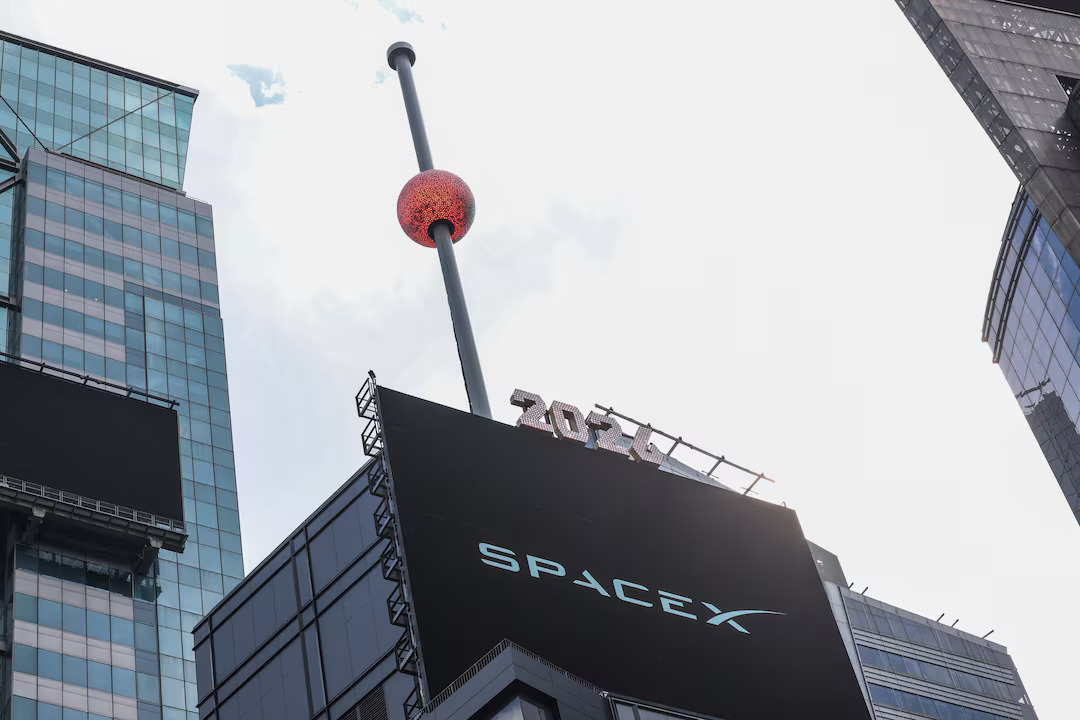
New York on the day of SpaceX's IPO, June 12, 2026. Photo: Reuters / Brendan McDermid
Why Now
The timing is no accident. The deal is paid for in stock: Cursor's shares convert into SpaceX Class A stock, and the exchange ratio will be set by the average price over the seven days before closing. The IPO itself made this possible.
On June 12, SpaceX went public in the largest offering in history, raised $75 billion, and its shares quickly climbed – from $135 at the offering to around $200, which corresponds to a valuation of roughly $2.7 trillion. Public status and a high, liquid valuation turned the company's shares into a convenient currency for major acquisitions. In effect, SpaceX is putting the market capital it just raised toward buying strategic assets without spending cash.
The Race for Developer Tools
Cursor isn't the only one fighting for the developer-tools market, and the deal reflects a broader consolidation in this segment. Its main rival, Microsoft's GitHub Copilot, has millions of paying subscribers and holds a notable share of the market, with almost the entire Fortune 100 using its tools. Earlier, OpenAI agreed to buy Windsurf (formerly Codeium) for about $3 billion, Anthropic is developing its own tool, Claude Code, and Replit is active on the market too.
Big players are buying up the application layer because that is where AI models reach the end user and generate revenue. Control over a tool like Cursor brings not only income but also a constant stream of data on how developers actually use AI – data that then improves the models themselves.
The Regulatory Question
The deal still has to close. That's expected in the third quarter of 2026, and only after regulatory approval. The purchase of the fastest-growing software startup by a company of this size will almost certainly draw the attention of antitrust authorities: the concentration of the AI-tools market is now in focus in both the US and Europe. Before closing, the timing, structure, and even the deal itself could change.
SpaceX is buying Cursor's maker for $60 billion
What It Means for the Industry
The deal sets a new logic for the market. First, public status and expensive stock are becoming a weapon in the fight for AI assets – more large all-stock acquisitions should now be expected from other recently listed tech companies. Second, value is shifting to those who control the whole chain: from chips and data centers to the applications used by millions.
The balance of power within development tools is shifting too. Where choosing an editor used to be a matter of taste, the biggest tech empires now stand behind it, and whoever owns the tool decides whose models and whose infrastructure end up under the hood.
What It Means for Investors
Cursor's story is a vivid reminder of how fast value is created in AI: from $400 million to $60 billion in under two years. But that same speed carries risks. High valuations already price in much of the future growth, big deals depend on regulators, and leadership in tech shifts faster than in most other industries.
Behind the loud deals and numbers, the takeaway is simple: in AI, the winner is the one who controls the whole chain – from compute to the application in the user's hands.
This material is for informational purposes only and does not constitute investment advice.
