

Investing in video gaming and esports ahead of GTA VI: how the ESPO ETF works

On November 19, 2026, Grand Theft Auto VI is released – the sequel fans have awaited for 13 years. According to analysts, it could become the biggest entertainment release of the decade. But interest in the event goes beyond the gaming community: GTA VI is being watched closely on the stock market as well.
The GTA phenomenon
The scale of expectations around GTA VI is easiest to grasp through the success of the previous installment. GTA V launched in 2013 and became one of the most profitable entertainment products in history. In its first three days, sales exceeded $1 billion – faster than any film or music album at the time. Since then the game has sold more than 200 million copies and continues to generate revenue years after release.
That result changed how the industry is viewed. A single project can operate like a franchise on the scale of the biggest cinematic universes, while its online mode can retain an audience and generate income for years.
Why one game matters for the market
Behind the GTA franchise stands Take-Two Interactive – a public company that owns Rockstar Games. The effect of GTA V quickly showed up in the business: in fiscal 2014, Take-Two's revenue rose from $1.21 billion to $2.35 billion, almost doubling. The main growth driver was Grand Theft Auto V, which became the company's key commercial asset and sharply strengthened its position among the largest public players in the gaming industry.
The market re-rated Take-Two's scale as well. On the day GTA V launched, September 17, 2013, the company's shares opened at around $17.70. Today Take-Two trades at about $250 per share, and its market capitalization exceeds $46 billion.
Now the market is waiting for GTA VI. Expectations around the release have already become part of the investment narrative: trailers draw record views, discussions on social media never die down, and investors are weighing whether the new installment can repeat the commercial scale of GTA V. The exact outcome cannot be predicted in advance, but interest in the gaming industry and the sector's stocks has grown noticeably.
The industry is bigger than it seems
Video games have long moved beyond niche entertainment to become one of the largest markets in the global experience economy. According to Newzoo, in 2025 the global games market reached nearly $189 billion, with an audience of around 3.6 billion players. For comparison: the global box office in 2025 was estimated at about $33.5 billion, and the global recorded music industry at $31.7 billion.
Games no longer compete only with films or music. They compete for users' time with streaming, social networks and short-form video. And the gaming industry has an edge: it does more than sell content – it builds long-term digital ecosystems where users spend hundreds of hours, buying in-game items, subscriptions and add-ons and taking part in online events.
The market brings together several segments at once: game developers and publishers, owners of platforms and online services, makers of game engines, hardware, cloud infrastructure and monetization solutions. That is why a major release affects not a single company but the entire chain: the publisher, platforms, game stores, advertising channels, streaming services, esports teams and device makers.
That is why releases like GTA VI become a major event for players, investors and the whole gaming industry. A successful game can influence console sales, activity in online services, the advertising market, streaming and interest in the stocks of companies across the gaming sector.

The sector awaits a new catalyst
The industry approaches the biggest game release of the decade after a weak stretch. The thematic video gaming and esports ETF ESPO has fallen about 17% since the start of 2026: the sector was weighed down by a pause in major releases, investor caution and the re-rating of fast-growing gaming companies.
For the gaming industry, this kind of pattern is not unusual. The sector is cyclical and heavily dependent on the calendar of major launches: in periods without high-profile releases, market interest can fade, while strong projects bring attention back to the industry. That is why GTA VI is becoming a major event for the entire sector and a potential catalyst for interest in gaming companies.
Exposure to the entire industry
One can invest in the expectations around GTA VI directly through Take-Two shares, but such a bet carries concentrated risk. The outcome largely depends on a single key release: a date delay, weak reviews, sales below expectations or cautious management guidance can quickly show up in the share price.
A more diversified approach is to invest in the whole sector through a thematic ETF. ESPO (VanEck Video Gaming and eSports ETF) brings together around 30 companies from the gaming industry: game developers and publishers, platform owners, online services and makers of gaming technology.
The fund's holdings include Take-Two, NetEase, Tencent, Nintendo, Roblox, Electronic Arts, Capcom and Bandai Namco. ESPO tracks the MVIS Global Video Gaming and eSports Index.
This format reduces dependence on a single release or a single company: the investor gets exposure to the entire gaming sector, including the industry's largest public players.
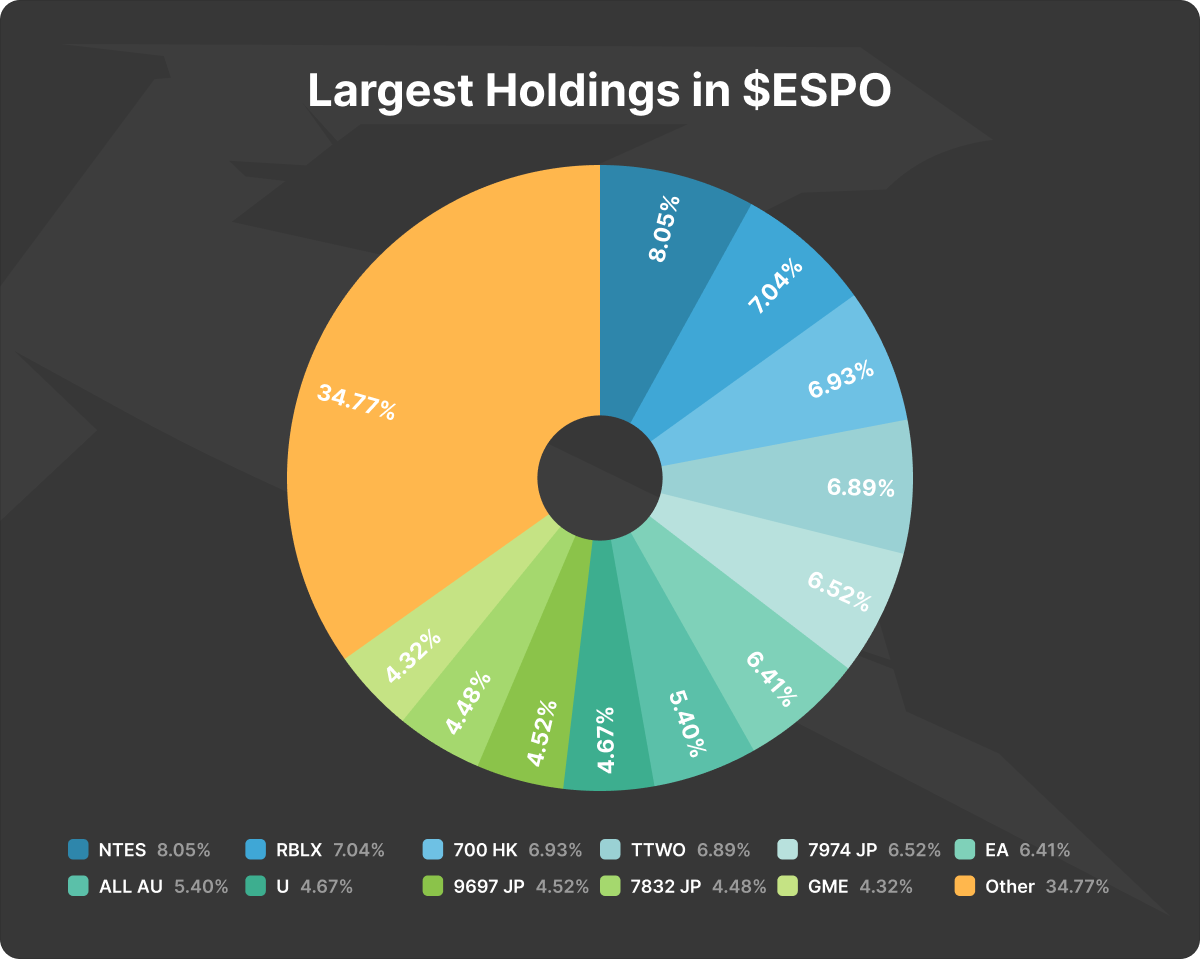
The fund's geography reflects the structure of the industry itself: a notable share is in the US, as well as in Asian markets – China, Japan and South Korea. This mix spreads the investment across many companies and reduces the dependence of the result on any single stock.
What else drives the sector
Beyond GTA VI, the industry has long-term drivers. Esports has grown into an industry of its own: major tournaments fill stadiums and draw tens of millions of viewers online, with prize pools running into the millions of dollars. Cloud and mobile gaming make games accessible without an expensive console – a smartphone is enough.
A separate area is artificial intelligence: it is changing development itself, making game worlds more complex and lifelike while making production faster and cheaper.
Together, these trends shape the sector's long-term potential, which extends far beyond individual releases.
Risks
The sector also has its constraints. Gaming remains a volatile area: the returns of funds and individual companies can vary widely depending on the market cycle, the release calendar and investor expectations. For example, in 2022 ESPO fell 34.7%, which shows the sector's sensitivity to a broad correction in technology assets and a repricing of growth valuations.

The financial results of gaming companies depend heavily on the quality and commercial success of major projects. A release delay, weak reviews or sales below expectations can affect individual companies' share prices and sentiment across the whole sector. Additional risk factors relate to the market's geography: a significant part of the gaming industry is concentrated in Asia, including China, Japan and South Korea, which adds currency and regulatory risks.
Company valuations are also worth considering. Amid interest in AI, major releases and digital entertainment, some players in the sector may trade at elevated multiples. This supports investor interest in strong periods, but also increases sensitivity to disappointments in earnings, guidance or launch timing.
GTA VI could become an important catalyst for the industry, but the final effect will depend on sales, user activity, the monetization of online services and the market's reaction after release.
This material is for informational purposes and is not investment advice. Past performance does not guarantee future results. Any investment decision is made independently.
