

Pre-IPO Explained: How Investing in Pre-IPO Differs from Buying a Regular Stock
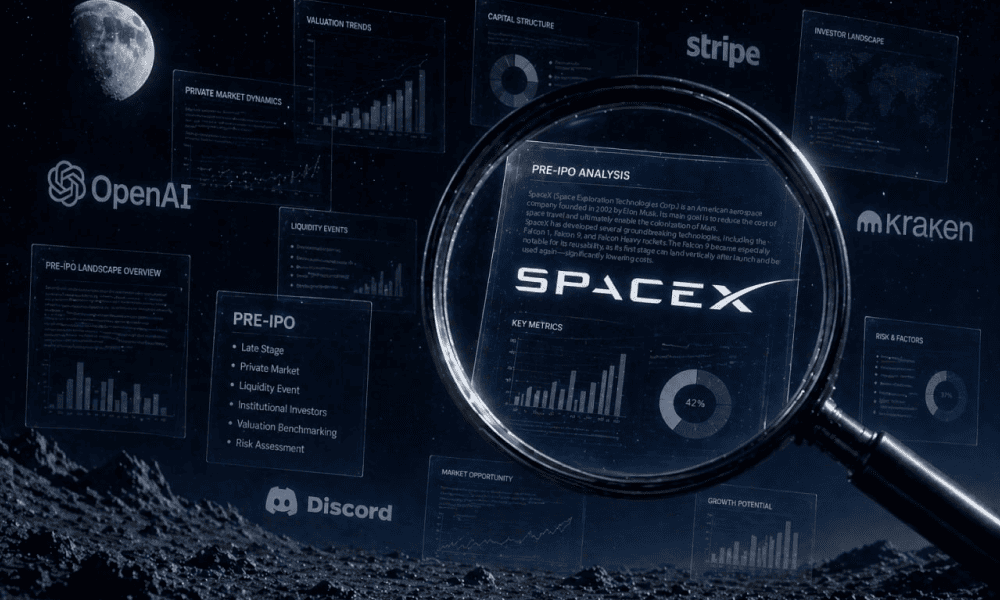
A private company stake looks, counts, and often trades like a stock. But it behaves nothing like one – and that's what matters to understand before any deal.
An investor who opens their first SpaceX or Kraken position through an app like Regolith usually expects something close to buying Apple through a broker. Click a button, get the asset. Change your mind, sell in one tap. The disappointment comes on day two, when they try to lock in profits and find that they can't. The problem isn't the platform. The point is that Pre-IPO is a different financial instrument – one that only outwardly resembles a regular stock.
What Pre-IPO Actually Is
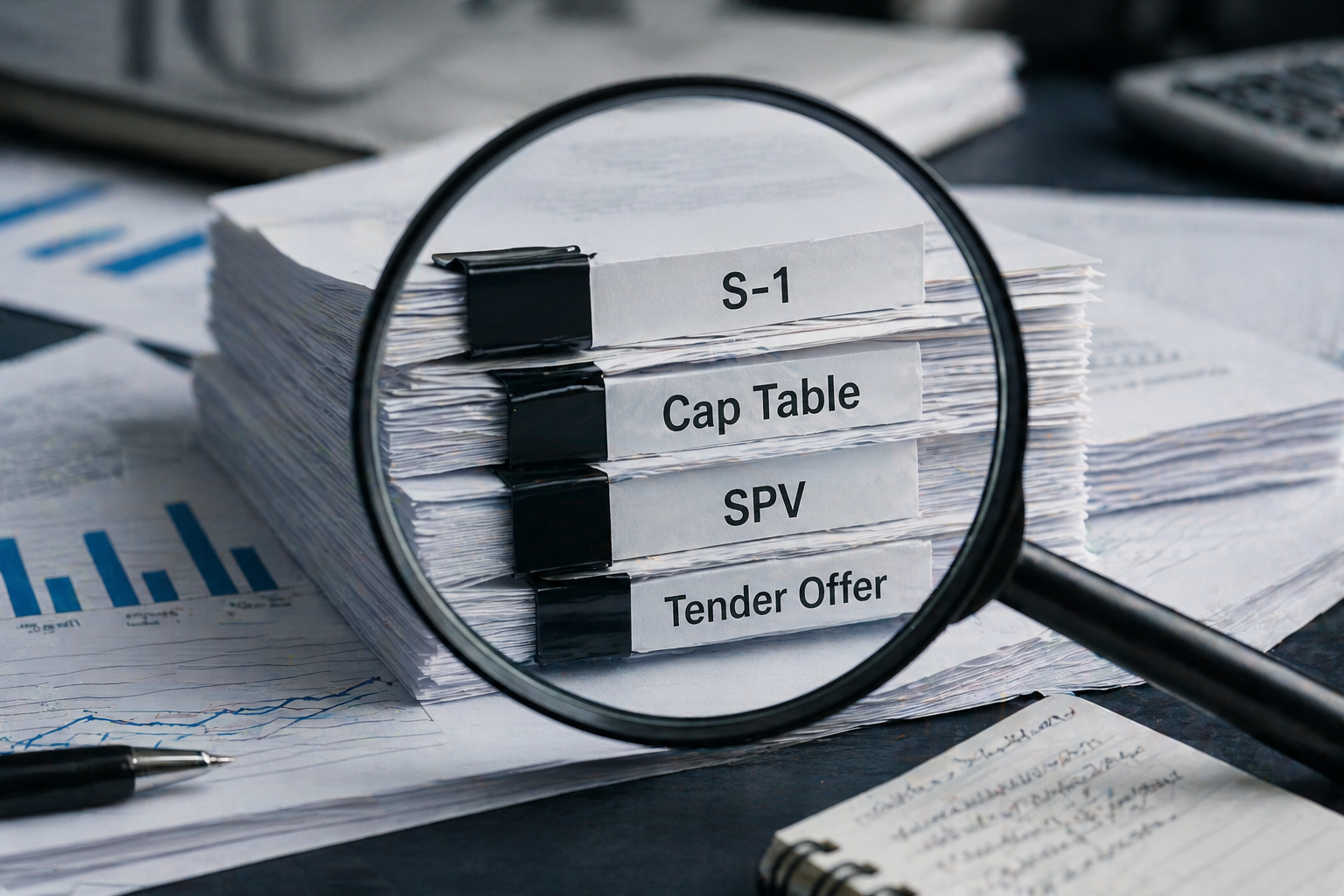
Pre-IPO (literally "before IPO") is the purchase of a stake in a company that hasn't yet gone public. Such a company already has a legal structure, a valuation, shares, and a cap table – the ownership ledger. But its shares aren't traded on Nasdaq or NYSE. They exist in the company's registry, in contracts with early investors, and in SPVs – special-purpose legal vehicles through which a retail investor gains access to a stake.
Historically, Pre-IPO was the domain of venture funds, family offices, and large institutional players. Minimum tickets typically started at a million dollars. That's changed over the past ten years. Secondary markets like Forge and EquityZen have emerged, alongside specialized platforms that wrap a stake into an SPV with entry points ranging from $100 to $10,000. Today, a retail investor can hold SpaceX in their portfolio as comfortably as an S&P 500 ETF. With one important caveat: this asset behaves differently.
How It Technically Works
When you buy "SpaceX stock" through a platform like Regolith, in most cases you're not buying the stock itself. You're buying a stake in an SPV, or Special Purpose Vehicle – a separate legal entity created specifically to hold a block of SpaceX shares and distribute economic rights across multiple investors.
The SPV holds the shares acquired on the secondary market from employees or early investors. You own a stake in the SPV that mirrors the economics of a corresponding number of shares. When (and if) SpaceX goes public or is acquired by a strategic buyer, the SPV distributes the proceeds among stakeholders pro rata.
Two terms worth memorizing right away
Lock-up – the period during which the stake cannot be sold. Typically this covers the entire run-up to the IPO plus 90-180 days after. For Pre-IPO deals, this window can stretch into years.
Secondary market – the market where investors trade stakes in private companies. It moves slowly, runs wide spreads, and is far from available for every company.
How This Differs from a Listed Stock
At first glance, almost nothing. In both cases, you own a piece of a business. In practice, there are five differences – and each one can turn into an unpleasant surprise if you don't know about it.
- Liquidity. A Tesla share can be sold in three seconds. A stake in a SpaceX SPV cannot. The exit is only possible at the company's IPO, its acquisition, or through the secondary market – if the SPV structure allows it. Even when secondary access is available, the deal takes weeks, and the execution price can deviate from the portfolio mark by 10-30%.
- Horizon. A listed stock is an instrument you enter for hours, months, or years – at the investor's discretion. Pre-IPO is always about years. Typical horizons are 1-5 years, sometimes longer. SpaceX has remained private for 23 years; its 2012 investors are still waiting for liquidity.
- Entry price. Apple trades around $180 per share – anyone can buy one. In Pre-IPO, minimum tickets historically ran into the millions. On today's platforms, the threshold has dropped to $100-5,000, but a single "stake" usually represents fractional economics – say, 0.01 shares of a company. That's normal and shouldn't be alarming, but the structure needs to be understood before the purchase.
- Access. Before Forge, EquityZen, and Regolith, private deals existed in a closed ecosystem. Getting into a SpaceX round in 2015 required a personal relationship with a Founders Fund partner. Today, the same instrument is technically available through an app – but only as long as the platform has an allocation, and allocations are finite.
- Transparency. A public company is required to disclose its financials every quarter. Revenue, profit, debt, risks. That's an SEC requirement. Private companies have almost no disclosure obligations. You invest in SpaceX without knowing its exact revenue, margins, or debt load. That data isn't published. Some of it surfaces through leaks and reporting from Bloomberg, WSJ, and The Information – but there's no systematic disclosure.
Five Companies That Make This Easier to Understand
- SpaceX. Founded in 2002. Listed on Regolith in March 2022 at a $100 billion valuation – by April 2026, the target IPO valuation had reached $2 trillion, a 20x increase. The largest public offering in stock market history is in preparation. Tops the Pre-IPO request rankings across every secondary platform. The reasons are obvious: Starship, Starlink, contracts with NASA and the Pentagon.
- Kraken. A cryptocurrency exchange, founded in 2011. In April 2026, it confidentially filed for an IPO with the SEC. Secondary market valuation – $13.3 billion, down from a peak of $20 billion in late 2025. In 2025, it acquired NinjaTrader for $1.5 billion – the largest TradFi-crypto deal to date.
- Discord. Filed paperwork for a direct listing in 2021, then withdrew. In March 2026, it confidentially filed Form S-1 with the SEC – per Reuters. Last known valuation – around $15 billion.
- Abra. A crypto-economy financial service, founded in 2014 by Bill Barhydt. In March 2026, it signed an agreement to go public via SPAC – per Reuters. Closes a specific niche of wealth management in crypto for institutional clients.
- OpenAI. Technically private, with an unusual structure (a non-profit with a commercial subsidiary). Conducts tender offers in which employees can sell shares at internal valuations. In 2024, one such tender priced the company at around $157 billion. In March 2026, OpenAI closed a $110 billion round at an $850 billion valuation – moving toward the status of the first trillion-dollar AI company.
Each of these companies appears in the active inventories of platforms like Forge, EquityZen, and Regolith. None guarantees that an IPO will happen within any predictable window. That's the first thing to keep in mind.
Why This Matters to the Investor
Pre-IPO solves a specific problem. It provides exposure to a company's late-stage growth – before the volatility of the first months after IPO eats away a meaningful share of the upside. A textbook example: Airbnb went public in December 2020 at $68. Private investors who bought shares in 2019 at $42 captured a return unavailable to the public market.
But the same mechanism cuts both ways. WeWork was preparing an IPO in 2019 at a $47 billion valuation and ended 2023 in bankruptcy. Instacart went public in September 2023 at a price below its last private round – late-stage investors took a loss.
The conclusion is one. Pre-IPO is not about guaranteed upside. It's access to an instrument with a different risk profile and a different horizon. If an investor is ready to hold for 3-5 years, understands illiquidity, and accepts the possibility of a full capital loss on a single position, the tool works. If they expect behavior similar to Apple stock, that's a systemic error of expectations.
Where Regolith Fits In
Regolith provides access to Pre-IPO deals through an SPV structure with a minimum entry of $100. The platform's portfolio includes SpaceX, Kraken, Discord, Abra, and other late-stage private companies. Separately, there's the Regolith Capital Statutory Trust – an SEC-registered structure (Wyoming, 2021) through which deals with U.S. investors are processed. This is a deliberate regulatory choice, not a marketing posture.
Risks Every Investor Needs to Know
- The IPO may not happen. A company can remain private for another decade. Stripe, founded in 2010, still hasn't gone public – and this is at a $159 billion valuation after the tender offer of February 2026 and payment volume of $1.9 trillion per year.
- The valuation may decline. Between funding rounds, a private company can be priced lower than before (down round). Klarna ran the full cycle: $45.6 billion in 2021, dropping to $6.7 billion in 2022 (–85%), an IPO in September 2025 at $15.1 billion, and by early 2026 the stock had lost another 66%.
- Capital can be lost entirely. Private companies go bankrupt without the option to liquidate the position on a market. SPV stakeholders receive whatever remains after all senior obligations are met.
- Liquidity is limited. Even with a healthy business, selling a stake may be impossible for 1-5 years.
- Past performance does not guarantee future results. SpaceX in 2012 and SpaceX in 2026 are entirely different deals with different risk profiles.
Conclusion
The most common mistake in Pre-IPO is treating it like a long-term stock. It's a different instrument. It gives access to companies that aren't on any exchange. But in exchange, it takes away three things: speed of exit, predictability of valuation, and completeness of disclosure. That doesn't make it a bad instrument – it makes it a different one.
The investor who understands this before the deal is playing the game that Forge and EquityZen have been playing since 2015. The investor who doesn't learns the rules through a loss.
Explore the available Pre-IPO opportunities in the Regolith app. Before investing, carefully read the documents for each deal and consider the horizon you are prepared to hold for.
Disclaimer. This material is provided for informational and educational purposes only and does not constitute an investment recommendation, an offer, or a solicitation to buy or sell securities. Investing carries risk, including the possible loss of capital. Past performance does not guarantee future results. Each investor is responsible for reviewing the relevant documents and making their own decision.
