

Regolith Secures U.S. Trademark Registration. What It Means for the Platform and Its Clients
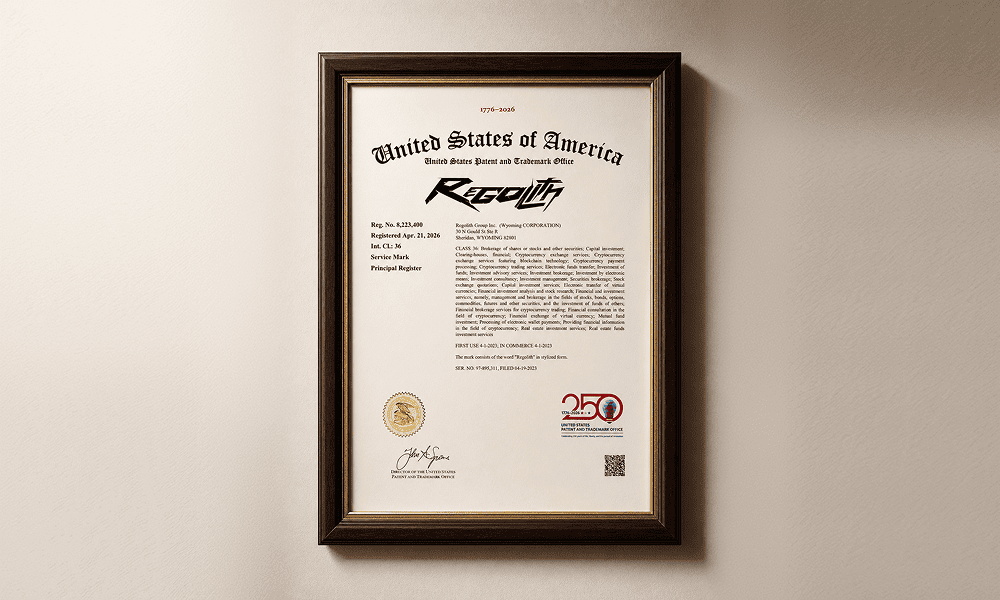
Three and a half years after filing its application, Regolith has secured trademark registration with the United States Patent and Trademark Office (USPTO). This transforms the brand into a fully-fledged intangible asset, protected in one of the most important jurisdictions in the world, and closes an important chapter in preparing the platform for international scaling.
What Happened
In April 2026, Regolith secured federal trademark registration in the United States. The application was filed three and a half years ago – in the early stages of the platform's development. Registration means that the Regolith brand has been officially entered into the public USPTO registry, and the company has obtained exclusive rights to use the mark within the United States and its territories across the designated classes of goods and services.
For a technology company, this isn't merely a legal procedure. It's the final step in turning the brand into an intangible asset – one with recognized market value that can be reflected in the company's capital structure.
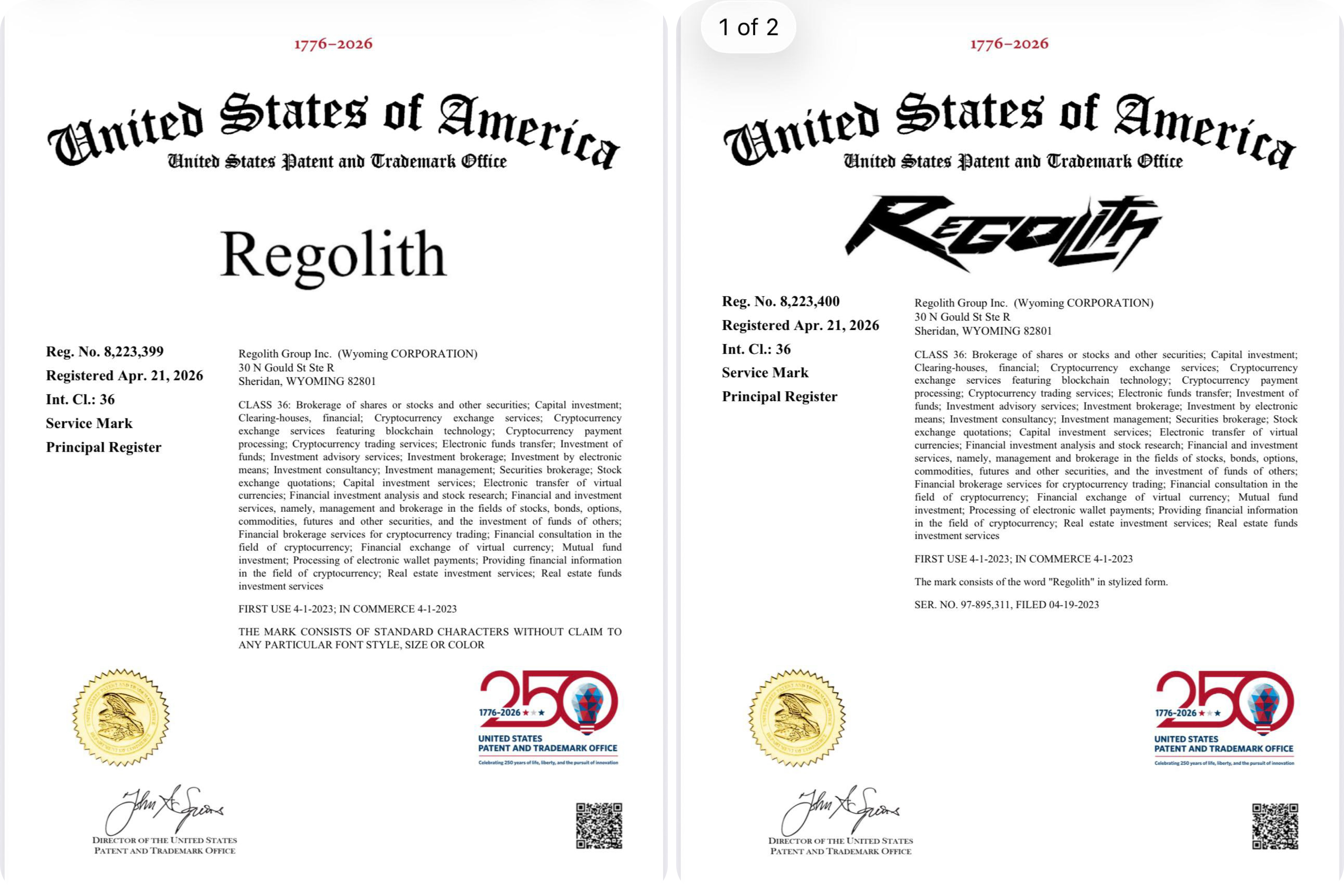
With this registration in place, Regolith now holds the full set of strategic brand assets:
- a strong name, recognized across the financial and technology communities
- the premium Regolith.com domain in the .com zone
- a registered Regolith trademark in the United States
This is the trio on which international finance and SaaS companies are built.
Where to Verify the Registration
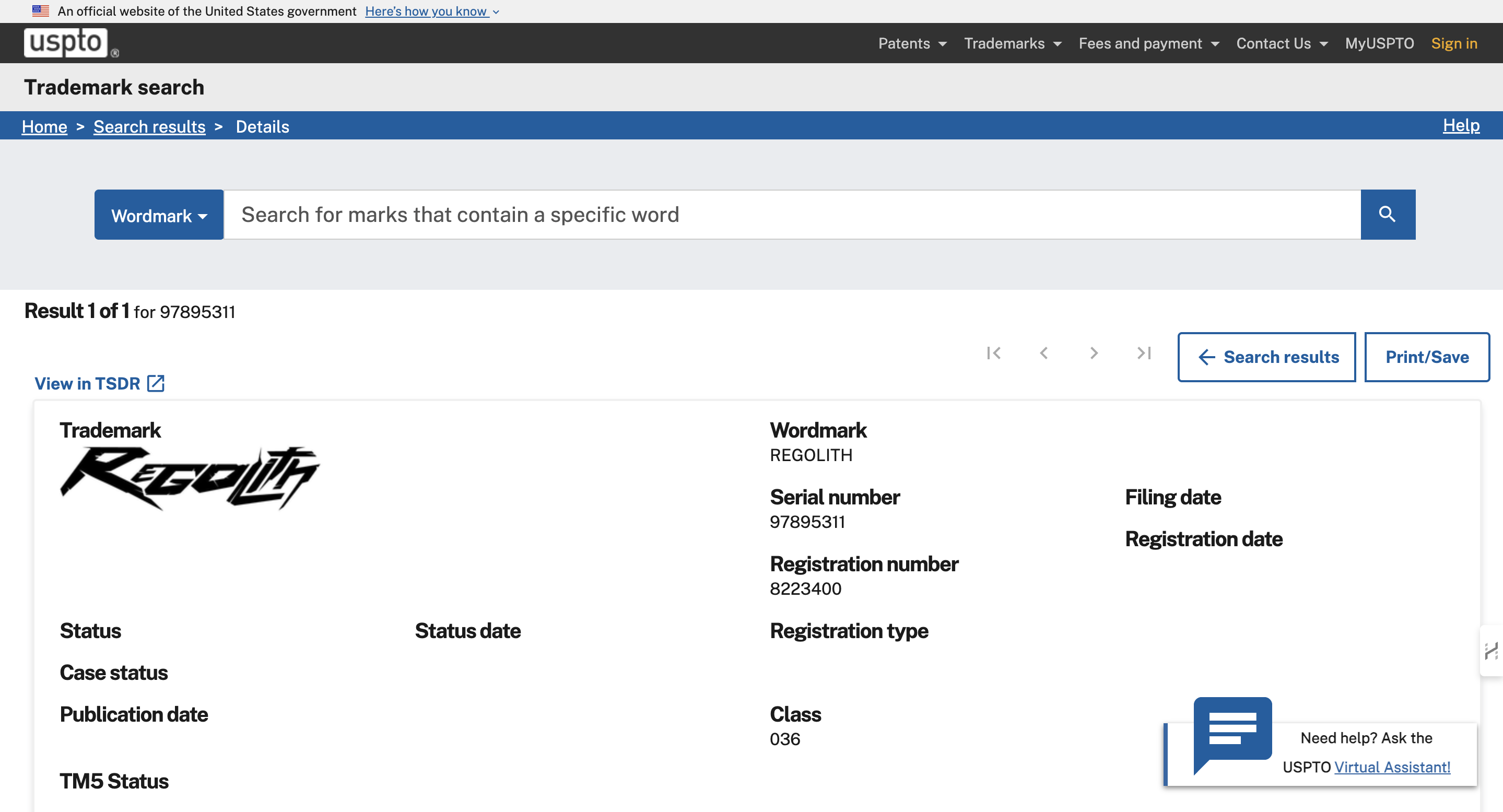
All USPTO records are publicly accessible. Anyone can confirm the registration's authenticity by searching the database:
A simple search for Regolith returns the registration status, filing date, class of goods and services, and the legal owner of the mark.
The openness of the public registry is a meaningful detail. Any company's claim of holding a trademark can be verified in seconds through the official portal – with no need to request a copy of the certificate.
What U.S. Trademark Registration Provides
Federal registration in the United States establishes rights across the U.S. and its territories and adds the mark to the public USPTO registry. From the agency's perspective, the owner of a registered mark gains the following:
- Legal brand protection. A registered mark is protected from use by third parties for the same or similar goods and services without the owner's permission. The USPTO specifically notes that the owner can prevent such use through judicial and administrative procedures.
- Reduced risk of parallel registrations. Once a mark is on the registry, other companies seeking to register similar names in adjacent categories will face rejection or formal objections.
- Stronger trust from investors and partners. Registration in the U.S. is considered a standard signal of brand maturity in the venture and legal communities. It simplifies negotiations around partnerships, licensing, and M&A transactions.
- Increased value of intellectual property. A registered mark becomes a standalone asset that can be valued, licensed, or transferred. On financial statements, it appears as part of the company's intangible assets.
- Confidence in international scaling. Registration in the U.S. often becomes the starting point for subsequent filings in the EU, the UK, the UAE, and Asia – via the Madrid system or direct national applications.
Why This Matters Especially for a Fintech Company
Regolith isn't building a local service. The platform is designed for international investors from the outset and offers access to products across multiple jurisdictions: alternative investments, pre-IPO deals, ETF funds, public markets. In this context, the brand carries additional weight: it conveys to the client the company's level of seriousness and long-term outlook before they ever look at the products themselves.
In fintech, trust starts with the brand. The client needs to understand that what they're looking at is a company built for the long term, with a thought-through legal structure and protected intellectual property. A registered trademark becomes one of the formal indicators of that long-term commitment.
Regolith.com is already a strong digital asset in its own right. A short, memorable, international .com domain for a fintech project carries strategic value: it simplifies direct traffic, boosts recognition, and lowers customer acquisition costs. When a registered trademark is layered on top of the domain, the brand gains a stronger legal and market structure. Domain, name, visual identity, and product ecosystem begin to work as a single asset – and each of these layers reinforces the others.
What This Means for Future Investors
A protected trademark is one of the factors traditionally considered when venture and strategic investors evaluate a company. In venture logic, assets fall into two categories: current cash flows and long-term value drivers. Brand, intellectual property, client base, technology, data, product architecture, and regulatory strategy – together they form the foundation of future valuation.
A trademark registration signals that the company is thinking beyond today's revenue and is focused on long-term value creation. For future funding rounds, this is a positive signal: the brand is protected, the risk of parallel registrations is minimized, and the asset has independent standalone value.
Context: Regolith Over the Past Three and a Half Years
When the trademark application was filed three and a half years ago, Regolith was at an early stage – an ambitious idea about reshaping how people access investments. Today the platform operates as a full investment ecosystem, where clients can access several categories of products at once:
- Alternative investments – auto, rental, mining, options strategies (SLAT 2.0 Fund), staking (TRX Staking Fund)
- Pre-IPO deals – stakes in late-stage private companies: SpaceX, Kraken, Discord, Abra, and others
- Funds and ETFs – a lineup of 12 exchange-traded funds covering the world's key market sectors
- Public markets – access to trading operations through a single interface
- Paul AI – an AI assistant for platform users
- Personal financial dashboard and the upcoming AI Family Office
Over these years, the platform has gone from concept to an operating business with a real client base and a product lineup covering every major asset class.
The Company's Goal
Regolith's strategic goal is openly declared: to build a company valued at more than $1 billion and to make Regolith a global investment platform. A place where a user can open the app, see their assets, get recommendations from an AI assistant, invest across asset classes, and manage capital more simply, more quickly, and more intelligently.

Securing the U.S. trademark is part of that strategy.
Legal brand protection in a key jurisdiction removes a series of risks tied to future scaling and simplifies work with international partners.
What's Next
Securing the Regolith trademark in the U.S. is not a finish line. It's a marker that the company is moving to its next stage. Where Regolith stands today:
- an industry-recognized name
- the premium Regolith.com domain
- a working product with a real client base
- ambition for international scaling
- the legal foundation of the brand in the United States
The next steps involve expanding into new markets, continuing product development, and registering the brand in other key jurisdictions. The goal: to make Regolith recognized across every target market where the platform operates or plans to operate.
