

SLAT 2.0 Fund: Options Wheel Strategy, New Trader and Updated Fund Terms
SLAT Fund, available through the Regolith platform, has undergone a significant transformation. Active equity trading has given way to the Wheel options strategy under a new portfolio manager. In this article, we break down what exactly changed, how the strategy delivers 25% annual returns, and how the updated fund is structured.
A shift in model
SLAT Fund launched in September 2025. Its original mandate centered on active trading of US equities listed on NYSE and NASDAQ, taking both long and short positions, using stop-loss orders and focusing on capturing short-term price movements.
While the strategy adapted to shifting market conditions, the most recent period proved challenging. Markets turned exceptionally unstable: geopolitical developments, sharp reversals on political statements, and unpredictable volatility created a difficult trading environment. Hedge positions opened as protection against market declines did not deliver the expected results.
Following a thorough review, Regolith made the decision to change both the portfolio manager and the strategy. All positions were closed, and operations were migrated to Interactive Brokers – one of the world's largest regulated brokers, providing full access to US market infrastructure.
How the Wheel strategy works
The Wheel is an options-based strategy that generates income through the systematic sale of options on liquid assets. Unlike directional equity trading, the Wheel does not depend on market direction – returns come from options premiums, which tend to be particularly elevated during periods of heightened volatility.
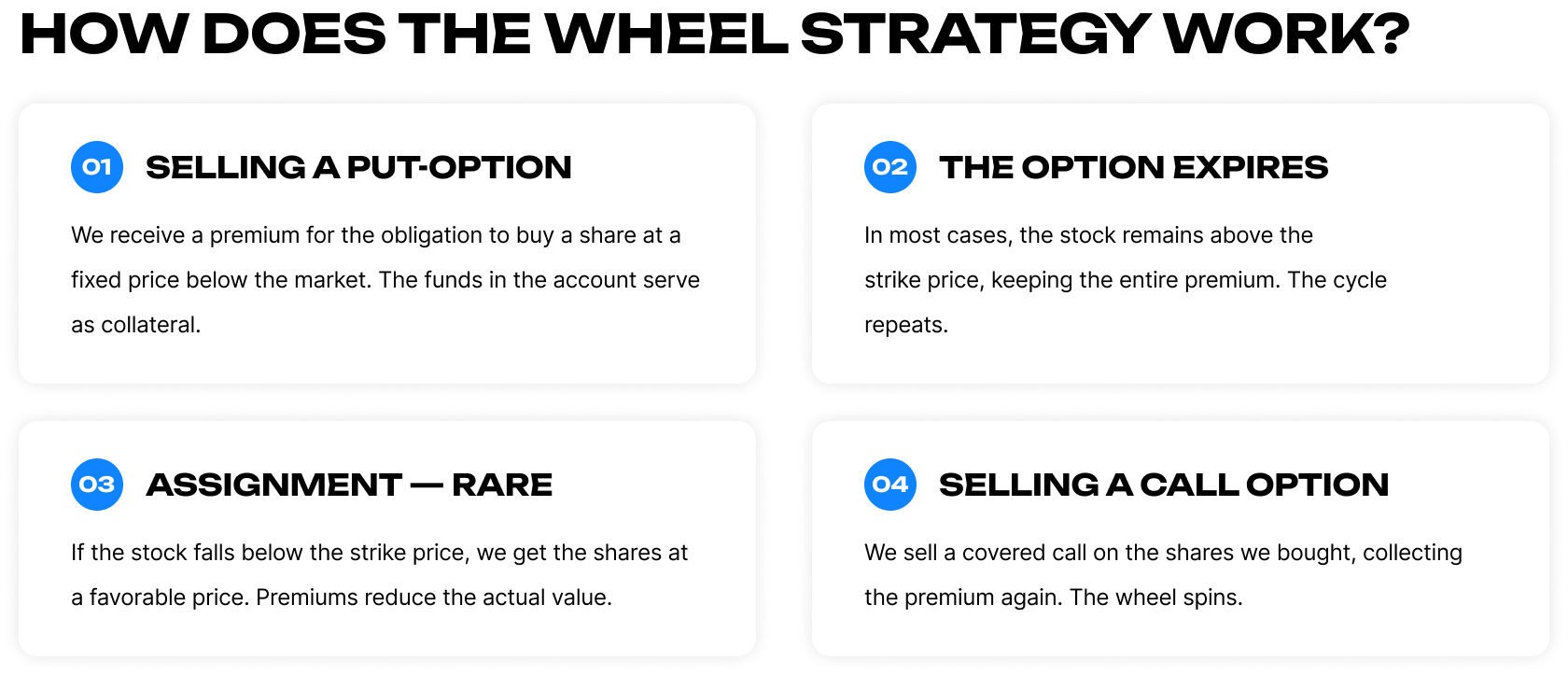
The strategy consists of four steps that form a continuous cycle:
- Selling a PUT option. The manager sells a put option with a strike price set at least 10% below the current market price. In exchange, the fund collects a premium. Cash on the account serves as collateral. Strikes are chosen so that the statistical probability of assignment remains below 15%.
- Option expiration. In most cases, the asset price stays above the strike, the option expires worthless, and the fund retains the full premium. The cycle repeats – a new option is sold.
- Assignment. If the price does fall below the strike, assignment occurs – the fund acquires shares at the strike price. At that point, the effective cost basis is already reduced by the premium previously collected.
- Selling a CALL option. Against the acquired shares, the fund writes a covered call – an option to sell the shares at a price above the purchase cost. A new premium is collected. If the stock rebounds, the shares are sold at a profit and the cycle returns to step one. If not, the fund continues writing additional call options.
The key distinction from speculative trading is that the fund does not attempt to predict market direction. Strikes and underlying assets are selected based on a mathematical probability model. In roughly 98% of cases, capital on the account is not deployed into equity purchases – it serves as collateral while simultaneously earning interest at the broker's prevailing rate.
Who manages the updated fund
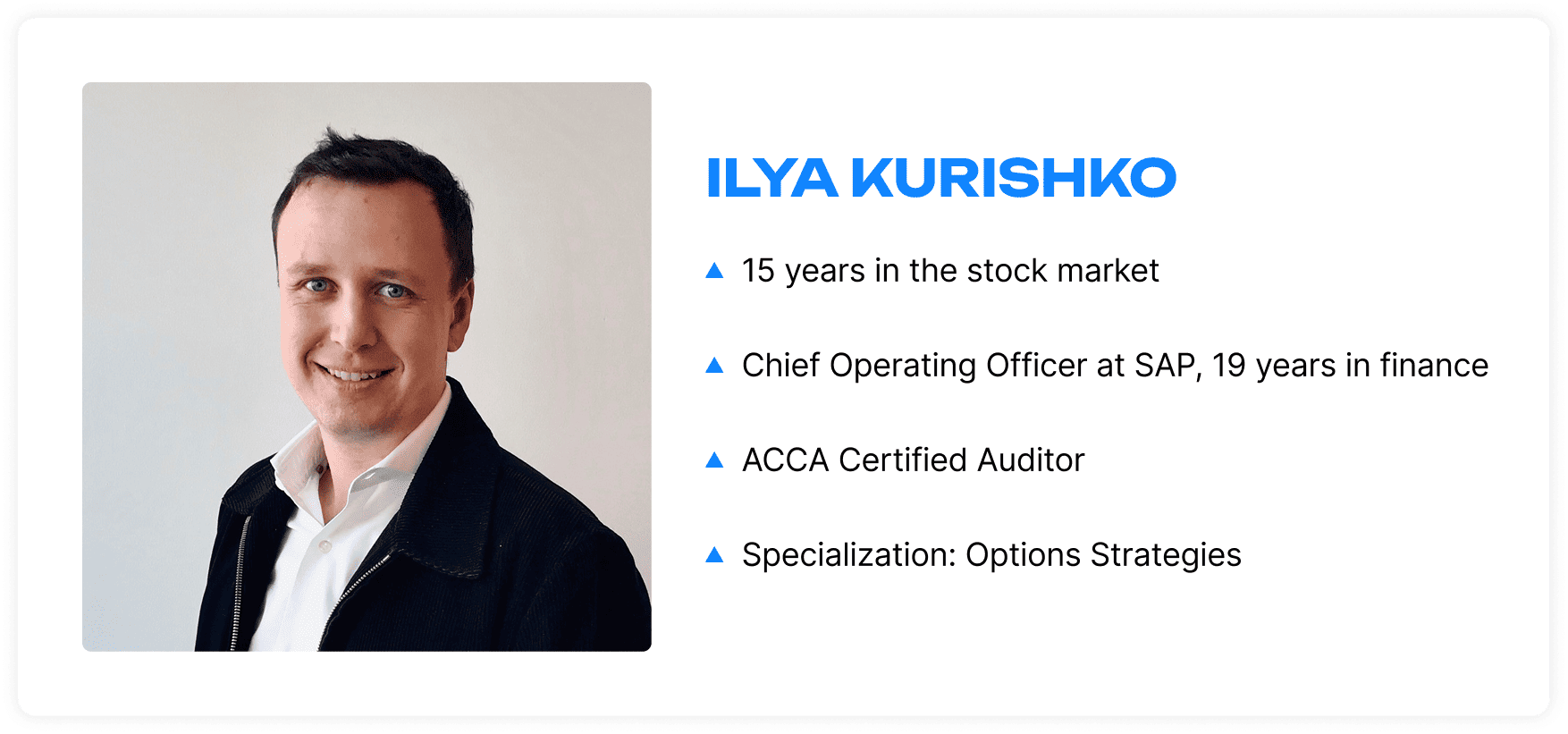
SLAT 2.0 is now managed by a trader with a strong professional background. Ilya Kurishko has 15 years of experience in capital markets – as a private investor, trader, and discretionary portfolio manager. His client base includes private individuals, family offices, and investment funds.
In parallel, Ilya holds the position of Operations Director at SAP – one of the world's largest enterprise software corporations. He brings 19 years of experience in finance and business process optimization, having worked in offices across Russia, the United Kingdom, France, and Germany. For the past 8 years, he has been based in the United Arab Emirates.
Education and certifications
• Financial Academy under the Government of the Russian Federation
• ACCA – Certified Auditor under international standards
• CFA Candidate, Level 2 (Chartered Financial Analyst certification in progress)
Beyond his professional career, Ilya co-authored a financial literacy and investment course with his wife, which has trained over 2,500 students worldwide.
His two core areas of specialization are passive investment strategies and options trading. The latter forms the foundation of SLAT 2.0.
Performance results
To illustrate the effectiveness of the Wheel strategy, here are the actual results for the period from May 2025 through March 2026 (11 months).
Key metrics
- Realized XIRR (Extended Internal Rate of Return): 31.73% annualized
- Target return: 20–25% per annum in USD
- Win rate: 97% (265 profitable trades out of 274)
- Profitable months: 11 out of 11 – zero losing months
- Average monthly return: 2.07%
Capital and return dynamics
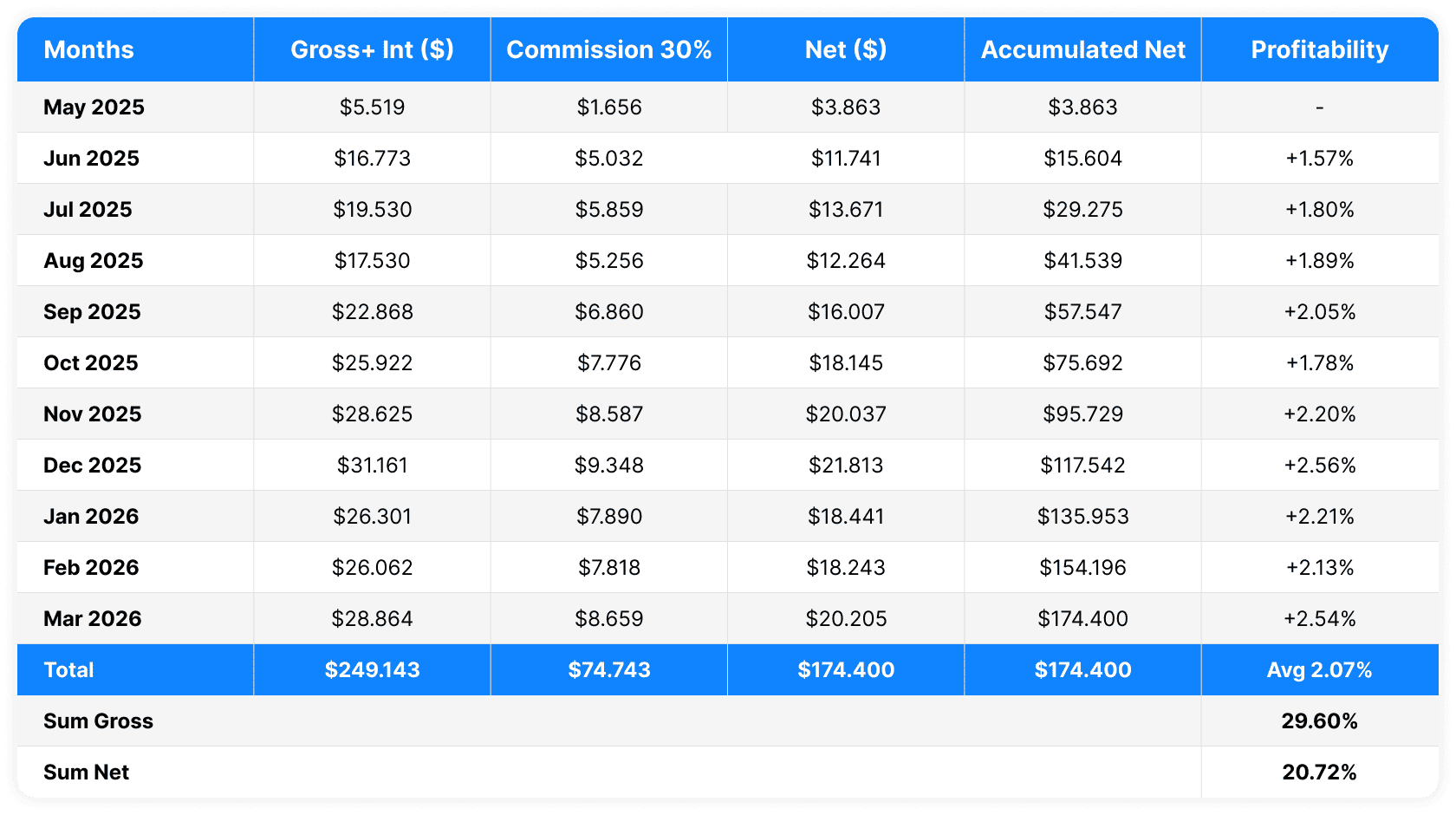
Notably, March 2026 turned out to be one of the strongest months, despite elevated volatility in US markets. For the Wheel strategy, high volatility is a constructive factor – it directly translates into larger options premiums.
Risk management and the sources of resilience
The stability of SLAT 2.0 is underpinned by several layers of risk control.
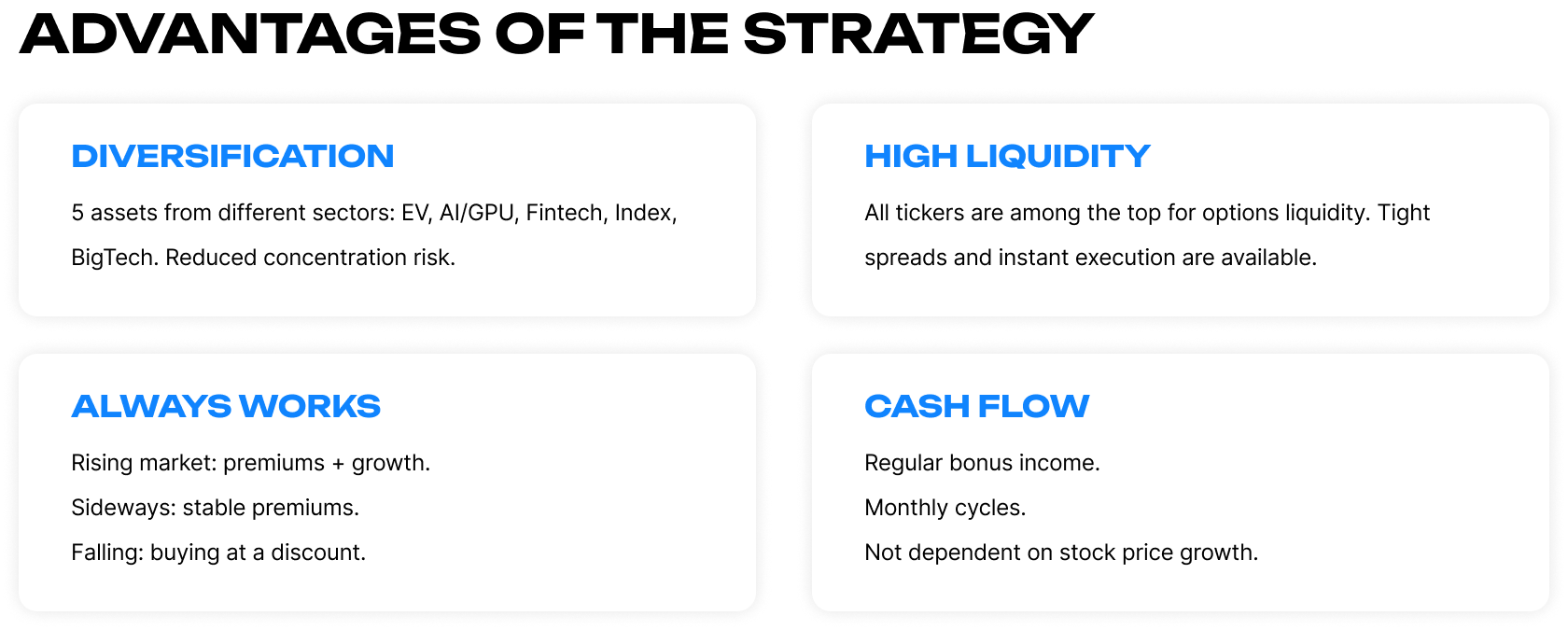
- Probability-driven strike selection. Options are sold with strikes set more than 10% below the current price of the underlying, with deltas (the probability of assignment) below 15%. Statistically, this means that only around 15% of trades may result in assignment – and even then, the position does not turn into a loss but rather transitions into the covered call phase of the cycle.
- Avoiding abnormal periods. The fund does not trade on earnings release days for portfolio companies. During such windows, volatility spikes above statistical norms – premiums are higher, but so is the risk of sharp price movements.
- No leverage. All positions are fully backed by actual capital on the account. The strategy does not use margin leverage to amplify returns – growth potential comes from the careful selection of volatile assets and optimal sector allocation.
- Short-duration positions. The average time in an options position is 8–10 days. Roughly 80% of trades are weekly options (sold on Friday for the following Friday), with the remainder being monthly. Short exposures mean that potential losses in any force-majeure scenario are contained.
- Roll capability. If price moves against a position, the option can be closed and a new one opened with a later expiry – this allows the manager to avoid realizing a loss and wait for market conditions to normalize. Most loss-making trades in the strategy's history resulted from client redemption needs rather than unfavorable position selection.
- Interactive Brokers infrastructure. The brokerage account is held in the name of Regolith, not personally by the manager. Access to capital remains with Regolith; the manager only executes trades. This mitigates key-person risk – if anything were to happen to the manager, positions can be closed quickly and capital remains accessible.
Portfolio composition and asset allocation
SLAT 2.0 operates across five liquid US market instruments. The selection balances implied volatility (IV), which drives the size of options premiums, with fundamental reliability of the issuer, which supports the durability of the strategy.
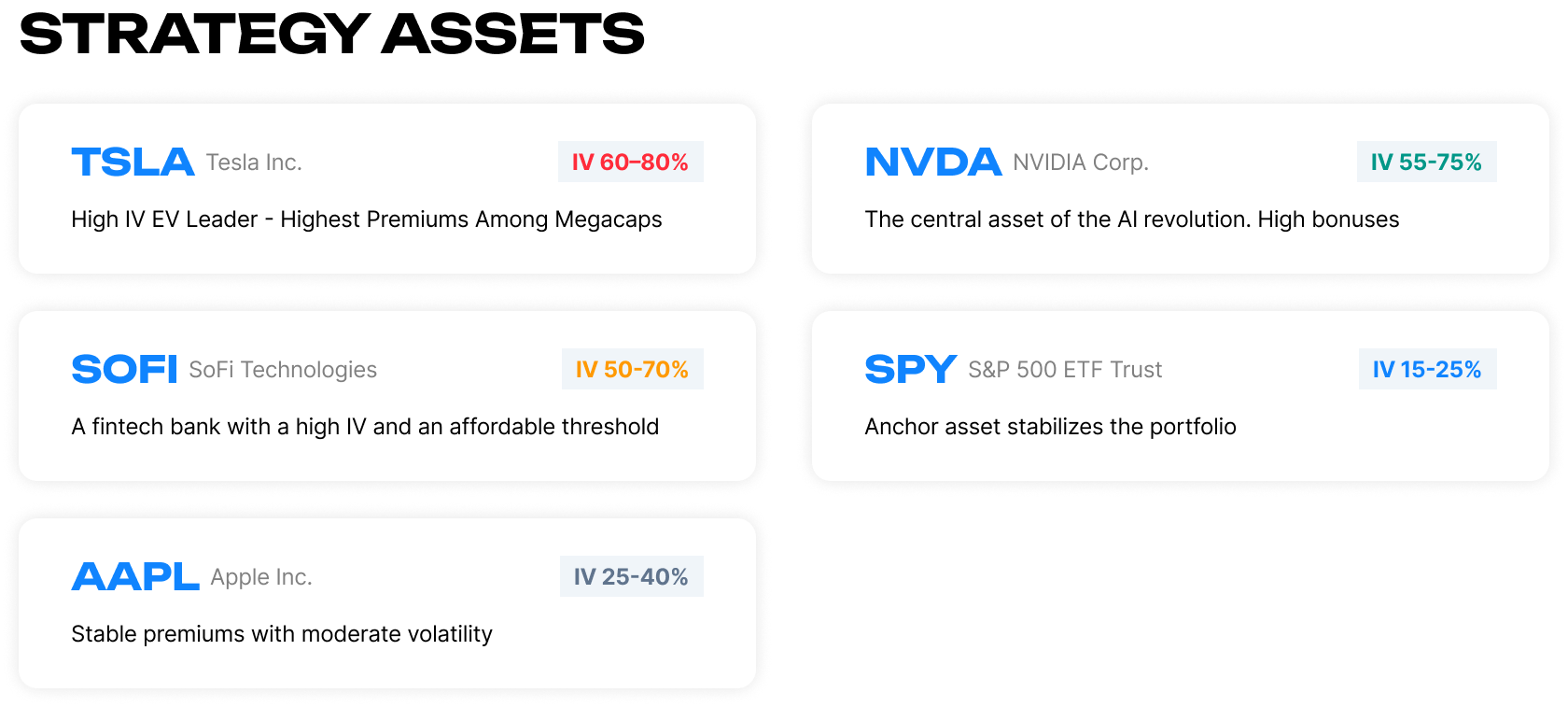
- Tesla (TSLA) – one of the most volatile mega-cap names. IV of 60–80%. Serves as the primary return driver of the portfolio through elevated options premiums. High liquidity ensures tight spreads and swift execution.
- Nvidia (NVDA) – a core enabler of AI infrastructure and leader in the GPU and TPU segments. IV of 55–75%. Sustained institutional demand supports elevated premium levels.
- SoFi Technologies (SOFI) – a fintech-sector name with elevated volatility. IV of 50–70%. A relatively low share price allows the fund to operate efficiently with smaller capital per contract, providing flexibility in positioning.
- Apple (AAPL) – the world's largest company by market capitalization. IV of 25–40%. Offers a steady premium flow at moderate volatility, with deep options market liquidity and a defensive profile that reduces systemic risk within the portfolio.
- S&P 500 ETF (SPY) – the anchor asset of the strategy, providing broad-market exposure. IV of 15–25%. Delivers a conservative cash flow stream and, historically, a short recovery period after corrections – which makes assignment on the index strategically favorable.
The portfolio covers five distinct sectors of the economy – EV, Semiconductors, Fintech, BigTech, and the broad market. This structure reduces concentration risk: a downturn in any single segment does not compromise the portfolio's overall ability to generate premium income.
March 2026 data shows the following Net income distribution by asset: Tesla – 47%, SPY – 35%, NVDA – 9%, SoFi – 5%, Apple – 3%. The largest trade of the month was an SPY PUT at the 596 strike, generating $4,189 in gross income.
Fund terms
SLAT 2.0 has revised its terms for investors – the new structure is tailored to the specifics of the options strategy and its monthly trading cycle.
- Minimum amount. The entry threshold is $375, making the fund accessible to a broad audience. For individual brokerage accounts at Interactive Brokers, the threshold is $500,000 – a format suited for larger clients seeking a fully segregated strategy.
- Deposits. Contributions are accepted at any time but become active in the strategy on the 1st day of the following calendar month. The pending period is up to one month. This is required for proper options position planning – the manager locks in the available capital two weeks before month-end and opens positions accordingly.
- Withdrawals. The minimum holding period is 3 months. Withdrawal requests must be submitted no later than two weeks before the start of the month, and the withdrawal itself is executed after the 5th day of the following month, once all current options positions are closed.
- Lock-up. During the transition from SLAT 1.0 to SLAT 2.0, a 90-day lock-up applies. This is standard practice when changing strategy and manager – it allows a stable capital pool to form and gives the new manager the opportunity to demonstrate performance.
- Distributions. Paid monthly based on the results of the trading period. By default, profits are reinvested – enabling compounding on the capital base. Investors may switch to cash distributions upon request.
- Fees. The fee structure is transparent and scaled with commitment size:
- 5% – one-time deposit fee
- 30% success fee – for investments up to $500,000
- 25% success fee – for investments from $500,000
- 20% success fee – for investments from $1,000,000
The success fee is charged only on realized profit – there is no management fee and no hidden charges.
Return illustration
For illustrative purposes, below are projected returns across different capital commitments, based on the target return of 20–25% per annum (approximately 1.7–2.1% per month):
$10,000 commitment:
• After 5% entry fee: $9,500 at work
• Monthly gross income: $162–$200
• After 30% success fee: $113–$140 net per month
• Annual income (without reinvestment): $1,356–$1,680$600,000 commitment:
• After 5% entry fee: $570,000 at work
• Monthly gross income: $9,690–$11,970
• After 25% success fee: $7,268–$8,978 net per month
• Annual income: $87,216–$107,736$1,100,000 commitment:
• After 5% entry fee: $1,045,000 at work
• Monthly gross income: $17,765–$21,945
• After 20% success fee: $14,212–$17,556 net per month
• Annual income: $170,544–$210,672
With profit reinvestment, total annual returns will be higher due to compounding.
SLAT 2.0 within the Regolith product lineup
Regolith continues to expand its range of instruments for different types of capital and objectives. SLAT 2.0 occupies the niche of actively managed products focused on regular cash flow generation.
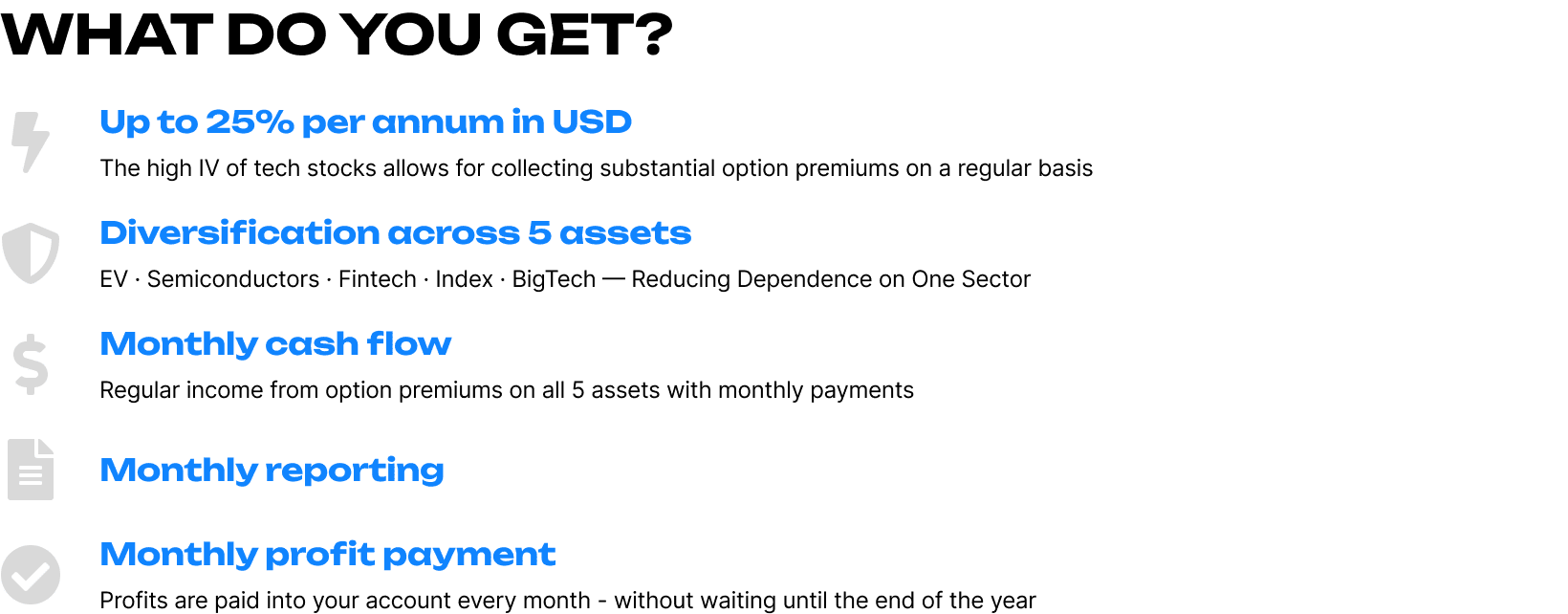
Compared with other funds on the platform – such as TRX Staking Fund, which operates through crypto staking, or Real Estate Rental Fund, built on rental income from Dubai – SLAT 2.0 offers exposure to the US equity market without the need to predict its direction. Investors gain access to top-tier liquid assets (Tesla, Nvidia, Apple) in a format where risk management and trade planning are handled by a professional portfolio manager.
For comparison of expected return levels
Against traditional USD-denominated instruments, SLAT 2.0 stands out through its combination of active management and consistent monthly income generation. The following overview places the fund's target return in context of the broader market landscape:
- SLAT 2.0 – target return of 20–25% per annum in USD
- S&P 500 (historical average) – 10–12% per annum
- USD deposit / money market – 4–5% per annum
- US Treasuries (T-Bills) – 4–5% per annum
At the same time, SLAT 2.0 generates monthly cash flow rather than requiring capital to be locked up until a growth-driven exit. For investors who prioritize regular income and diversification across currency and market exposure, it can be a well-suited instrument.
What changes for existing investors
Investors who were in SLAT at the time of transition are automatically migrated to SLAT 2.0. Their capital is included in the new pool managed by Ilya Kurishko. The realized loss is locked in as a reference point – from the next trading cycle, Ilya begins operating under the new terms.
Throughout the 90-day lock-up period, investors can observe the performance of the new strategy. Once it ends, standard withdrawal rules apply. New contributions to the fund are deployed under SLAT 2.0 terms immediately.
Conclusion
SLAT 2.0 represents a fundamentally new product compared to the previous version of the fund. The shift from active equity trading to the Wheel options strategy changes both the risk profile and the source of returns. Instead of relying on directional market forecasts – a systematic approach to working with volatility.
The fund's performance from May 2025 through March 2026 – 31.73% annualized with zero losing months – shows that the model works. At the same time, the strategy retains a conservative profile: no leverage, short-duration positions, defensive strikes, and avoidance of abnormal market windows.
For Regolith investors, SLAT 2.0 opens access to the US market through an options strategy with transparent mechanics and a clear return logic. The fund's approach is built around options premiums – a source of income that is largely independent of market direction. Performance is generated systematically, based on a mathematical probability model, while the monthly cycle makes the strategy's operation predictable in both structure and timing.
