

SpaceX After IPO: A Record Debut, Stock Gains, and What the Market Will Watch Next

On June 12, SpaceX began trading on Nasdaq under the ticker SPCX and set a new benchmark for the global IPO market. The offering was priced at $135 per share, the company raised around $75 billion, and the stock ended its first trading day up 19%. Shares closed at $160.95, while SpaceX’s market capitalization exceeded $2 trillion.
For the market, it became one of the most closely watched events of the year. SpaceX went public after years of anticipation, completed the largest IPO in history and immediately joined the ranks of the world’s most valuable public companies. The debut matters for the company and for the broader technology sector: after several weaker years for IPO activity, the market received a clear signal that demand for large-scale growth stories remains strong.
How the First Trading Day Went
SpaceX prepared for the listing on an accelerated timeline. Ahead of the IPO, the company completed a 5-for-1 stock split, filed its S-1 with the SEC, built the order book and set the offering price at $135 per share. In total, more than 555 million shares were sold, allowing the company to raise around $75 billion.
After the market opened, the stock quickly moved above the IPO price. According to market data, shares opened at around $150, rose above $176 intraday and finished the first session at $160.95. The final gain versus the IPO price was around 19%.
That is a strong result for an offering of this size. Large IPOs often face a harder path to sharp first-day gains: the supply of shares is substantial, and the market needs to absorb a significant volume quickly. In SpaceX’s case, demand was strong enough to keep the stock above the offer price from the start of public trading.
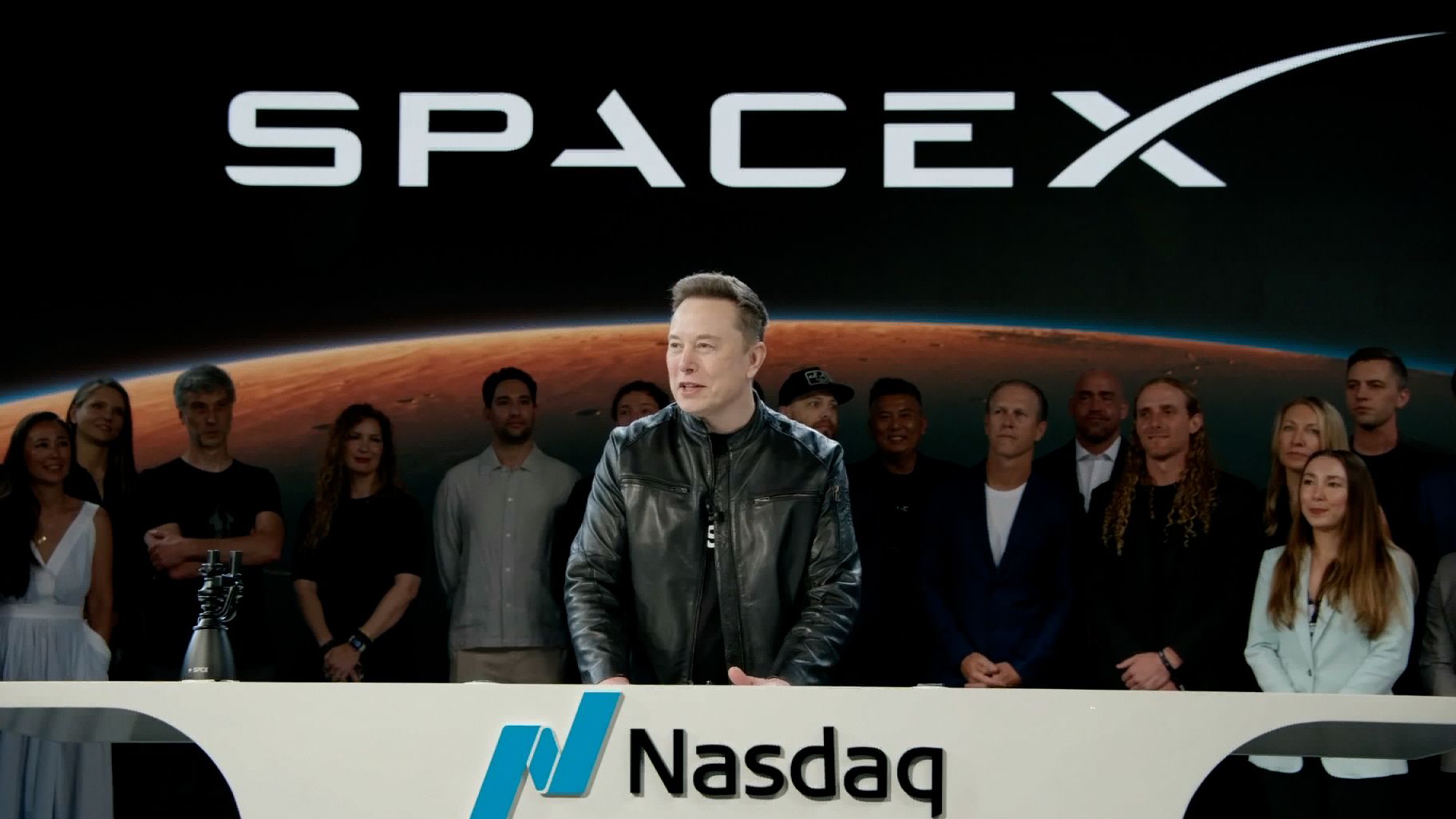
Elon Musk speaks to SpaceX employees during Nasdaq’s opening bell ceremony for the company’s IPO debut. Source: Nasdaq / SpaceX video still.
As of the morning of June 15, SpaceX shares were trading at around $170.26 in pre-market trading. That is more than 5% above the first-day closing price and points to continued strong interest in the company after its debut.
A Historic Opening Bell Ceremony
SpaceX’s debut was accompanied by a symbolic opening bell ceremony. For the first time, Nasdaq held the ceremony in two locations at once: in New York and at SpaceX headquarters in Starbase, Texas.
At Nasdaq MarketSite in New York, company president Gwynne Shotwell opened the trading session alongside the team and stakeholders. Elon Musk joined by video link from Texas, where hundreds of SpaceX employees watched the event. For the company, this was more than a formal start to trading. It marked the transition from one of the most closely watched private technology companies to a public market giant.
The format captured the scale of the moment. In New York, SpaceX was introduced as a new Wall Street asset. In Starbase, the IPO was marked as an internal milestone for a team that has spent more than two decades building around launches, Starlink and space infrastructure.
Why It Became the Largest IPO in History
The defining metric of the offering was the amount of capital raised. SpaceX raised around $75 billion, making it the largest IPO in stock market history. Previous major listings were measured in tens of billions of dollars, but SpaceX moved the benchmark higher both in deal size and in final market value.
According to media reports, the order book included strong participation from large institutional investors, sovereign funds and long-term holders. That matters for post-IPO trading dynamics: the larger the share of long-term holders in the allocation, the lower the risk of immediate heavy selling in the first days of trading.
The market is also watching the free float structure. After the IPO, only a limited portion of SpaceX shares is available in public trading. A significant part remains held by early backers, employees and insiders under lock-up restrictions. This limits the available supply in the first months of trading and may support the stock if demand remains strong.

SpaceX IPO debut in New York, June 12, 2026. Photo: Spencer Platt / AFP / Getty Images.
Index Inclusion as the Next Demand Driver
One of the key questions after the IPO is whether SpaceX could be fast-tracked into major indexes. Analysts expect the company to be eligible for inclusion in the Nasdaq-100, as well as FTSE Russell and MSCI indexes.
For the market, this has practical importance. Index funds and ETFs that track those benchmarks are required to buy shares of companies included in them. If SpaceX is added to major indexes quickly, it could create additional demand from passive funds.
This type of demand is different from regular retail activity. Index funds buy shares mechanically based on a company’s weighting in the index. With a market capitalization above $2 trillion, SpaceX could receive a meaningful weight, which means fund flows could also become significant.
What Changes for SpaceX After Going Public
Before the IPO, SpaceX was the largest private technology company with limited access for the broader market. A public listing changes that status.
The company will now publish regular financial reports, face public market valuation and respond to expectations around revenue, margins, capital expenditure and the development of key business lines. For SpaceX, this brings a new level of transparency and a new level of pressure.
The market will closely watch several areas:
- Starlink’s performance as the company’s main revenue engine;
- launch cadence and the economics of reusable rockets;
- spending on Starship and long-term space programs;
- integration of the AI segment following the xAI transaction;
- potential monetization of computing infrastructure;
- timing and terms of lock-up expirations for early shareholders.
The main question now is whether SpaceX can support its public valuation with sustainable financial performance, rather than relying primarily on brand scale and market expectations.
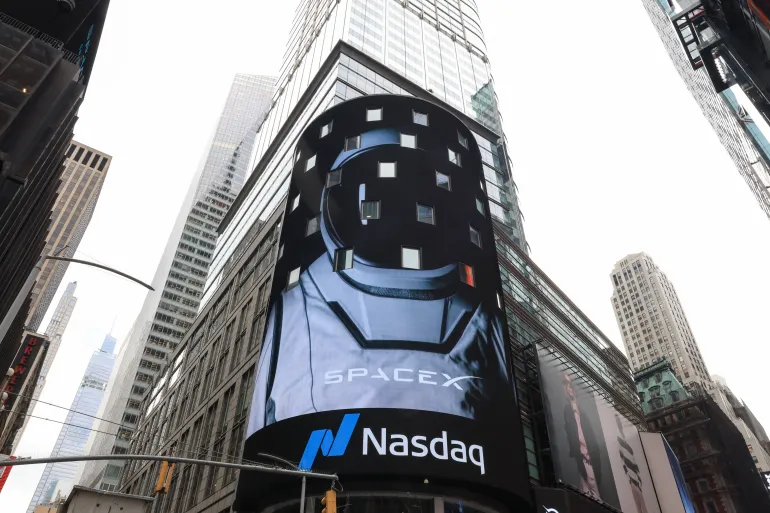
SpaceX display on the Nasdaq MarketSite screen in New York during the company’s IPO debut. Photo: Timothy Clary / AFP.
Why the Market Sees SpaceX as More Than a Space Company
The market thesis around SpaceX has expanded significantly in recent months. The company remains a leader in space launches and satellite internet, but after the combination with xAI, investors have started to view it as a more complex technology platform.
In this framework, SpaceX brings together several layers of infrastructure: rockets provide access to space, Starlink builds a global communications network, and the AI segment adds a new layer of computing infrastructure. This is why the market is valuing the company through current revenue and through its potential role in the future AI economy.
That scenario still needs to be proven. Orbital data centers, space-based computing and large-scale AI infrastructure remain long-term areas. Still, the market is already pricing in the possibility that SpaceX could become one of the key infrastructure players of the next technology cycle.
What Matters for Early Shareholders
For early SpaceX shareholders, the public listing marks an important stage. Before the IPO, the company’s value was formed in the private market, where liquidity is limited and valuation depends on secondary transactions and tender offers. After the Nasdaq debut, the company now has a daily public quote, giving the market a transparent reference point for value.
At the same time, many early holders remain subject to lock-up restrictions. This is a standard mechanism in large IPOs, limiting the ability to sell shares during the first months after the offering. As a result, a significant portion of the stock does not enter the public float immediately after listing.
For the market, this is an important factor. In the first months, share performance will depend on the balance between demand from new buyers and limited available supply. Later, as lock-up periods expire, the amount of tradable stock may increase, which could become a separate source of volatility.
What Comes Next
he first day of trading showed strong demand for SpaceX as a public company. The record IPO size, first-day stock gains and potential index inclusion create a strong market backdrop.
From here, investor attention will shift from the IPO itself to operating performance. The market will be watching the first public earnings reports, management commentary, Starlink data, AI infrastructure spending and new space programs.
For SpaceX, a new stage has begun. The company has moved from a private technology asset to one of the largest issuers on Nasdaq. It will now need to support its valuation in the public market, where every earnings report, strategic move and major corporate update can be reflected directly in the share price.
The first trading results look strong: SpaceX completed the largest IPO in history, showed strong demand and immediately secured a place among the world’s largest companies. Further performance will depend on how quickly the company can turn the scale of its technology into a sustainable financial model in the public market.
This material is provided for informational purposes only and does not constitute financial advice.
