

SpaceX Prepares to File S-1: What to Know About the Largest IPO in History
SpaceX is moving closer to an IPO. On March 25, Reuters reported that the company is preparing to file its S-1 with the U.S. Securities and Exchange Commission (SEC).
Elon Musk founded SpaceX in 2002 with the goal of making space more accessible. Since then, the company has evolved from a high-risk startup with multiple failed launches into the dominant player in commercial space. Today, no company launches rockets more frequently.
Timeline: From xAI Merger to S-1 Preparation
February 2, 2026: SpaceX merged with xAI. The combined entity was valued at approximately $1.25 trillion, with shares trading around $600 on the private market. The deal effectively brought together space infrastructure and artificial intelligence under one structure.
March 13: Top-tier legal advisors Gibson Dunn and Davis Polk joined the process. These firms have previously worked on IPOs for companies like Uber, Airbnb, Alibaba, and Meta. In the industry, their involvement is widely seen as a sign that preparations have entered an active phase.
March 25: Reuters and The Information reported that the company is preparing its S-1 filing. Shortly after, Bank of America and Morgan Stanley were brought in.
The lineup of advisors and early role allocation suggest that the company is steadily moving toward a public listing.
Three Businesses in One Company
SpaceX’s estimated $1.75 trillion valuation reflects not a single business, but a combination of three major segments—each potentially worth tens or even hundreds of billions of dollars.
Today, SpaceX operates across three core areas:
- Launch services (SpaceX)
- Satellite internet (Starlink)
- Artificial intelligence (xAI)
The interaction between these platforms underpins the company’s current valuation.
Launch Services: Market Leader
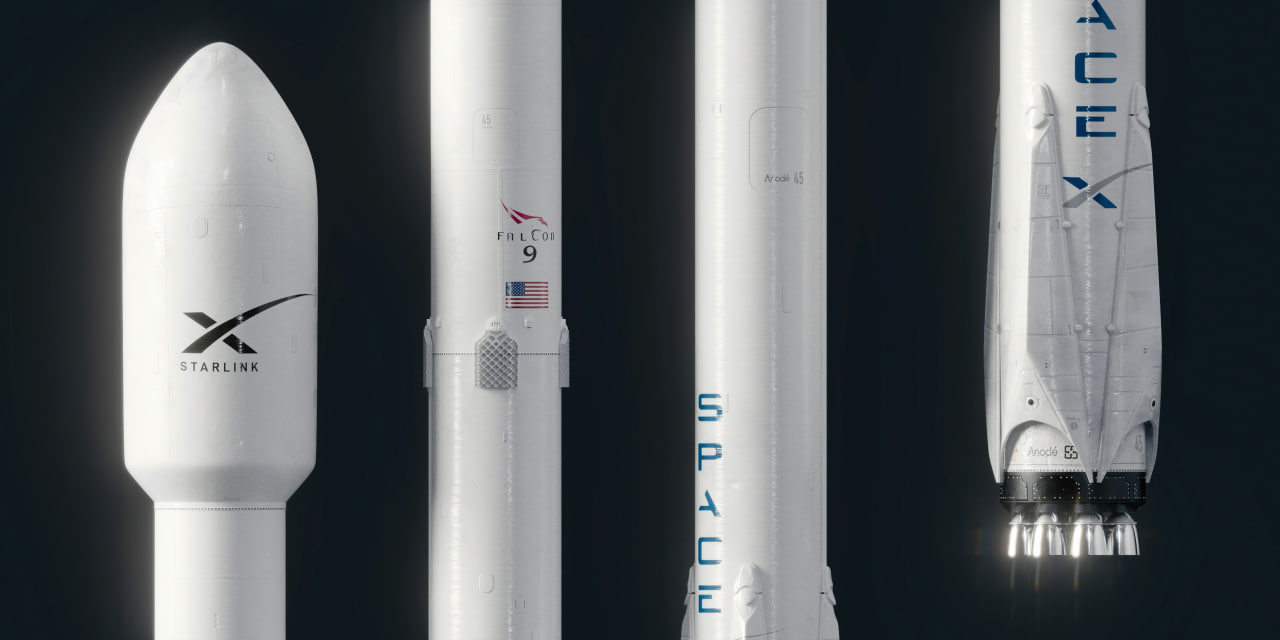
SpaceX now conducts more launches than all other companies and countries combined. In 2025 alone, it completed over 100 Falcon 9 missions.
The turning point came with reusable rocket technology. This fundamentally reshaped launch economics: where sending one kilogram to orbit once cost $20,000–50,000, Falcon 9 reduced that figure to around $2,700.
The next step is Starship, which is designed to lower costs even further and reinforce SpaceX’s position in the industry. The company already holds major contracts with NASA, the U.S. Department of Defense, and commercial clients.
Starlink: A Global Internet Provider
Starlink is the largest satellite network in operation, available in over 100 countries. More than 7,000 satellites are in orbit, and the service has surpassed 5 million users.
For investors, this is the most straightforward part of the business. Unlike launch services, which rely on contracts, Starlink operates on a subscription model with recurring revenue.
With infrastructure already in place, each additional user contributes incremental revenue. In 2025, Starlink generated over $10 billion and continues to expand.
Competition remains limited. Amazon’s Project Kuiper is still in early deployment, while OneWeb operates at a smaller scale and targets different use cases. SpaceX has effectively built the first global satellite internet provider at scale and established a leading position in the market.
xAI: Expanding the Ecosystem
Following the merger, artificial intelligence has become a strategic pillar for SpaceX. The company is developing the Grok model alongside its own data infrastructure.
Integration with the X platform allows the model to process real-time information, improving responsiveness and relevance.
The advantage lies in combining capabilities: Starlink’s global network and SpaceX’s computing resources enable data processing across geographies without reliance on local infrastructure.
This reflects a broader strategy. SpaceX is not just a launch provider or an internet company—it is building an integrated system where connectivity, data, and AI reinforce each other.
Retail Investors: Why It Matters
In most IPOs, retail investors receive only 5–10% of the allocation, with the majority going to institutional funds. In SpaceX’s case, the share for retail investors could reach up to 30%.
The rationale is straightforward. Retail investors tend to hold positions longer and are less likely to sell immediately after listing, which can help stabilize price action in early trading.
There is also a built-in audience. Tesla has one of the largest retail investor bases globally, many of whom are long-term holders. A similar dynamic could emerge for SpaceX.
A comparable approach was used by Google in 2004 through a broader retail participation model, though at a smaller scale.
IPO Structure: Scale and Key Parameters
The upcoming SpaceX IPO could become the largest in history. Current discussions point to the following parameters:
- Valuation: up to $1.75 trillion
- Capital raised: more than $75 billion
- Retail allocation: up to 30%
For comparison, Saudi Aramco raised $29.4 billion in 2019, while Alibaba raised $25 billion in 2014. SpaceX could exceed these figures significantly.
The deal is supported by leading financial and legal institutions. Gibson Dunn and Davis Polk are advising on legal matters, while Bank of America, Morgan Stanley, Goldman Sachs, and JPMorgan are involved on the banking side.
Roles are beginning to take shape: Bank of America is focusing on large private capital, while Morgan Stanley is expected to reach a broader retail audience through its platforms.
If the valuation is confirmed, SpaceX would rank among the world’s most valuable public companies, alongside Apple, Microsoft, Nvidia, and Amazon.

Secondary Market: Pre-IPO Pricing Signals
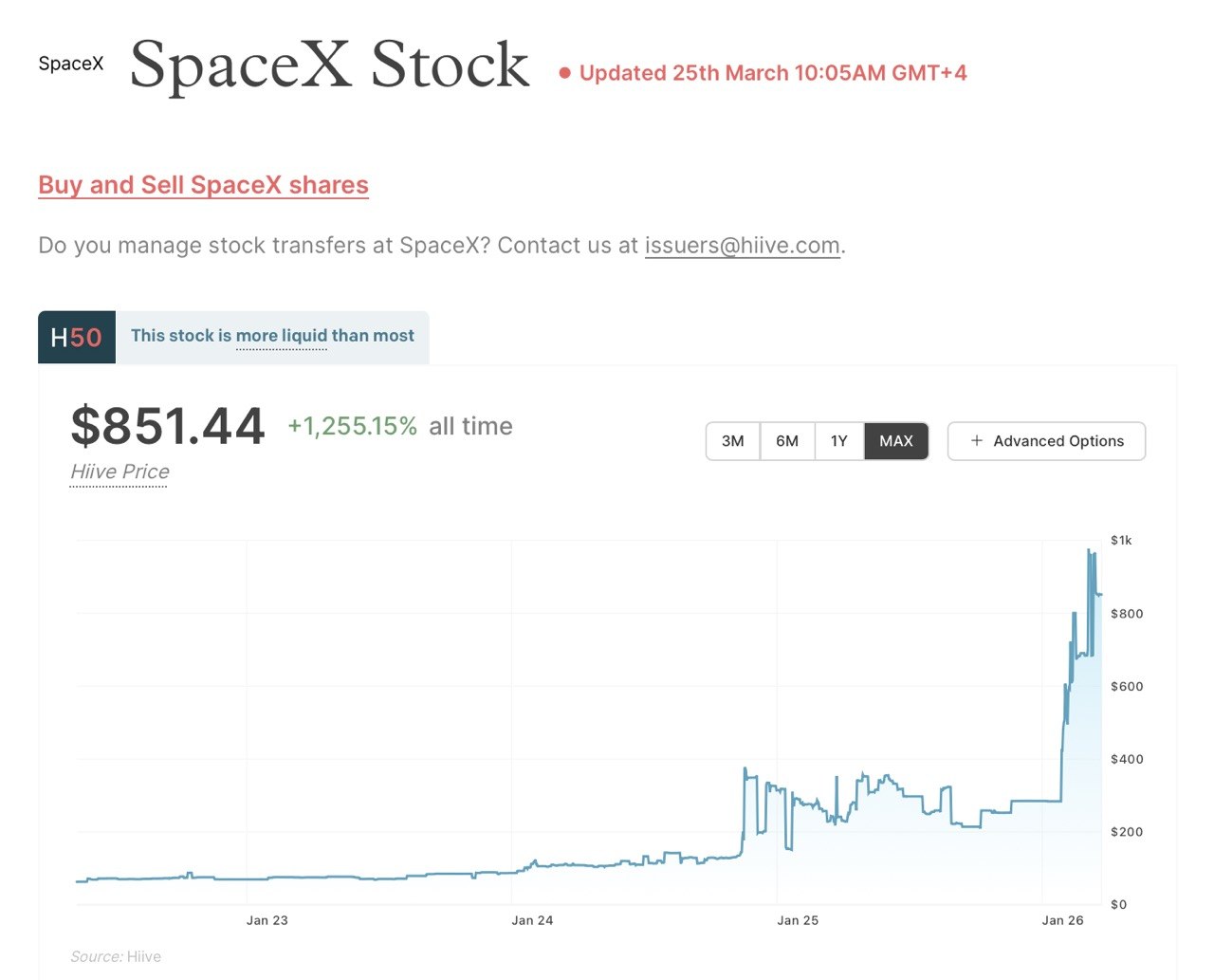
Private market trading provides a view into investor sentiment ahead of the IPO. According to Hiive, SpaceX shares were trading around $851 as of March 25. Just two months earlier, following the xAI merger, the price was closer to $600.
This shift reflects increased demand, as investors look to gain exposure ahead of a potential listing. At the same time, secondary market pricing reflects current sentiment and may change as conditions evolve.
Market Context: A New Wave of IPOs
SpaceX’s potential listing is part of a broader trend. After a relatively quiet period, the IPO market is gaining momentum again, with several large private technology companies preparing to go public.
Among them:
- Anthropic, an AI developer behind Claude, targeting a valuation above $60 billion
- Databricks, a data platform preparing for IPO with a valuation exceeding $130 billion
- Discord, a communication platform that has confidentially filed, targeting around $25 billion
Analysts expect a new wave of listings, with combined valuations potentially exceeding $1.4 trillion.
SpaceX in the Regolith Portfolio
SpaceX is one of the key assets in the Regolith portfolio. The position was initiated in March 2022 at around $79 per share.
With secondary market prices around $851, this reflects how the company’s valuation has evolved over time.
Current access conditions:
- Minimum investment: from $50,000
- Availability: limited supply of shares on the secondary market
Access depends on current supply, which fluctuates based on shareholder activity. Entering at this stage means acquiring exposure at prevailing market prices ahead of a potential listing.
What Comes Next: From S-1 to Trading
Filing the S-1 marks the beginning of the formal IPO process. Several steps follow:
- SEC review, which typically takes several weeks to a few months
- Roadshow, where management presents to institutional investors
- Book-building and price discovery
- Final pricing shortly before trading begins
The full process typically takes several months. If filings proceed in the near term, the IPO could take place in the second half of 2026.
For investors, this suggests that the window to access shares before a public listing may gradually narrow. At the same time, secondary market prices are driven by current demand and can move in either direction.
