

The Biggest IPOs of 2026–2027: Who Goes Public After the Record SpaceX Debut
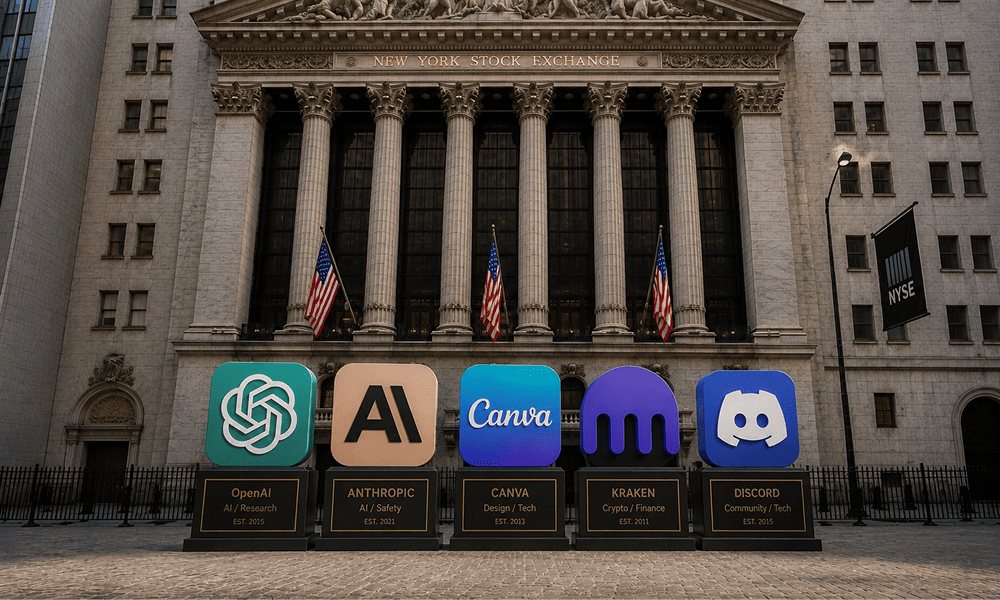
On June 12, SpaceX pulled off the largest IPO in history. According to analysts, a successful debut of this scale improved sentiment in the primary-listings market and reopened the "IPO window" after several weak years. Now investors' attention is shifting to the next candidates. There are many of them – both in Regolith's portfolio and beyond it. Let's break down the key companies: what they do, what stage of going public they are at, and what IPO timelines the media is citing.
Abra: going public on Nasdaq via a SPAC merger
A crypto-based wealth management platform founded in 2014. Abra develops services for working with digital assets: custody, trading, lending and investment products for retail and institutional clients.
The company is preparing to go public not through a classic IPO, but through a merger with a SPAC – an alternative listing mechanism in which a private company combines with an already public "blank-check" company and, once the deal closes, gains access to the public market.
The deal was announced in March 2026. Abra is valued at around $750 million, the expected ticker is ABRX, and the venue is Nasdaq. The listing should take place once all the deal's conditions are met and it closes.
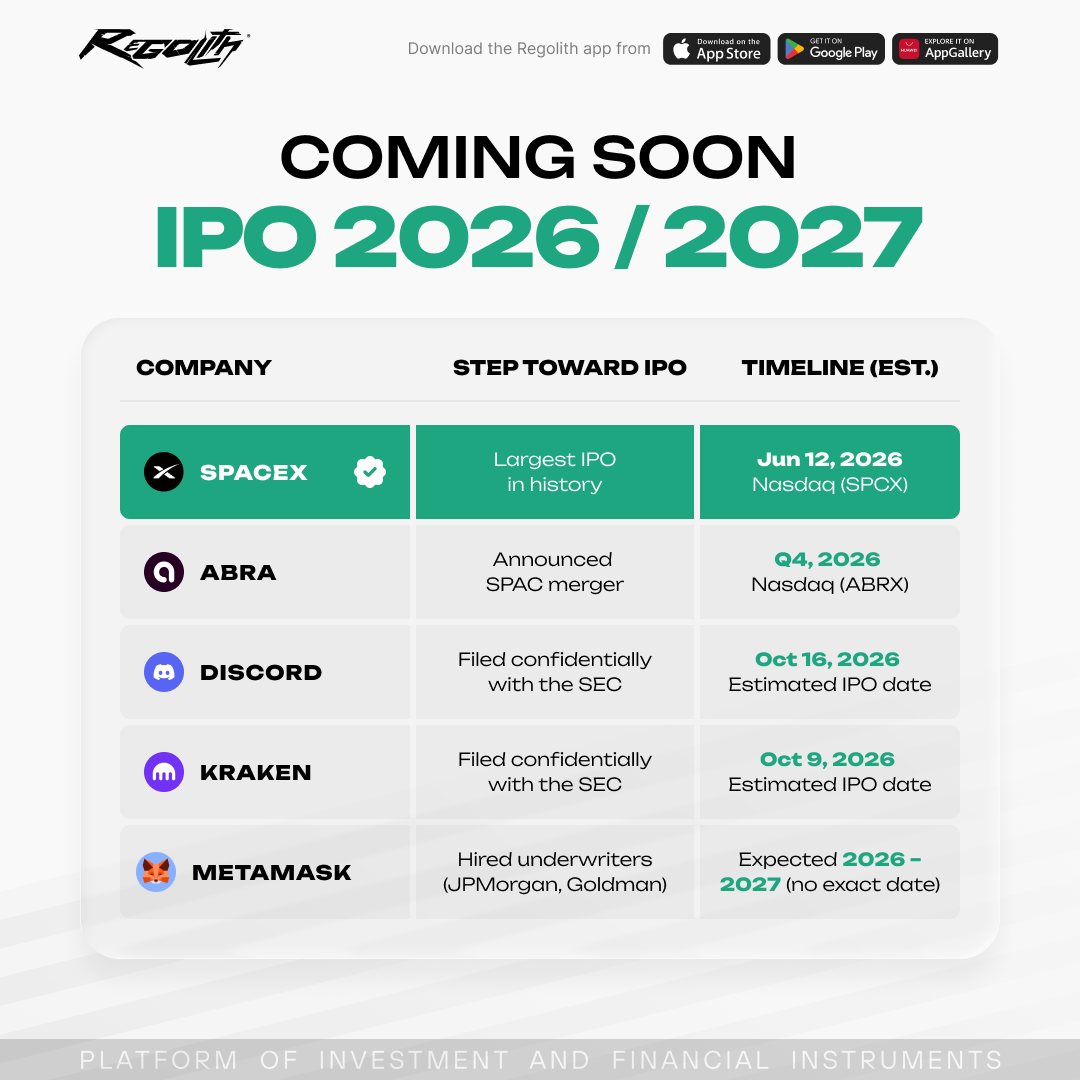
IPO candidates for 2026–2027: their step toward listing and estimated timelines
Discord: an SEC filing and the wait for an IPO
Discord launched in 2015 as a voice service for gamers, but over time it grew into one of the largest communication platforms for online communities. Today it brings together more than 200 million users and tens of millions of servers – from gaming and educational communities to work teams and brands.
Discord's main source of revenue is its Nitro subscription, which gives users advanced features, better streaming quality, profile customization and other paid options. In recent years the company has also strengthened monetization and moved toward profitability – an important factor for the market ahead of a potential IPO.
In 2021, Discord turned down Microsoft's acquisition offer of nearly $12 billion, betting on independent growth and a future listing. In January 2026, the company filed confidentially with the SEC, and the media named Goldman Sachs and JPMorgan among the underwriters. According to sources, the listing could take place in the second half of 2026.
At the same time, the company's secondary-market valuation has fallen to roughly $8.5 billion, down from $15 billion at its 2021 peak. For a potential IPO this is important context: the market will assess not only the scale of its audience but also Discord's ability to turn it into sustainable revenue and profit.
Kraken awaits a new window for its IPO
Kraken is one of the oldest crypto exchanges, founded in 2011. The company provides access to digital-asset trading, staking, custodial services and other products for retail and institutional clients.
Kraken has long been viewed as one of the main IPO candidates among crypto companies. According to media reports, the company filed confidentially with the SEC back in November 2025 and initially aimed for a listing in the second half of 2026 at a valuation of $13–20 billion.
However, in March 2026, amid weaker crypto conditions and investors' caution toward new listings, preparations were put on pause. The expected IPO timeline shifted closer to 2027. On the secondary market, Kraken is currently valued at around $12 billion.
Crypto exchange Kraken and the symbol of Wall Street
ConsenSys (MetaMask): on course for an IPO in 2026
ConsenSys is a blockchain company founded by Ethereum co-founder Joe Lubin and the developer of MetaMask, one of the most popular crypto wallets in the world. Through MetaMask, users gain access to Ethereum, DeFi protocols, NFTs and Web3 apps, which keeps the product one of the key interfaces of the crypto ecosystem.
The company has already begun preparing for a possible listing: according to media reports, ConsenSys has brought in Goldman Sachs and JPMorgan to work on an IPO that could take place as early as 2026.
In parallel, ConsenSys is preparing to launch its own token, MASK. Another positive factor was the closing of the SEC's case: it reduced regulatory uncertainty and removed one of the major legal obstacles ahead of a potential listing.
Anthropic: one of the leading IPO candidates
Anthropic is the developer of the AI assistant Claude and one of the leading private companies in artificial intelligence. The company was founded in 2021 by former OpenAI employees Dario and Daniela Amodei. From the start, Anthropic bet on AI safety and enterprise clients – a focus that helped it become one of the key players in the market.
Growth accelerated amid demand for generative AI: according to media reports, Anthropic's revenue reached around $47 billion on an annualized basis, up from $30 billion at the start of the year. Among its largest investors are Amazon and Google, which are also strategic partners in cloud infrastructure.
In May 2026, Anthropic closed a Series H round of roughly $65 billion at a valuation of around $965 billion – according to media reports, this made it the most valuable AI company in the world, overtaking OpenAI.
On June 1, 2026, Anthropic filed a confidential draft S-1 with the SEC, becoming the first major AI lab to formally begin the IPO process. The exact timing, price and venue have not yet been determined.
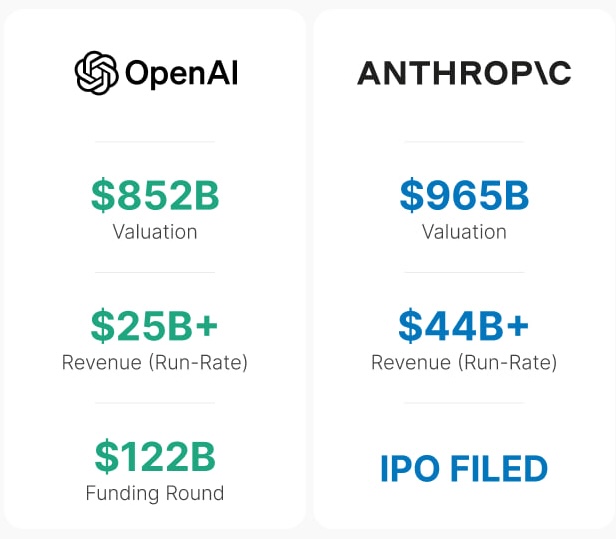
Valuation, revenue and IPO status of two giants – OpenAI and Anthropic
Canva: IPO preparations are accelerating
Canva is an Australian platform for graphic design and visual communications, founded in 2013 by Melanie Perkins, Cliff Obrecht and Cameron Adams. The service started as a simple online tool for creating presentations, posts, résumés and marketing materials, and today it has grown into a major software platform for individuals, small businesses and corporate teams.
In recent years, Canva has been actively building out its AI direction. The company is adding tools for generating images, text, presentations and marketing materials, developing the product as a working platform for creating visual content.
This matters for its future valuation: investors will look at Canva not only as a competitor to Adobe in mass-market design, but also as a participant in the broader AI-software market.
Canva has not officially announced an IPO yet, but the company has already taken several steps that usually precede going public. It hired a chief financial officer with experience preparing Zoom for its IPO, moved its parent structure to the US, and carried out an employee share sale at a valuation of around $42 billion.
Databricks: a profitable AI candidate for the public market
Databricks is a platform for data, analytics and AI. It helps companies unify, process and use large volumes of information for machine learning and enterprise AI products. Amid the AI boom, the company has become one of the key players in data infrastructure.
Unlike many fast-growing AI companies, Databricks already looks financially solid: annual revenue is estimated at around $5.4 billion, growth is about 65%, and cash flow remains positive. This makes it one of the strongest candidates for the public market.
According to analysts, Databricks could file for an IPO in the third quarter of 2026, with the listing itself possibly taking place in late 2026 or early 2027. The company's potential valuation is over $100 billion.
OpenAI: an SEC filing and the wait for an IPO
OpenAI is the developer of ChatGPT and one of the most influential companies in the AI market. In June 2026, according to media reports, the company filed confidentially with the SEC, which became one of the most notable signals of its IPO preparations.
The scale of the business is already comparable to the largest late-stage tech companies: OpenAI's private valuation stands at around $850 billion, while its annual revenue is estimated at roughly $25 billion. At the same time, the company is still unprofitable and, by expectations, may turn a profit before 2029–2030 – one of the key questions for future public investors.
OpenAI's chief financial officer, Sarah Friar, has previously named late 2026 to 2027 as a possible window for the listing. Analysts forecast that the offering could take place closer to early 2027, with the company's potential market capitalization approaching $1 trillion.

OpenAI under a magnifying glass. Photo: © IB Photography / stock.adobe.com
Plata: the path to a $7 billion valuation and a future IPO
Plata is a Mexican neobank founded in 2022 by a team of former Tinkoff top managers, with the involvement of Oleg Tinkov and Michael Calvey. The company is building a digital bank for the Mexican market, where demand for modern financial products remains high while banking penetration is still lower than in developed countries.
Today Plata is considered the most valuable private fintech in Latin America. The company already has more than 3 million customers and accounts for around 10% of all new credit cards in Mexico. In March 2025, Plata reached unicorn status with a $1.5 billion valuation, and by April 2026 its valuation had grown to $5 billion.
According to Oleg Tinkov, the next step could be a new round at a valuation of around $7 billion. He added that, in the longer term, Plata's valuation could grow to $10 billion, after which the company may consider an IPO. Official listing dates have not yet been announced.
Dataminr: preparing for the public market
Dataminr is an AI platform for real-time data analysis, founded in 2009 by Yale graduates. The company monitors open sources, news, social media and other data streams to spot important events before they reach traditional news feeds. Dataminr's clients include major media, corporations, government agencies and international organizations, among them CNN and the UN.
There is no official IPO date yet, but the company is already taking steps typical of preparations for the public market. In 2025, Dataminr appointed a chief financial officer with experience taking CrowdStrike public – which the market reads as a signal of possible preparations for a listing. On the secondary market, Dataminr is currently valued at around $705 million.
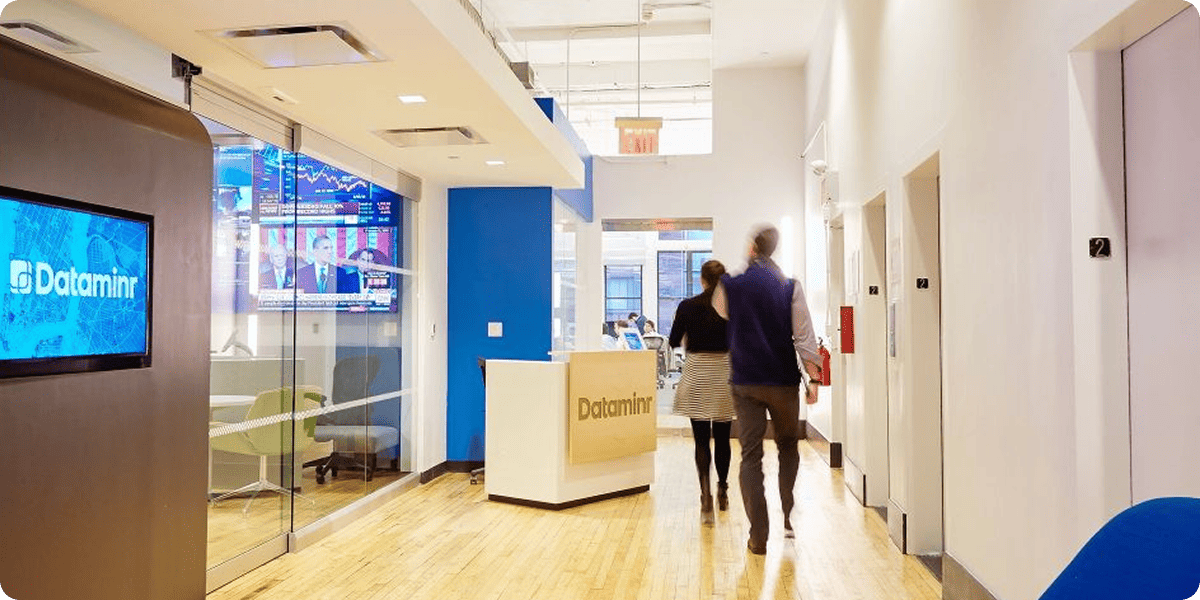
Inside the Dataminr office
What this means for the market
SpaceX's IPO became an important test for the market: investors showed a willingness to take part in large offerings if a company is strong, clear and large-scale enough. Now this demand will be tested by the next candidates – from AI companies to crypto platforms and fintech.
This does not mean that all private companies will immediately go public. Timelines will still depend on interest rates, market conditions, financial performance and investors' readiness to take on risk. But after several weak years, the IPO pipeline has noticeably revived, and large private companies are once again starting to view the public market as a realistic scenario.
Regolith continues to follow the key candidates and will keep investors informed about new opportunities.
This material is for informational purposes only and is not investment advice. Valuations and timelines are approximate, based on media reports, and may change.
