

Kraken Secures Direct Access to the Federal Reserve Payment System – A First for Crypto Companies
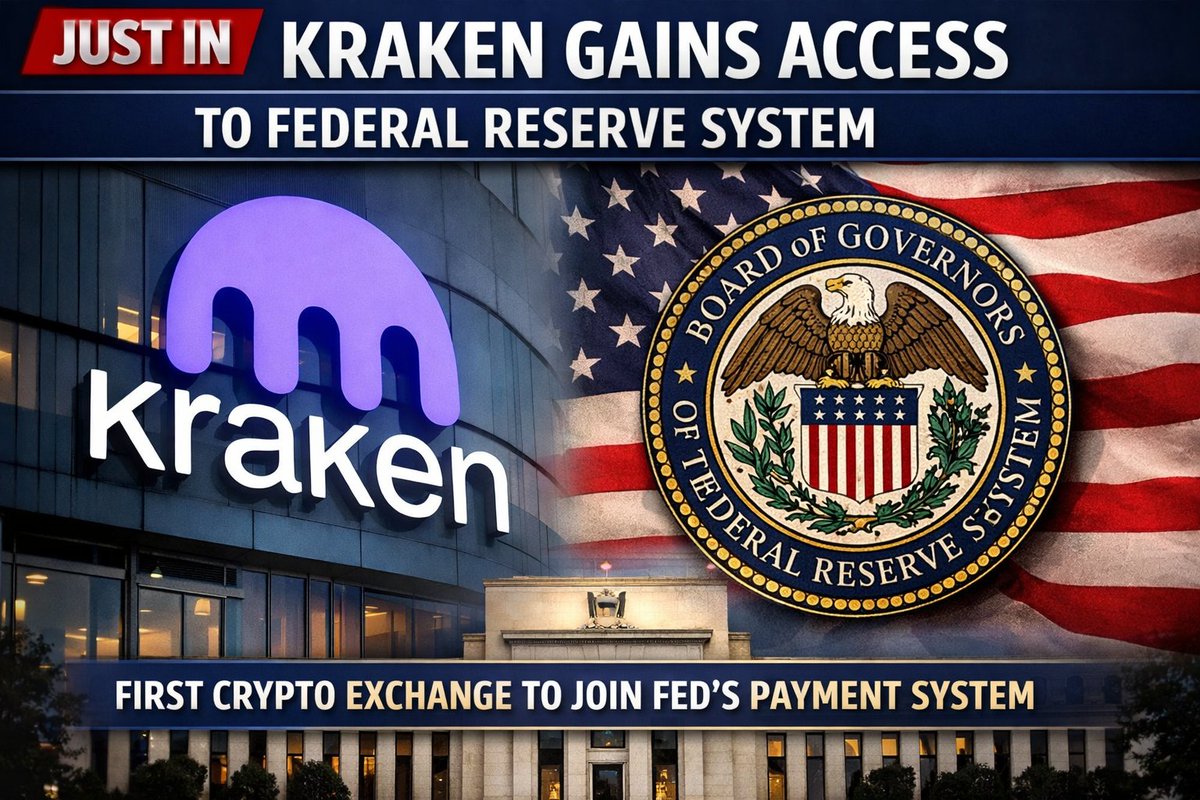
The Federal Reserve Bank of Kansas City has opened a master account for Kraken Financial – the first time a cryptocurrency company has gained direct access to the Federal Reserve’s payment infrastructure.
With this approval, Kraken can now settle transactions directly through Fedwire, the same network used by major U.S. banks. Transfers, clearing, and settlements between financial institutions can now be processed by the crypto company without intermediaries.
Until now, crypto exchanges relied on partner banks to process U.S. dollar transactions. A Federal Reserve master account removes this dependency and allows Kraken to operate much closer to the traditional banking system.
The decision follows five years of discussions and review with regulators.

A full-reserve banking model
Kraken Financial operates under a Special Purpose Depository Institution (SPDI) charter issued in Wyoming. The key difference from a traditional bank 100% of client funds must be held in highly liquid assets, such as cash, deposits at central banks, or government bonds.
Traditional commercial banks operate differently: they use part of their deposits to issue loans. Kraken Financial does not. Client funds are not used for lending, which reduces the risk of liquidity shortages during periods of large withdrawals.
For the Federal Reserve, this structure was one of the key factors behind the approval. In practice, Kraken functions as a custodial institution rather than a lending bank.
Restrictions and Tier 3 status
Despite receiving a master account, its use comes with strict conditions. The Federal Reserve classified Kraken Financial as a Tier 3 institution, a category that includes organizations outside direct federal banking supervision. As a result, these institutions undergo enhanced scrutiny.
The account has been granted for one year, with the possibility of renewal. Compared with Tier 1 banks such as JPMorgan Chase and Bank of America, Kraken’s capabilities remain limited:
- Kraken cannot earn interest on excess reserves held at the Fed.
- The company has no access to the Federal Reserve’s emergency lending facilities.
- Client deposits are not insured by the FDIC (Federal Deposit Insurance Corporation).
These limitations are designed to allow a new type of financial institution to connect to the Federal Reserve’s payment infrastructure without introducing risks to the U.S. banking system.
Reaction from the financial sector
The Federal Reserve’s decision has triggered mixed reactions. Banking industry groups, including the Bank Policy Institute, criticized the move, arguing that granting master accounts to companies without FDIC insurance could set a precedent and create additional risks for the payment infrastructure.
Wyoming Senator Cynthia Lummis – one of the most prominent crypto advocates in Congress – offered a different perspective. According to her, Kraken’s case shows that Wyoming’s regulatory framework for crypto companies can work in practice and helps establish clear rules for how the crypto industry and the banking sector can work togetherthe crypto industry and the banking sector.
New possibilities for payments
With a Federal Reserve master account, Kraken can now conduct U.S. dollar transactions directly through the Fed’s payment infrastructure, without relying on commercial banks as intermediaries. At the initial stage, these capabilities will be available primarily to large institutional clients, including investment funds and corporations.
Before approval, the company went through a multi-stage review process conducted by the Federal Reserve. Regulators assessed security systems, anti-money-laundering (AML) controls, and know-your-customer (KYC) procedures. During the first year, Kraken Financial will remain under enhanced monitoring by the Federal Reserve, to evaluate how direct crypto access impacts the stability of the U.S. payment infrastructure.
A Federal Reserve master account, a partnership with Nasdaq, a growing institutional client base – Kraken is steadily building the infrastructure for a public listing. The company filed its S-1 with the SEC in November 2025, and an IPO is expected in 2026.
