

Kraken's Long-Awaited IPO: Crypto Exchange Returns to the Public Markets After a Pause
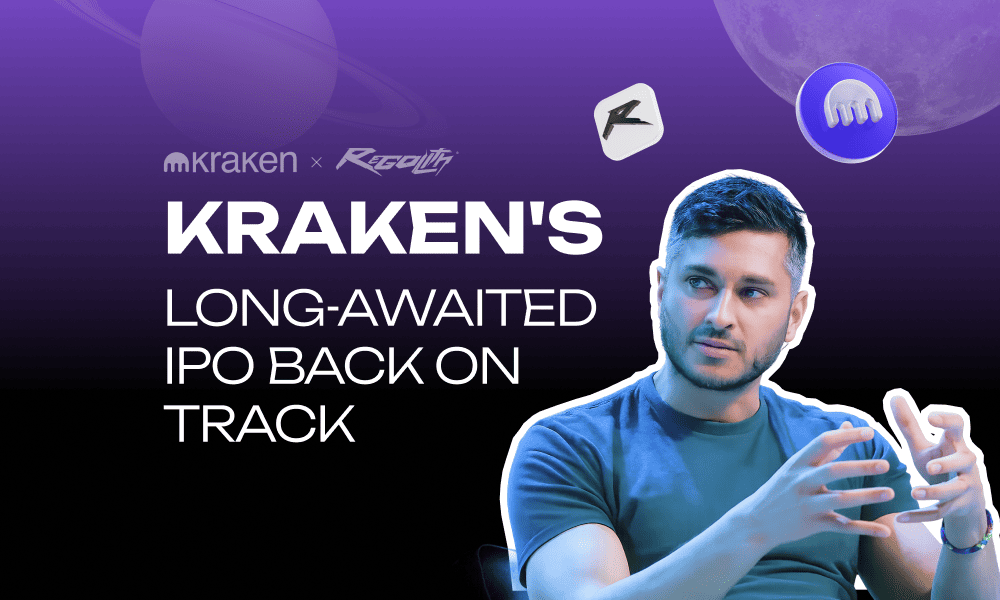
Kraken, one of the world's largest crypto exchanges, has officially confirmed its confidential IPO filing with the U.S. Securities and Exchange Commission (SEC). The announcement was made by co-CEO Arjun Sethi at the Semafor World Economy Summit on April 14, 2026. It marks a return to the company's public listing plans after a brief pause in March, when the process was temporarily put on hold amid a broader correction in the crypto market.
For the crypto industry, Kraken's IPO is shaping up to be an event on the scale of Coinbase's 2021 listing. But there is a key distinction. Coinbase went public as a classic spot exchange – essentially, a venue for buying and selling crypto. Kraken, by contrast, is entering the public markets with a fully developed ecosystem spanning multiple business lines: spot trading, derivatives (futures and options), staking, tokenized equities, and a dedicated institutional services division. That makes the listing more than a financial milestone – it reflects a broader maturity of the crypto sector as a whole.
Kraken – one of the industry's longest-standing players
Kraken was founded in 2011 in San Francisco by three partners – Jesse Powell, Thanh Luu, and Michael Gronager. By that point, Powell already had first-hand experience with Mt. Gox, one of the earliest crypto exchanges, which he had consulted for following a hacking incident. That experience proved pivotal: having seen firsthand how vulnerable the early platforms were, Powell set out to build an exchange designed around security and regulatory compliance – areas where most of the industry at the time fell short. Powell led the company as CEO until April 2023.
In October 2024, Arjun Sethi joined the company as co-CEO, having previously served on its board of directors since 2021. Sethi is the founder of venture fund Tribe Capital, whose portfolio includes xAI, Rippling, Slack, Gusto, and Carta. His arrival marked a turning point – under his leadership, the company shifted into an aggressive product expansion mode and began preparing for an IPO. Sethi has been openly vocal about his ambition: to build Kraken into the "Nasdaq of the crypto industry."
A notable point: over 15 years of operation, Kraken remains one of the few major crypto exchanges that has never been hacked. In April 2026, the company disclosed an internal incident – two cases in which support staff gained unauthorized access to client data. Around 2,000 accounts were affected – approximately 0.02% of its total user base. Kraken publicly refused to comply with the extortion demands and voluntarily disclosed the details of the incident, an approach that is far from standard for the industry.
Key IPO parameters
The company's current valuation stands at $13.3 billion – below the peak of $20 billion recorded in late 2025. The targeted listing date is Q3 2026. The legal entity behind the listing is Payward Inc., headquartered in San Francisco. The underwriting syndicate has not yet been officially disclosed.
In parallel with the IPO process, German exchange group Deutsche Börse is taking a stake in the parent Payward Inc. – $200 million for 1.5% of the company. The transaction is expected to close in Q2 2026, pending regulatory approval. Deutsche Börse's entry represents a strong institutional signal. It is not a venture investor, but one of Europe's largest exchange operators – effectively validating the $13.3 billion valuation and reinforcing a partnership focused on regulated crypto infrastructure.
Another milestone for Kraken came in March 2026, when the company secured a master account with the Federal Reserve Bank of Kansas City. This status provides direct access to U.S. payment rails and is rarely granted to crypto firms. For the industry, it sets an important precedent – Kraken now stands notably closer to traditional banks in terms of regulatory positioning.
The road to IPO
Talk of a Kraken listing has been circulating since 2021, but active preparation only began in 2025. Below are the key milestones of the past year:
- July 2025 – $500 million funding round at a $15 billion valuation
- November 2025 – initial S-1 filing with the SEC, $800 million raise at a $20 billion valuation
- March 2026 – the process was paused amid a 40% correction in Bitcoin from its October peak of $126,200
- April 2026 – the IPO is active again, with a public confirmation and the Deutsche Börse deal
- Q2 2026 – expected closing of the Deutsche Börse transaction
- Q3 2026 – targeted listing date
The drop in valuation from $20 billion to $13.3 billion reflects the broader repricing of the crypto market. Kraken's operating metrics, meanwhile, remain firmly in growth mode – what has changed is the market environment in which the company is now going public.
The SEC filing itself remains active, and given Bitcoin's ongoing recovery, a listing within the year looks entirely realistic.
Key milestones of recent years
Over the past two years, Kraken has grown significantly, transforming from a pure crypto exchange into a multi-functional financial platform.
- Financial performance. Kraken's 2024 revenue reached $1.5 billion – more than double the prior year. In 2025, the company continued its trajectory, posting $2.2 billion in revenue, a 33% year-over-year increase. Adjusted EBITDA reached $530.6 million – up 26% versus 2024. The company operates with sustained profitability, which remains an exception rather than the norm among crypto exchanges.
- Client base and assets. The number of funded accounts grew from 3.8 million in 2024 to 5.7 million in 2025. Total client assets on the platform increased from $43.5 billion to $48.2 billion. Average revenue per client now exceeds $700 per year – a figure comparable to leading players in the traditional brokerage industry.
- Trading volumes. In 2024, $665 billion in trading activity was processed through the platform. In 2025, volumes rose to $2.0 trillion – a 34% year-over-year increase. Within the fiat stablecoin pairs segment specifically, Kraken's market share grew from 43% to 68%, effectively making it the leader in that segment. Kraken also holds the number one position by euro-denominated trading volumes.
- Regulatory standing. Kraken was the first in the industry to receive a MiCA license from the Central Bank of Ireland – opening access to 30 European markets. The company also secured a Restricted Dealer licence in Canada.
Strategic acquisitions
- In March 2025, Kraken completed the acquisition of NinjaTrader for $1.5 billion – the largest transaction to date bridging traditional finance and the crypto industry. NinjaTrader is a leading U.S. retail futures trading platform with a CFTC-registered FCM license. The deal enabled Kraken to offer crypto futures and derivatives within the U.S. market.
- In April 2026, Kraken announced the acquisition of derivatives exchange Bitnomial for $550 million – intended to strengthen infrastructure for 24/7 trading of traditional assets. That same year, parent company Payward also acquired Magna, a token management provider.
In total, Kraken executed six strategic M&A transactions in 2025 – a pace that has earned the company the informal title of "Bloomberg of the crypto industry" in sector media, in recognition of its ability to unify multiple asset classes and instruments under a single platform.
From exchange to ecosystem
One of the key shifts of the past two years has been Kraken's transformation from a conventional crypto exchange into a multi-product financial platform. The company has actively expanded beyond spot trading into tokenized equities, derivatives, and fixed-yield products.
- Tokenized equities (xStocks). In 2025, Kraken acquired Swiss-based Backed Finance AG, the issuer of xStocks. It is a platform that produces tokenized versions of publicly listed equities and ETFs – effectively digital counterparts to traditional securities, tradable 24/7 on-chain. At the time of the deal, the catalog already included more than 60 products, and cumulative trading volume since launch had exceeded $10 billion. Kraken's roadmap for 2026 is to scale the lineup to 500+ tokenized instruments, including not only U.S. but also international equities.
- Derivatives. In 2026, Kraken launched Kraken Derivatives US – a regulated U.S. derivatives division with direct access to crypto futures listed on CME. By year-end, the offering is expected to expand into commodity, fixed-income, FX, and equity futures. In Europe, the company has rolled out perpetual futures that allow traders to use BTC, ETH, and stablecoins as collateral – making Kraken one of the first regulated platforms in the region with this functionality.
- Staking and fixed-yield products. Kraken offers staking across more than 20 crypto assets, with clients able to choose between flexible programs, where funds remain accessible at any time, and fixed programs with higher yields. In 2026, the company introduced Dual Investment – a fixed-return product on Bitcoin and Ethereum available to qualified clients.
Benchmarking against Coinbase
With the upcoming IPO on the horizon, it is natural to compare Kraken with its main competitor – Coinbase, which remains the only large-scale publicly traded crypto exchange. Despite operating in the same segment, the two platforms differ meaningfully in positioning.
By market capitalization, Coinbase currently trades at roughly twice Kraken's pre-IPO valuation. In terms of U.S. trading volumes, Coinbase also holds a firm lead – an advantage that predates Kraken's recent push into the American market. That said, Kraken offsets this with the breadth of its listings: the platform supports more than 500 cryptocurrencies compared to 341 on Coinbase – nearly 1.5 times the coverage. For investors who prioritize access to a broad set of assets, this becomes a meaningful factor.
The picture shifts on the European side. Kraken holds a leading position and ranks number one by euro-denominated trading volumes, while also dominating the segment of pairs with stable fiat currencies. This gives the company an additional foothold that is not dependent on the state of the U.S. market.
When it comes to regulatory standing, both exchanges are moving along a parallel path – and this, arguably, is one of the key distinctions separating Kraken and Coinbase from the rest of the crypto industry. Kraken secured a master account with the Federal Reserve in March 2026, while Coinbase received conditional approval from the Office of the Comptroller of the Currency (OCC) on April 2, 2026. Both companies are committed to full integration with the regulated U.S. financial infrastructure – a development that should be viewed positively by institutional investors as Kraken approaches its listing.
Market context
Kraken's IPO is unfolding against the backdrop of a broader recovery in the crypto sector following a prolonged correction. Bitcoin has returned to around $75,000 – with April highs reaching $78,000 (a 10-week peak). Inflows into crypto funds totaled $1.1 billion in the week leading up to April 13 – the highest level since the start of the year. BlackRock's IBIT alone attracted $871 million over the week, including $214 million in a single day – the strongest signal of institutional confidence since January.
On April 8, Morgan Stanley launched its own spot Bitcoin ETF, which drew $30.6 million in inflows on its first trading day. In parallel, the Trump administration has outlined plans to expand the U.S. government's Bitcoin reserves – another factor positively influencing institutional sentiment toward the sector.
For the crypto industry, Kraken's IPO is set to become one of the key events of the year. Following Coinbase's earlier listing, it will mark the second major publicly traded player in the segment – and a meaningful benchmark for other companies currently preparing their own offerings. Kraken enters the public markets with a sustainable business model and a growing client base, which makes the company a compelling case for both institutional and retail investors.
